Human Rights League
The Glass RoomThe Human Rights League is a civic organization that seeks support for refugees and oppressed peoples. In the novel, its work becomes visible when Viktor Landauer is invited to join its committee and proposes using his modernist home for a charity recital. The benefit brings the League’s appeal into a conspicuous cultural setting, where charitable purpose, architectural spectacle, and public performance meet.
Committee Invitation and Fundraising
Viktor tells Liesel Landauer that he has been invited to join the League’s committee. A newspaper account of the recent influx of refugees from Germany, most of them Jews, gives the invitation immediate context. The League’s president has asked about raising money, and Viktor expects the Landauer business to contribute. He also proposes using the house, extending the family’s support beyond a financial donation.
The proposed fundraiser is a recital. Viktor suggests inviting the pianist Miroslav Němec and charging an unusually high price per person; the scale he imagines is sixty guests. His plan connects a cultural event to practical relief, while recognizing that people are already curious to see the house. The venue’s attraction thus becomes a means of drawing an audience and raising funds for the League.
The Benefit at Landauer House
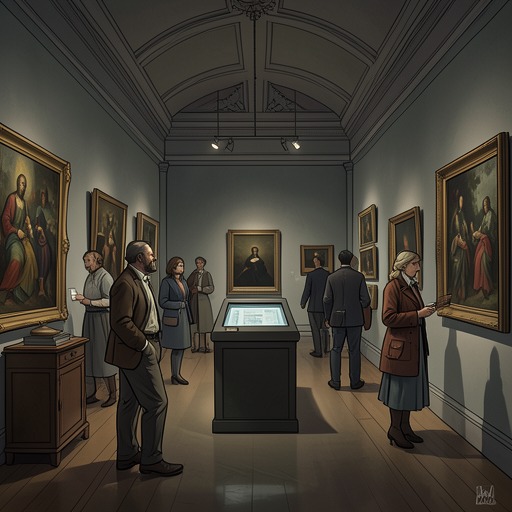
The announced recital sells all sixty-five tickets within a few days. On the evening, chairs are placed in arcs on either side of the onyx wall, and the piano is moved so that the room’s focus turns inward, away from the glass walls. This arrangement makes the house an active part of the event: its celebrated interior frames the performance, while the guests’ attention is redirected toward the gathering itself.
Many attendees have come as much to see the building as to hear Němec play. Viktor gives a brief introductory speech, welcomes them, and stresses the value of their support for the Human Rights League. He also urges the citizens of their young democracy to look beyond their immediate concerns. The League’s appeal is therefore presented not only as fundraising but as a call to civic responsibility amid the refugee crisis.
Hana Hanáková sits at the back, in the library area, her face drawn and solemn. Milada Němcová, the pianist’s wife, takes a prominent seat at the front. During the performance, Hana quietly compares Němec’s crouched posture at the piano to a bird of prey. The contrast between the formal public success of the evening and Hana’s private, watchful presence gives the occasion a less celebratory undertone without displacing its charitable purpose.
Public Reception and Significance
The recital is praised as both an artistic success and an expression of solidarity with oppressed peoples. A critic for Moravské Noviny places Němec among the foremost interpreters of his time, and the event is mentioned in the cultural pages of Prager Tagblatt under the title Human Rights Bring Cultural Bonus. These notices record the benefit’s success in cultural terms as well as its stated humanitarian aim.
The League’s committee and fundraising work are shown through a single, concrete undertaking rather than through a detailed account of its internal structure. The benefit’s significance lies in how it brings together refugees’ urgent circumstances, the Landauers’ resources, and the public fascination with their house. The building helps attract the audience; the event asks that audience to look beyond the building and contribute to people in need.