Josef Laník
The Glass RoomJosef Laník is the Landauer House’s caretaker and, across the novel’s changing regimes, one of its most persistent custodians. His practical command of the building’s concealed machinery and rooms helps him survive the war, but survival also teaches him to treat the house as a resource. After the Landauers’ departure, he stores goods in its subterranean maze, shields its onyx wall, and waits out a battle underground with his sister. Later he becomes a local Party official and a public spokesman for the house’s architectural importance. His story follows the building’s transformation from private home to Nazi research centre, wartime refuge, and socialist-era heritage site, while exposing the difference between preserving a place and possessing it.
Identity and Place in the House
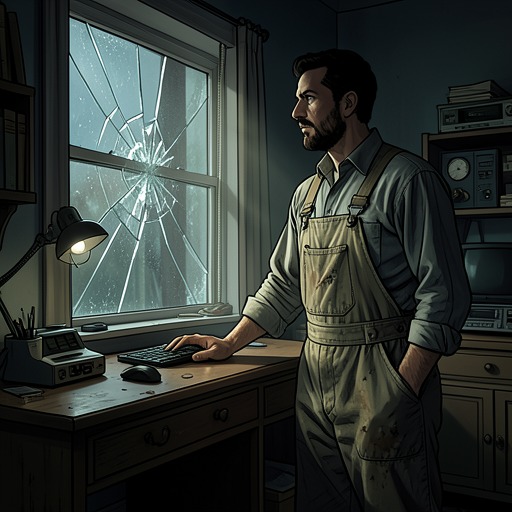
Laník first appears as a figure at the margins of the Landauer household: he and his sister occupy rooms behind the garage, the kitchens, and the basement rather than the Glass Room’s open, luminous centre. The contrast is built into the house itself. Above ground, the Glass Room is all space and light; below, the basement is a low-ceilinged, narrow-doored maze of laundry rooms, storage rooms, and machinery. Laník inhabits that hidden infrastructure, where the boiler drives the heating system, a compressor runs the air cooling, and water and fuel tanks sit among conduits and pipes. Electric motors there raise and lower the Glass Room’s windows into twin bays beneath it. He knows the house not only as architecture but as a working system, with routes and mechanisms that remain invisible to its more privileged occupants.
The novel sets Laník’s dependence on the house against its owners’ absence. He and his sister live there like epiphytes on a tree: sheltered by the building, yet not integral to the life for which it was made. They sometimes check that shutters are closed and doors secured, but their day-to-day world is the back rooms and basement. This limited access gives him a distinctive relation to the house: he is neither its designer nor its owner, but he comes to know its practical vulnerabilities and possibilities better than those who built it.
Occupation and the Work of Survival
During the Nazi conversion of the house into a biometric centre, the former domestic rooms acquire an alien purpose. Offices occupy the upper floor, the kitchens are being turned into a laboratory, and the basement is prepared for an X-ray machine. The Glass Room is divided by curtains; anthropometric equipment stands before the onyx wall, while the dining area becomes a photographic studio. The old photographic darkroom remains in use, and the Bösendorfer piano is the incongruous survivor of the house’s former life. Laník’s later custodianship takes place in a building whose rooms have already been reorganized to classify and document human beings. Its openness has not made it safe: curtains and instruments make the bright, transparent space part of a system of examination and control.
As the war continues, Laník makes the basement serve a different purpose. He builds up a store of goods, explaining to his sister that they must think about the future and accumulate capital; when she asks what capital means, he reduces the idea to “stuff.” The bluntness is revealing. For him, the future is not an abstraction but supplies gathered in advance, hidden in a building whose owners are gone and whose uses are changing. His sister assumes the Landauers will return and life will resume as before. Laník rejects that hope: they are not coming back, and nothing will be the same. Their disagreement gives the house’s occupation a domestic scale. The question of who may live there is also a question of whether its past will be restored or whether a new order has already taken hold.
Laník does not greet the approaching Soviet army with uncomplicated faith. News of the Red Army reaches him through a pub conversation, where workers and rumours circle around the advancing front. He looks forward to the Soviets but harbours no illusions about them, and he fears that the valuable onyx will be taken. At last he carries out Viktor Landauer’s parting instruction to conceal the wall behind a partition of wood and plaster. The decision protects the material, but its eventual use remains uncertain; Laník imagines it might become hundreds or thousands of ashtrays. In this grimly practical fantasy, an architectural treasure becomes potential stock. Preserving the onyx does not mean preserving its meaning.
Scarcity, Exchange, and the Cellar
In the final phase of the war, scarcity makes Laník’s stores a form of power. After Hitler’s death, the streets of Město are largely deserted, and people emerge from cellars seeking candles, potatoes, bread, paraffin, soap, matches, and cigarettes. Money has lost its force; barter sets the value of necessities. Laník understands these exchanges instinctively, calculating how much bread can be traded for cigarettes and how much cake for a candle. His knowledge of value is no longer simply a private survival skill: it determines what others can obtain from him.
A young woman, Jana Kubecová, comes for powdered milk for her baby. Her husband was deported to Germany to work in a factory near Hamburg six months earlier, and she has heard nothing from him for two months. Laník takes her down the outside steps into the basement, where the transaction becomes intimate as well as economic. He offers to add cigarettes, and she accepts with a bleak smile. The scene makes the cellar’s double character plain: it is a storehouse where Laník controls scarce goods, but also a hidden space to which desperate people descend. The exchange is not presented as simple generosity; his offer is bound up with his power over the goods and the conditions of access.
When fighting reaches the house, the cellar changes once more, from stockroom to refuge. Laník and his sister hear footsteps running overhead and machine-gun fire immediately above them. He tells her to keep quiet; in the candlelight his face is flabby with fear. They crouch in darkness as mortars pound and men run across the paving stones overhead. His sister grips his hands and calls him Joška, the childhood diminutive she used while rocking him to sleep. The name briefly restores an older relation between them inside a space shaped by present danger. When the noise recedes, the battle is no longer directly above them, but the uncertainty remains: they are sheltering beneath the house while the ownership and fate of the city are being violently decided.
From Caretaker to Official and Interpreter
After the war, Laník’s position changes from caretaker living at the edge of the house to a man with authority in the new political order. When a group visits the building, he is introduced as the chairman of the District Committee responsible to the Party for the Blackfield area. He meets the greeting that he has risen in the world with a reply that the proletariat is now in power. The change is more than a title: his practical knowledge of the house has become civic and political standing.
His knowledge complements Hana’s during a guided tour. She recounts the architect’s story and details of the owners’ lives, while Laník knows the construction date, the materials, and what happened to the building after the family left. Together they make its past legible to visitors, joining architectural history to the house’s successive uses. Laník insists that a journalist explain how he defended the building against counterattack, and his own account emphasizes his wartime maintenance, the danger of the bombing, and the defence of the house against the Nazis before it was handed over to the Soviet forces. He hopes it will open to the public so ordinary people can enjoy what had once been reserved for a few. His appeal to public access coexists with his earlier appropriation of the cellar’s stores and his protection of the onyx; the building’s history is never just a neutral record of stewardship.
The journalist’s account frames Landauer House as a functionalist masterpiece in a pleasant residential district overlooking Lužánky Park and the city centre. It specifies a living room of 230 square metres, two walls of glass, chrome pillars, and an onyx partition, while noting that a wartime bomb destroyed the original plate-glass windows. The lowering mechanism remains in working order, although the glass has been replaced. Laník’s narrative of guarding the structure helps explain how it survived, but the restored building also unsettles the official story: preservation is credited to a former caretaker who now serves the state, while the house’s private origins are recast through the language of public benefit.
Memory, Recognition, and the House’s Afterlife
Decades later, Liesel meets Laník again at the house. A voice addresses her as Comrade Landauerová, and she recognizes the coarse accent and undercurrent of sarcastic laughter before he gives his name: Josef Laník. Her small pang of guilt comes from realizing she never knew his first name. The recognition is therefore asymmetrical. Laník’s life has remained tied to the place and its history; for Liesel, even the identity of the caretaker who guarded it has been incompletely remembered.
He speaks at her rather than with her, recounting his trials, his care of the building, the dangers and fighting, the bomb, and what he calls its glorious liberation by Soviet forces. His account reaches across distinct political moments without clearly separating what liberation meant then from what it means now. The uncertainty is part of the scene’s force: the house has survived, but the language used to explain its survival carries the marks of changing authority. Laník’s insistence on his own role is at once a claim to recognition and an effort to fix the building’s past in a public narrative.
In 1990 the house stands fixed in time like a fossil, imperfectly repaired and furnished again with objects from the Moravian Museum. Its Glass Room regains plate-glass windows and its full clarity; visitors arrive in small groups, at first largely from fraternal Soviet states and later from beyond them. The building is again valued as architecture, but its restored transparency cannot erase the uses and concealments that preceded it. Laník’s arc gives that history a human custodian: he preserves the fabric of the house while repeatedly adapting it to immediate needs, from hidden stores and wartime shelter to political heritage. His attachment is practical, compromised, and durable, shaped by the knowledge that a home can outlast its owners without ever returning to what it was.