Kata and Marika flee Vienna
The Glass RoomKata and Marika flee Vienna in an abrupt escape from Nazi violence, carrying their few possessions toward the border and an uncertain refuge. Their flight begins as a mother’s split-second decision, but the train journey exposes the fragility of that escape: at a checkpoint, officials take Kata and Marika away even as the Landauer family tries to keep them together.
The decision to flee
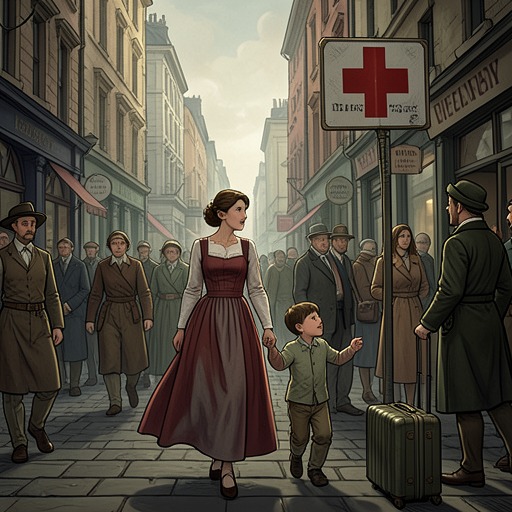
Kata tells the story of the morning uniformed men invaded the Jewish workplace where she was employed. The attackers were Austrian, she says, and wore armbands bearing the Hakenkreuz. They beat women and wrecked the machines; Kata escaped unharmed and ran straight to Marika’s school, taking her daughter out of class. When they returned to their flat, Nazi violence had spread to the butcher’s shop on the ground floor: its window was smashed, its goods thrown into the street, and the butcher lay in the gutter with his throat cut by one of his own knives.
Kata remembers the attackers laughing as she and Marika hurried inside to collect what they could. They stuffed their belongings into two suitcases and went back out. A uniformed man shouted at them, asking whether they were Jews too, but did not stop them. Kata took Marika by the hand and ran with her to the railway station. The narration lingers on the audience’s reaction to her blunt word for what someone was doing to the wreckage: the word shocks them more than the beatings and the killing she has described. The contrast exposes how easily witnesses can recoil from a spoken obscenity while absorbing the violence itself.
The escape offers no time for a considered plan. Kata describes it as a decision that was no decision, an instant of caprice. The trains were all heading north, toward the border, and were packed. Kata and Marika queued for six hours before finding space aboard one. Their departure is thus both purposeful and improvised: they flee a scene of immediate danger without knowing whether the crowded route ahead will deliver safety.
Refugees before an audience
The story is presented in the Glass Room during a meeting about refugees. Three adults and three children are ushered into the room, apparently through the kitchens, and positioned by a committee secretary in front of the assembled audience. Their entrance gives the room the air of a small theatre, with the witnesses close to those made to stand before them. Kata and Marika are among the six: Marika is about eight, blonde, and wearing a shabby floral dress; her mother appears to be in her early thirties, small and neat, with pale eyes and an expression of faint disdain.
Kata seizes a moment when another refugee’s account has occupied the audience’s attention and speaks for herself. Her recollection restores the people in the room from a staged display of displacement to individuals with distinct histories. Yet the theatrical arrangement remains significant: the refugees are made to stand while others watch, and their sudden appearance leaves them confused. When the meeting ends, Liesel approaches Kata with sympathy. Viktor finds the two women’s presence together difficult to reconcile with the gulf he imagines between their worlds, but Liesel introduces Kata to him as Frau Kalman.
Flight, dependence, and the border
Kata later explains that, before this escape, making ends meet had sometimes been difficult. Viktor helped her from time to time. She refuses to express shame for accepting money from him, pointing to the practical pressures of finding work, paying rent, buying clothes for a baby, and securing somewhere to sleep and a next meal. Her account makes the conditions behind her vulnerability concrete without reducing her decisions to dependence on Viktor.
At the border, the family’s papers are examined by a uniformed official of the Feldgendarmerie. Viktor lays out documents for himself, his wife and children, their nanny, and the nanny’s daughter; the official asks for tickets as well. The orderly piles of papers provide no guarantee of passage. When the official scrutinizes Kata’s passport and visas, she can only say that the document is all she has. Viktor says she is in their employ, but the soldier tells him, with elaborate politeness, that he was not asked to speak. Officials consult, then lead Kata away by the elbow toward a hut. Marika cries out for her mother, and Liesel pulls the child close, promising that she is with the family and that they will look after her.
Marika is then led toward the hut as well. Kata looks back desperately and calls Viktor’s name. He protests that her papers are in order and identifies her document as a Nansen passport, arguing that it had sufficed for entry into France and was valid for Spain. The official warns him to return to the train or risk detention. The crowd presses forward, eager not to become the next people taken away, while the official turns to the next family. A young soldier pushes the Landauers back toward their carriage and removes Kata’s and Marika’s suitcases. The episode turns flight into separation: paperwork and the family’s intervention cannot prevent officials from removing mother and daughter from the train.
The meaning of the escape
Kata and Marika’s flight links private survival to the larger machinery of persecution and displacement. In Vienna, violence makes staying untenable; on the railway, crowds and scarce space narrow their choices; at the checkpoint, a refugee passport and supporting visas fail to secure freedom of movement. The route north begins with Kata’s hand around her daughter’s and ends, in the scene at the border, with officials taking them away while the Landauers are ordered back aboard.
The episode also contrasts two kinds of looking. In the Glass Room, refugees are arranged for an audience, their distress visible but initially framed as a public spectacle. At the checkpoint, officials inspect documents and decide who may proceed, treating identity as something to be verified on paper. Kata’s recollection and the physical separation of mother and daughter expose what those arrangements leave out: the lived urgency of escape, and the human bonds that neither an audience nor a passport can protect.