Katalin and Marika's refugee circumstances
The Glass RoomKatalin and Marika’s refugee circumstances show how displacement turns a family’s safety into a matter of documents, employment, and official discretion. They travel with the Landauers, but Katalin’s lack of a national passport leaves her and her daughter exposed to a border regime that can separate them in moments, regardless of their practical ties to the people around them. Their passage makes the difference between having papers and having secure status painfully concrete.
A precarious life before flight
Katalin’s vulnerability predates the journey across Europe. Years earlier in Vienna, she walked in the Prater, where Viktor found her and helped her financially. When the circumstances are discussed, she rejects the implication that accepting money should make her ashamed: she had no job, could not afford rent, and had to find somewhere to sleep, food to eat, and clothes for her baby. Her explanation locates the exchange in material necessity rather than in an abstract judgment of respectability. The contrast with Liesel is explicit: Liesel has never had to worry about where she will sleep or how she will feed and clothe a child.
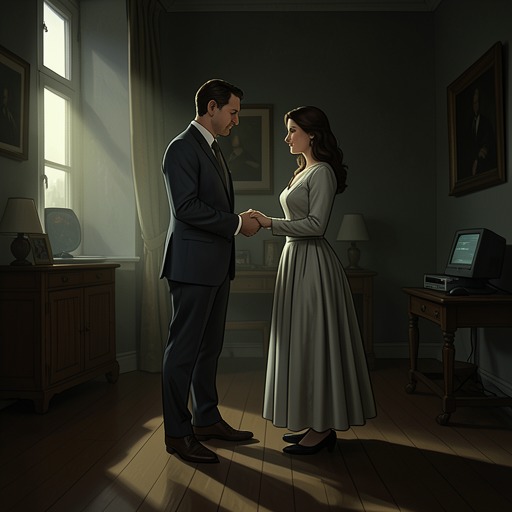
Katalin and Viktor’s past also makes her position within the Landauer household more complicated than that of an employee. When Viktor says their relationship seemed different, Katalin admits that she missed him, despite having tried to keep her distance. Yet the practical arrangement gives her and Marika a place among the people the Landauers are trying to protect. In an earlier moment, Katalin says she had not known how to reveal something about her situation and had feared that doing so might frighten Viktor away; when she finally decides to let him see, the act of disclosure marks both her exposure and her insistence that she should not have to hide.
Refugees made visible
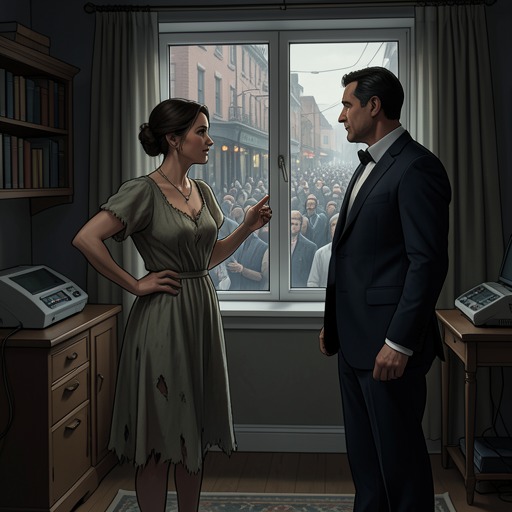
At a gathering in the Glass Room, refugees are brought before an audience rather than introduced on their own terms. The group includes a middle-aged couple and two children, as well as Katalin and Marika. Katalin is described as a small, neat woman in her early thirties, with a sharp face and pale eyes; Marika, about eight, wears a shabby floral dress and blushes as people stare. The cracked lens of another girl’s spectacles and the family’s crumpled clothing make the group’s hardship visible, while the audience’s close attention turns their arrival into a kind of performance.
The staging sharpens the difference between observers and people seeking help. Refugees are directed where to stand, and their presence becomes a spectacle inside a room associated in Viktor’s mind with rational order and balanced form. Katalin, who stands just feet away, unsettles that ideal: a person’s uncertain circumstances cannot be made legible or resolved by proportion and composition. The scene also gives the gathered refugees individual, material circumstances rather than leaving them as an abstraction. Katalin and Marika are among those whose predicament the committee is considering, but their presence before an audience does not itself give them control over what happens next.
Papers and the authority to cross
As Europe’s borders change, movement that had once seemed straightforward acquires new controls. On returning from Vienna, Rainer von Abt remarks on the irony of encountering a new border where none had existed before. The observation anticipates the refugees’ predicament: political change redraws lines and imposes checks, while the people forced to move must negotiate the new rules with whatever documents they can obtain.
Katalin has a Nansen passport, a refugee document issued to someone without a national passport. At the checkpoint, Viktor presents the family’s papers in neat piles: passports and visas for France and Spain, as well as Katalin’s temporary document. The official’s treatment of the Nansen passport makes the distinction between documentary evidence and accepted identity stark. He taps it, asks what it is, and orders Katalin to step forward. Viktor explains that she has no passport and that the League of Nations issues the document; Katalin, asked directly, can only say that it is all she has.
The exchange also strips Katalin of the ordinary authority to speak for herself. When Viktor identifies her as the children’s nanny, the soldier replies with elaborate politeness that he did not ask Viktor to speak. The official’s attention is fixed on the papers, but his decision is made through an encounter in which Katalin is examined, questioned, and judged by others. Her employment with the Landauers may explain why she is travelling with them, yet it does not settle whether she will be permitted to continue.
Separation at Bayonne
At the station, the danger is made palpable before Katalin’s own documents are examined. Soldiers search the train, and passengers hear that people without papers have been taken away. The queues move forward amid a mix of relief and fear: most people are being allowed through, but each traveller knows that a failed inspection may mean removal from the platform. The official confronting Viktor wears the insignia of the Feldgendarmerie. He asks for documents, then tickets, turning the family’s passage into a test whose outcome remains uncertain even after the papers are laid out.
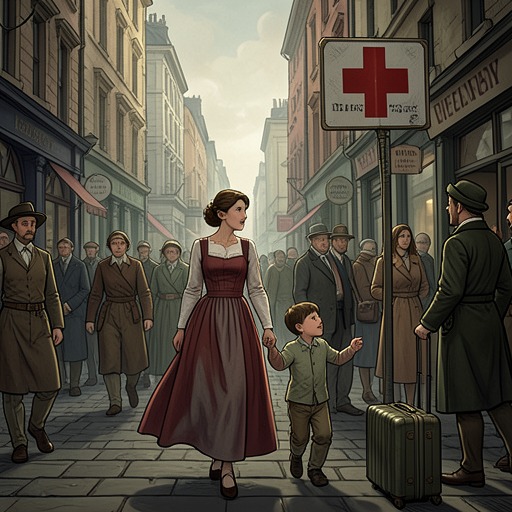
The official first recasts the political geography, stating that Czechoslovakia no longer exists and that the territory is now the Protectorate of Bohemia and Moravia. When he comes to Katalin’s refugee passport, the Landauers’ documents cannot make her status secure. She stands before him trembling; after a brief consultation between officials, a uniformed figure takes her by the elbow and leads her toward a hut. Marika cries for her mother. Liesel pulls the child close and promises that the family will look after her, but the official insists that the girl must go with Katalin.
The separation is justified as a procedural issue. The official returns the Landauers’ documents and allows the rest of the group to move on, while a soldier pushes Marika toward the hut after her mother. Katalin looks back desperately and calls Viktor’s name. Viktor protests that her papers are in order and points out that she is travelling on a Nansen passport, but the official warns him that he may be detained if he does not return to the train. He urges Viktor to move on, suggesting that the delay may be temporary and telling him to be patient; the reassurance offers no guarantee of reunion.
Dependence, belonging, and forced movement
Katalin’s own response to the prospect of leaving Europe makes the limits of her choices clear. She had imagined that the Landauers would wait for a while and that the danger would pass, not that they might travel to the other side of the world. Asked whether she would rather remain where she is, she answers that she has no choice: she cannot stay there alone. Her movement is therefore neither a simple decision to emigrate nor a journey she can independently refuse. It is bound to the Landauers’ flight and to her dependence on the household for shelter and safety.
The border sequence brings that dependence to its harshest point. Katalin is part of the family’s travelling party in practice, but the authorities can treat her as a separate case; Marika’s presence cannot protect her mother, and the Nansen passport cannot compel recognition. Conversely, the Landauers’ willingness to travel with them cannot overrule the official’s command. The episode makes refugee status a lived instability: movement is possible only through checkpoints where bureaucratic categories and discretionary power can override relationships, plans, and the evidence a family believes should be enough.