Landauer House housewarming party
The Glass RoomThe Landauer House housewarming party turns a private celebration into a public performance of modernity—and lets Hana Hanáková glimpse the fragility beneath it. Artists, architects, musicians, industrialists, and journalists gather in the Glass Room to admire the new house and its architect, Rainer von Abt. Inside, music and champagne give the evening the air of a confident cultural future; outside, Hana feels the cold and recognizes that the prosperity being celebrated may already be nearing its end.
An Opening Made into a Performance
What began as an informal gathering becomes something like an art exhibition once Rainer von Abt arrives. He has flown in from Berlin and is brought from the airfield by the Landauers’ driver. His arrival itself delights the guests: the architect descends from the sky, a figure of modern travel and celebrity, for an occasion as ephemeral as a party. Liesel greets him as he steps from the car and tells him, as she leads him downstairs, that everyone has been dying to meet him.
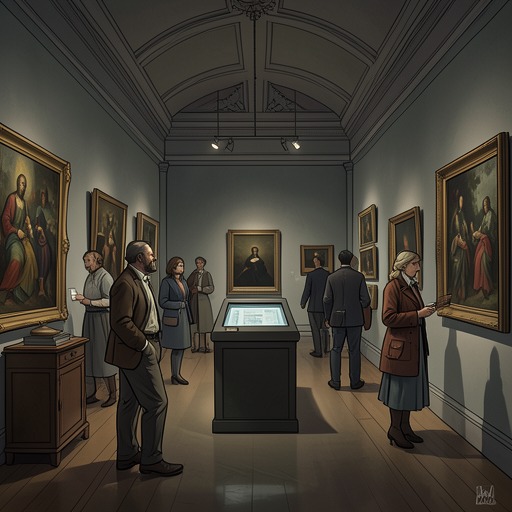
The guests waiting in the Glass Room form a portrait of Město’s cultural and commercial establishment. Musicians and composers stand alongside artists, architects, critics, writers, businessmen, and industrialists; journalists and a society-page photographer are there to record the gathering. The architects Fuchs and Wiesener offer grudging praise. The cubist Filla finds an echo of van Doesburg in the house’s plain geometry, while composer Václav Kaprál attends with his daughter Vítězslava. Von Abt moves through the company, greeting women and men, and declares himself delighted with the house he has brought to fruition.
He makes the building’s aesthetic claim into a social one: a work of art, he tells a journalist, requires a life lived in it that is also a work of art. He is certain that Viktor Landauer and his beautiful wife will do the house justice. The compliment places the couple inside the architect’s ideal, as though their domestic life were to complete the design. The party consequently displays more than a new home: it presents the house, its owners, and their guests as parts of a single work staged for public admiration.
Glass, Speech, and Music
Viktor welcomes the guests first in Czech and then in German, making the two languages part of the evening’s public civility. He calls for applause for the architect, then turns to André Breton’s novel Nadja, which Hana has lent him. Though he says he has prepared nothing, he recites from memory Breton’s vision of living in a glass house where visitors can always be seen and objects remain suspended as if by magic. The passage is an apt performance in a room made of glass, and the guests laugh at its appropriateness—whether or not they have read the novel.
Viktor then takes Liesel’s hand and says that the house tells the guests who they are: in their glass house, everything can be seen. The declaration gives transparency the quality of a domestic ideal, linking the visible architecture to the couple’s identity. But the party also makes that openness theatrical. The house is being shown to an audience, and its meaning is shaped by speeches, performance, photography, and the guests’ gaze.
The evening’s music extends the display from architecture to artistic succession. Viktor announces, without advance notice or rehearsal, that Maestro Němec will play. Němec approaches the Bösendorfer and jokes about caressing an untried maiden in a virginal house. After the laughter and applause, he begins hesitantly, listening for the piano’s voice, then grows more assured as he plays a piece by Leoš Janáček, the mentor whose influence shadows Město’s musicians.
When Němec finishes, he declines the calls for an encore and passes the responsibility to Vítězslava Kaprálová. At fifteen, she is already enrolled at the Conservatory and studying composition. Rather than Janáček, she plays Ravel’s “Ondine,” a movement from Gaspard de la Nuit that she is preparing for her finals. The wavering music seems to belong to the Glass Room: winter light enters through the plate-glass windows, while guests’ forms are vaguely reflected in the floor and compressed laterally in the slender chrome-plated pillars. At the piece’s ending, Vítězslava holds still above the keys before turning to the listeners with a quick smile. Her performance earns still more applause than Němec’s. He takes her fragile hand and raises it to his lips, then presents her as the country’s artistic future, a representative of a young country full of energy and talent.
Hana at the Edge of the Celebration
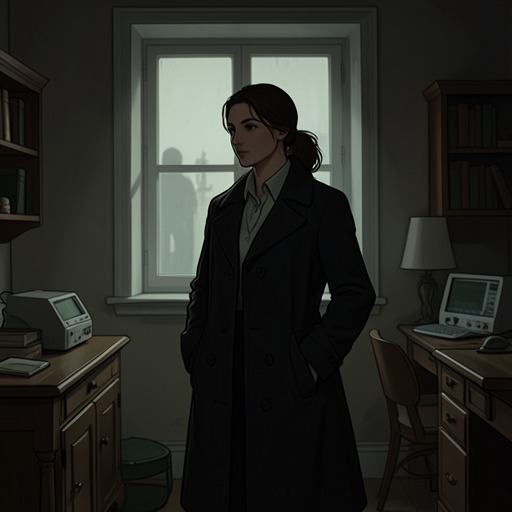
While the guests applaud, Hana walks around the other side of the onyx wall and looks out at the cold garden and winter trees. Liesel comes to stand beside her and asks what she thinks. Hana answers that Vítězslava is only fifteen and questions why Němec is flirting with her. Liesel clarifies that she meant the house. The exchange brings the party’s spectacle down to an uncomfortable detail: the celebrated maestro’s attention to a teenage prodigy looks different from the guests’ romantic framing of artistic mentorship and national promise.
Behind them, Němec returns to the piano and plays something fashionable, American, and described as Negro music, calling it honky-tonk. Some guests clap along. The sound seems to embody the party’s modern, hopeful carelessness, but Hana refuses its reassurance. She says that everything—the good times, the world they live in—is too good to last. Her answer is not a prediction tied to a specific event; it is an apprehension of instability that the people around her have not yet acknowledged.
The narrative makes Hana’s position at the window decisive. The other guests crowd into the Glass Room like passengers on the observation deck of a luxury liner. Some may look through its windows toward the city, but the mingling of Czech and German conversation accompanies their largely untroubled absorption in the party. They debate trivial matters, applaud the pianists, drink champagne, and eat smoked salmon and chicken legs. Hana alone feels the cold air while looking out over the peaceful city and its setting sun. Her separation is perceptual rather than social: she is among the guests, but she registers what their celebration screens out.
Celebration against the Approaching Storm
The party’s central contrast is between the Glass Room’s promise of visibility and the future that remains unseen. Viktor’s declaration that everything can be seen expresses confidence in openness, while the windows frame a city whose gathering storm clouds the celebrants fail to read. The house offers a view, but having glass walls does not guarantee that those inside understand what lies beyond them. The guests’ attention is fixed on art, taste, novelty, and their own place in the scene; Hana’s attention turns outward, toward the cold.
The gathering therefore becomes a moment of dramatic foreshadowing. Its cosmopolitan company, bilingual welcome, architectural admiration, and sequence of musical performances suggest a society at ease with its energy and possibilities. Against that display, Hana’s warning marks the party as precarious rather than secure. The storm is coming, although the guests will continue to argue and celebrate and, until it is too late, largely ignore the signs. By making one person’s unease visible amid collective applause, the episode turns a housewarming into an image of confidence just before its limits become impossible to overlook.