Landauer House onyx partition
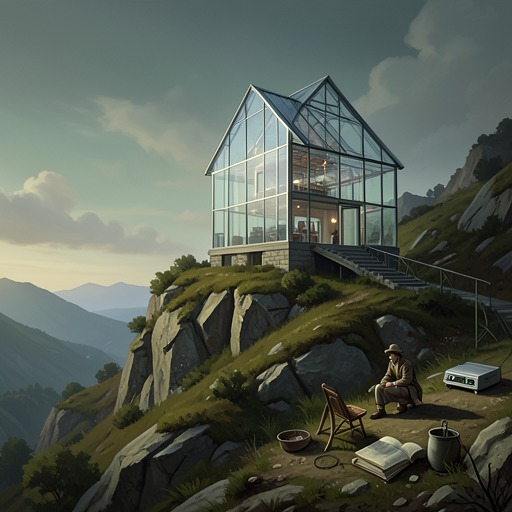
The Glass RoomThe Landauer House onyx partition is more than a striking element of the Glass Room: it is the fixed surface before which care for disabled children, an abandoned dance, and Hana Hanáková’s testimony converge. Its unchanging material presence holds the house’s modernist design alongside the human histories that the room can neither erase nor contain.
Setting and Use
The partition stands beside the floor where a dozen mats are arranged for children’s exercises. Zdenka leads the children through leg lifts, bending, stretching, and turns, while Tomáš watches from the windows. The onyx wall forms the backdrop to this adapted use of the house: a space where children with polio can move and exercise, and where Zdenka can work with them.
The room’s function is not limited to treatment. Zdenka explains that its space and light offer a kind of liberation to children whose lives are often dark and closed indoors. She also holds dance classes there. The partition remains part of the setting as the room becomes a place of practical care and of personal expression.
Dance and Memory
When Hana Hanáková visits, she walks to the onyx wall and touches it as though caressing the face of a loved one. The gesture registers a personal attachment to the room, though the wall itself does not explain its source. Later, Zdenka dances for Hana in the Glass Room, performing before the same partition.
The dance is a slow, sorrowful improvisation to Janáček’s piano music, played from a gramophone. Zdenka performs there the dance she never achieved on the stages of Prague, Leningrad, or Moscow, after an accident broke her ankle and ended her prospects as a dancer. She dedicates the performance to the Landauer family who lived in the house, to Hana’s husband, who died in Auschwitz, and to her own love of Tomáš, now a cherished and regretted memory. The onyx wall becomes the still centre of a performance in which private grief and the house’s earlier history meet.
Witness to Testimony
The partition is also present when Hana tells Zdenka about Světla, the daughter born in Ravensbrück. Hana recounts that the baby was briefly put to her breast, could not feed, and was then taken away; Hana never saw her again. She had imagined surviving in the hope that she and Světla might one day be reunited, and says that this hope became a reason to live.
As Hana weeps, Zdenka embraces her in the Glass Room. The narration places the room’s materials around this act of listening: glass and concrete, chrome, the onyx wall, tropical hardwood partitions, and milky ceiling lights. Designed by Rainer von Abt as a modern space, it is now saturated with the past. The onyx partition’s significance lies in this contrast: it remains a physical feature of the house while the room around it becomes a setting for remembrance, mourning, and the belated telling of what Hana had never shared.