Liesel returns to Landauer House after thirty years
The Glass RoomAfter thirty years away, Liesel Landauer returns to the Landauer House with her daughter, finding her way through a home she can no longer see but still knows in exact physical detail. The visit turns architecture into memory made tangible: its surviving surfaces and measured spaces confirm both the permanence of Liesel and Viktor’s vision and the history of their dispossession. In the Glass Space, an absent husband and a remembered life crowd the present; then Liesel recognizes Hana before anyone announces her, making recognition itself the scene’s emotional arrival.
The Return and Its Recognition
The return begins not with a view of the house but with Liesel’s bodily knowledge of the road. Though her perception of shape and motion has gone unused for thirty years, the car’s upward curve revives it. She announces their arrival and squeezes her daughter’s hand. The escort sitting behind them shifts on the shiny plastic seat, apparently relieved that their journey is nearly over. Liesel registers him through smell—damp cloth, cheap aftershave, old sweat—while the rain and the opening of an umbrella reach her through sound and touch.
A Tatra stops at the kerb. As someone opens the door, the movement of air recalls a sail catching wind and carries Liesel back to a dinghy on the Zürichsee with Viktor. She remembers the boat heeling over as he tested its balance, and her own reply that the experience was nothing like riding a bike. The recollection gives the arrival a double character: she has come home, but the physical present keeps opening onto a past in which Viktor was beside her.
Liesel says that Viktor should be there—not only in spirit but physically. She senses the house across the forecourt, and its light and space begin to take shape around her. Ottilie comes to her side instead. When an unfamiliar hand grasps her elbow, Liesel shakes it off and objects to being treated as if she cannot know her own house. She immediately recognizes the literal inaccuracy: it is no longer legally hers. Yet the distinction between legal possession and belonging is precisely what the homecoming exposes. The house has been taken through solemn legal procedures, twice and by two different authorities, but it remains hers and Viktor’s in the less juridical terms of vision, memory, and name.
A House Recalled by the Body
Moving across the forecourt with her cane, Liesel identifies the paving as unchanged. The man from the city architect’s office answers that its survival is remarkable and invokes the house’s artistic value. His admiration carries an implicit awareness that art does not guarantee survival: fire, damp, bombs, and neglect can undo a building. He points out how von Abt framed the view of the castle, then falls silent, embarrassed by his lack of tact. For Liesel, however, the frame is already present in memory. She recalls the gap between the main house and the servants’ apartment, formerly Laník’s, through which the hill beyond the city was set in view. Rainer’s phrase, that the future frames the past, returns with the image of the Špilas fortress and the cathedral’s black spires.
Liesel navigates not by sight but by remembered movement. She finds the freestanding pillar supporting the overhanging roof and recalls children swinging around it while Liba called for them to stop. Touching it with her cane confirms her position in the forecourt; she also hears the small intake of breath from the man beside her, astonished that she can orient herself so confidently. The cane is not merely an aid to movement. It lets her verify the house’s familiar geometry while demonstrating that blindness has not erased her knowledge of it.
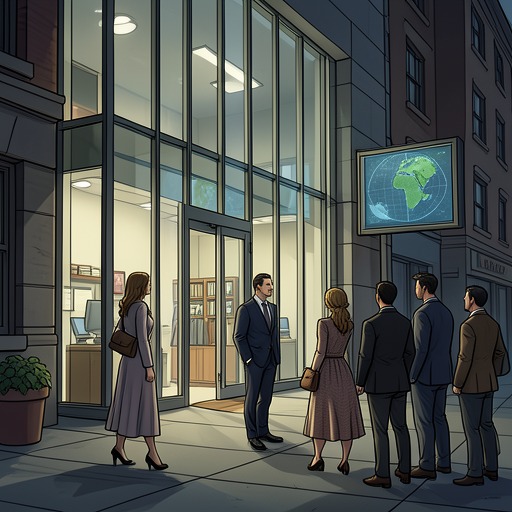
The route continues around the curve of the glazed wall to the front door. During a photograph, someone asks where Ottilie is, and Ottilie answers that she is there. The flash reaches Liesel as a brief brightness behind the milky light that fills her vision. Guided through the entrance, she encounters the soft, familiar silence of the hall. The whitened light also recalls Rainer’s account of the milk-white glass panes: soft light associated with detachment, reason, the future, and pure sensation. A design ideal once expressed in the house has become, for Liesel, the enduring condition through which she experiences it.
The Glass Space and the Absent Past
Inside, Liesel declines to depend on the architect’s narration. She finds the rosewood panels and the balustrade by touch, then makes her way down the stairs unaided. The descent requires her to retrieve the familiar sequence from memory: twelve steps to the curve, then nine more before the lower level opens around her. The passage describes a practiced knowledge reactivated after years of disuse, like a tune recalled at the keyboard without looking. Her movement makes the house legible as a bodily score, one she can perform despite blindness and the long interval away.
The lower level is the Glass Space, or the Glasraum. Liesel’s response is a faint sigh as she feels its volume almost as a physical substance. The remembered room gathers distinct materials and planes: the expanse of plate glass along the south wall, the Macassar wood, the onyx wall, the plain white ceiling, and the ivory-white floor. People occupy the space between these surfaces, some known and some not. The architectural room opens into a crowded inward scene in which the children run toward her, Viktor looks up from his newspaper, and her brother appears despite never having known the house; friends and parents join them too.
The remembered figures are not presented as proof that the past has literally returned. Rather, the Glass Space holds together the people and the home that exile separated. Viktor’s absence remains explicit even as his taste and vision persist in the house. The scene’s force lies in that unresolved coexistence: the building is materially present, the people inhabit Liesel’s mental image of it, and the life they shared cannot be restored simply by coming through the door.
Hana’s Arrival
The reunion with Hana begins as another exercise in perception. Liesel senses someone approaching, a shadowed form moving against the light. She wonders through the instant of recognition without settling on one explanation: the person’s motion, the sway of her hips, perhaps her scent or breathing. Before anyone else speaks, Liesel says Hana’s name. Her recognition precedes visual confirmation and turns the return from a recovery of place into a reunion with a person.
Hana answers with astonishment that Liesel has recognized her. Liesel explains that people are not forgotten but stored up. Their embrace follows: arms around Liesel and a smooth cheek against hers, with tears possible but not certain. The uncertainty preserves the restraint of the moment; what is unmistakable is the bodily contact and the recognition that has crossed the decades.
Dispossession, Memory, and Home
The event makes the Landauer House more than a surviving modernist building. It is a home whose legal ownership has been taken away, yet whose name and remembered design remain attached to Liesel and Viktor. Liesel’s acknowledgment that the house is no longer legally hers does not cancel her claim; instead, the scene distinguishes formal title from intimate belonging. The house can be stolen in law while continuing to bear the Landauer name and to preserve the lines of a shared vision.
The return is shaped by the contrast between impaired sight and exact spatial memory. The rain, the cane, the paving, the pillar, the staircase, and the remembered surfaces give Liesel concrete means to re-enter a place that has been absent for thirty years. This is not a simple restoration: Viktor is missing, legal dispossession remains, and the people who appear in the Glass Space belong to memory. Yet Liesel’s knowledge of the route and her recognition of Hana show that absence has not made the past inaccessible. The house becomes a structure through which memory can be entered, while the reunion confirms that what is stored up can still answer in the present.