Liesel's blindness
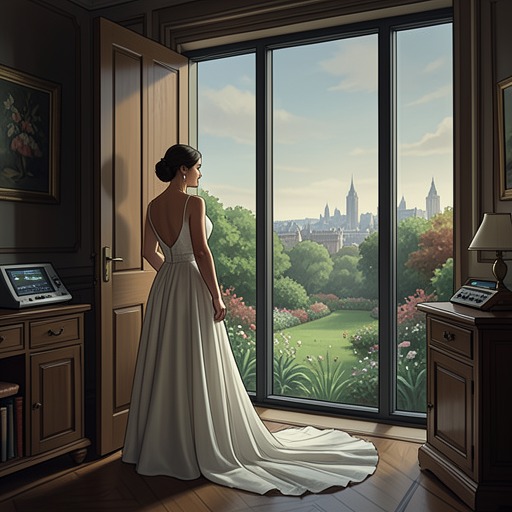
The Glass RoomLiesel's blindness is presented not as the erasure of her knowledge but as a change in how she reaches it. Returning to Landauer House after thirty years, she cannot see its rooms, yet recognizes the building through remembered proportions, touch, sound, and movement. Her experience makes the house at once a physical place, an inwardly preserved design, and a contested home: she can find her way through it even though its legal ownership has passed from her family.
Recognition and Orientation
At the house, Liesel senses the low mass of the building across the forecourt and resists assistance, insisting that she knows her own house. The claim is emotionally true but legally inaccurate. Landauer House has been taken through formal procedures more than once; what remains hers and Viktor’s is the vision embodied in its design, and the name the building still bears. The scene sets the difference between bodily familiarity and legal possession against the certainty of her inward claim.
Her knowledge is specific. She remembers how the main house and the servants’ apartment once framed the distant hill, with the Špilas fortress and cathedral in view. Though she now has only one eye, her mind’s eye can reconstruct this arrangement with a vividness that approaches sight. At the entrance, she touches a freestanding pillar with her cane to locate herself in the forecourt. She remembers the children swinging on it and Liba calling them to stop; then she follows the curve of the glass wall to find the front door. The sequence makes orientation an act of practiced memory, anchored in the house’s actual structure rather than in a generalized recollection of home.
The House Remembered Through the Body
Inside, familiar materials and routes serve as a map. Liesel identifies the rosewood panels, locates the stair balustrade with her left hand, and descends by recalling the staircase’s pattern: twelve steps to the curve, then nine more. The narration compares this to playing the piano without looking at the keyboard. The analogy emphasizes not an extraordinary recovery of sight but a bodily knowledge retained through repetition, even after many years away.
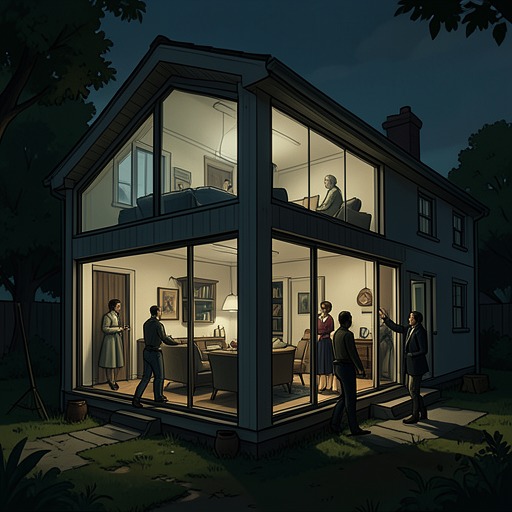
The Glass Space brings that remembered knowledge into sharpest focus. Liesel recognizes the lower level through its volume and arrangement: the plate-glass south wall, Macassar wood, onyx wall, white ceiling, and ivory floor. She cannot see the people gathered there, but senses their presence and imagines familiar figures among them, including Viktor and the children. Her memory does not simply supply a substitute picture; it joins the room’s physical dimensions to the life she associates with it. The house is perceived through a combination of touch, sound, spatial recall, and remembered relationships.
Light, Memory, and the Return
The novel connects Liesel’s experience of blindness with the house’s designed light without suggesting that one explains or cures the other. The milk-white glass panes admit a soft, diffuse light that Rainer had associated with detachment, reason, and the future. On her return, Liesel describes the light available to her as an encompassing blankness. The architectural ideal and her altered perception meet in the same space, but do not become identical: the building’s light remains part of its design, while the way she experiences it belongs to her life with blindness.
That distinction gives the return its emotional force. A photograph is taken outside, and then Liesel is led through the front door into the house’s familiar silence. She experiences the moment as coming home, although decades have passed and ownership is no longer hers. The visit is also a public handover to which the authorities of Město invite her as a witness. Martin warns that accepting the invitation could amount to recognizing the city’s legal ownership; the invitation is presented as part of a political opening and an effort to address past wrongs. Liesel’s intimate recognition of the house therefore takes place amid unresolved questions about who may claim it and what an official return can acknowledge.
Limits of Recognition
The Glass Space, once a place of balance and reason for Liesel, becomes oppressive when crowded with visitors. During the return gathering she feels trapped and asks Hana to take her outside. This response complicates any reading of the house as a simple refuge: even a place she knows intimately can be altered by the people and circumstances around it. Her blindness does not prevent her from recognizing the building, but recognition cannot preserve the conditions in which it once felt like home.
The house also holds memories that cannot be reduced to architectural familiarity. At the gathering, Liesel speaks with Laník, while Hana leads her toward the terrace; later, the novel’s return to the Glass Room frames Ottilie’s recognition of Marie within an image of an ageless space that seems to deny time. Against that apparent timelessness, Liesel’s experience registers the passage of thirty years, the loss of Viktor’s presence, and the transformations of political ownership. Her blindness makes remembered space newly visible to the reader, while the return demonstrates that memory can restore a route through a home without undoing displacement or history.