Město
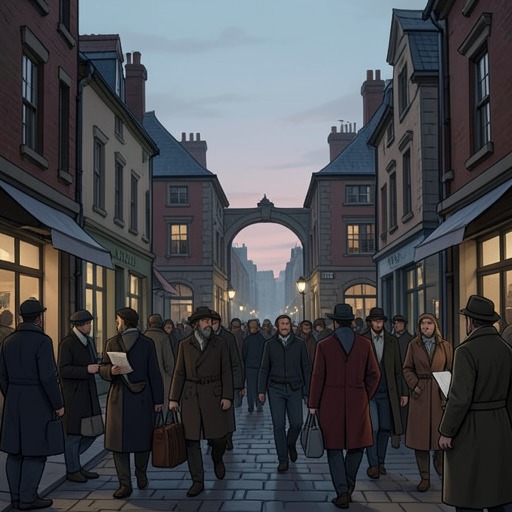
The Glass RoomMěsto, the fictional name for the city at the heart of The Glass Room, is both a setting and a measure of historical upheaval. The author states that the city behind the name is real, while the name itself is simply the Czech word for a town or city. From the heights above Lužánky Park, Město appears as a broad prospect and a home for ordinary family life; as political borders shift and armies pass through, it becomes a place of flight, occupation, deprivation, bombardment, and Soviet advance. In later decades, the Landauer House gives the city’s contested history a single, enduring address: a modernist residence remade by successive political orders and eventually preserved as architectural heritage.
Name, Setting, and the House Above the City
The name Město is a deliberate disguise, not an invention of the city’s underlying geography. The author explains that the house and its setting are real, though both have been renamed, and that seeing through those disguises reveals no further factual basis for the fictional characters or their story. The name also carries a small linguistic reminder of the book’s method: Město means town or city in Czech, a general word made to stand for a particular place.
The city is introduced through the landscape of the Landauer House. The residence is planned for a steeply sloping site overlooking Město, with Lužánky Park below the hill and the city laid out beyond it. The view is not an incidental backdrop: it is part of the house’s appeal and of its design brief. When Viktor takes the architect to the plot, the roofs stretch away towards Špilas fortress; the slope, park, and panorama establish a relationship between the private home on the hill and the city spread beneath it.
That commanding prospect makes the house a vantage point on the city’s changing life. Its windows open the domestic interior to the view, while the city’s transformations repeatedly reach the building and alter what it can mean. A home planned for Liesel and Viktor’s family will later be emptied, occupied by a racial-research organization, used as a children’s physiotherapy gymnasium, and treated as a modernist monument. Město is thus not merely the scenery around the house: the city’s political history determines the house’s changing occupants and purposes.
A City of Everyday Life and Sudden Contingency
In the house’s early domestic world, Město is approached through routine. At dawn, Liesel and Viktor look out across the terrace and the children’s sandpit; the day proceeds through washing, coffee, the children dressing, and Viktor’s work. From this hillside setting, the city is part of a life organized around family, business, and the repeated rhythms of a prosperous household. The contrast with what follows is sharpened by the plainness of these habits: the city’s history enters not as an abstract force but as a disruption of an existing everyday world.
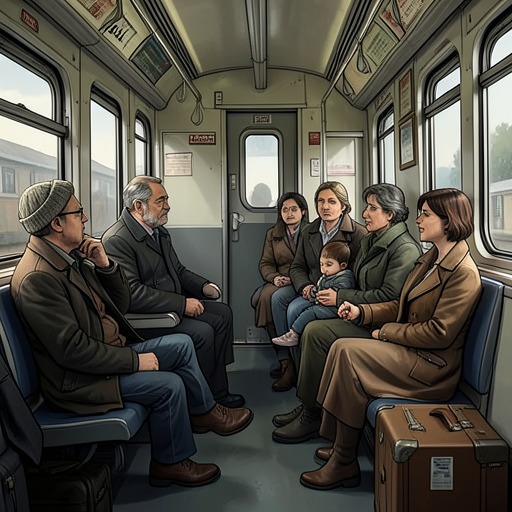
The city also becomes a place where chance gathers people whom the novel has kept apart. During flight from violence, Kata and Marika travel north towards the border on crowded trains and must wait six hours for a place. Their arrival among displaced people at Město’s railway station is described as an accident, not a predetermined reunion: people scatter across the countryside like thrown dice, and an extraordinarily unlikely convergence becomes certain only because it has happened. In Město, the consequences of displacement bring Kata into Liesel’s orbit, beneath the Glass Room’s distinctive white ceiling.
That encounter unsettles Viktor’s sense of social separation. He sees Liesel speaking with Kata as a conjunction between women from worlds he had regarded as impossibly distant. The city’s gathering of refugees makes that meeting possible, while the house temporarily contains it. Město’s role in the episode is therefore double: it receives people uprooted by political violence, and it creates new relations through the unplanned crossings that follow.
The novel refuses to let such encounters suspend ordinary life. Viktor reflects that countries are occupied and people scattered, but life continues as normal. The thought is set beside the recurring routines of the city and its residents, not offered as reassurance that suffering is small. Město’s ordinary continuities and its disasters coexist, making the persistence of daily life part of the historical pressure rather than an escape from it.
Disintegration, Occupation, and Departure
Město belongs to a state that is physically and politically dismantled. In the autumn crisis, the Great Powers witness the dismemberment of Czechoslovakia while the Czechoslovak army stands down. German troops enter towns in the north, Poland takes part of Czech Silesia, Hungary takes parts of Slovakia, and refugees move along roads, fields, and crowded trains. By the end of autumn, the Republic has ceased to exist; the brief, hyphenated CzechoSlovakia is described as a crippled successor destined for a short life. The city’s fate is inseparable from this collapse of the country around it.
Departure from Město is presented as a concrete convoy leaving a familiar landscape under changed conditions. Viktor and Liesel travel in the first car with the children; Katalin follows in a second car with Marika and the luggage, and Oskar and Hana bring up the rear. They drive down Blackfield Road, past the children’s hospital and towards the Ringstrasse. They are now required to drive on the right, under new regulations and a new highway code. The streets are almost empty, giving the Friday departure the uncanny quiet of a Sunday morning. A change in the rules of the road becomes one small, visible sign that the political order governing the city has already changed.
The house’s later emptiness gives that departure a material aftermath. When a planning-department official inspects the hallway and rooms, Laník identifies the children’s bedrooms in a house stripped nearly bare. The official corrects the tense: they were the children’s rooms. This distinction compresses the transformation of Město into a statement about the loss of home. The rooms remain identifiable, but their former inhabitants and their domestic future have been removed.
The family’s lawyers send a letter to the Landauer breakfast table in exile, its gravity perceptible even before Viktor explains its contents. The letter comes from the family’s legal representative in Město, one more connection across distance and dispossession. The city persists in correspondence and memory even after the household has been driven from it, but those channels cannot restore possession of the house or the life once organized there.
The City Under the Racial Research Regime
After the Landauers’ departure, Město’s political occupation becomes visible in the appropriation of their home. Stahl reaches the Landauer House on foot, passing suburban gardens and hearing the ordinary signs of life before the modernist building appears against the view of the city. Its low, almost featureless form does not resemble the triumphal grandeur of the regime’s preferred aesthetic. Yet its apparent neutrality does not protect it: Stahl enters, persuading Laník to show him through the stripped rooms, and recognizes the building as suitable for the institution planned there.
The next day, lorries deliver chairs, shelving, desks, and filing cabinets. A wooden guard hut is assembled inside the gate, and a sign bearing a wreathed Hakenkreuz identifies the site as a research establishment under the Rasse- und Siedlungshauptamt. The change is more than a new occupant’s name on a building. The private home is made into an instrument of state power, and Město’s residential landscape becomes part of an administrative project built around racial classification and measurement.
The conversion reaches into the house’s most distinctive spaces. Upstairs rooms become offices; the kitchens are adapted into a laboratory; a basement room is prepared for an X-ray machine, and another serves as a photographic darkroom. Curtains divide the Glass Room. In front of the onyx wall stand scales, a height-measuring frame, callipers, and a chair fitted with steel rulers. The curved dining area is turned into a photographic studio, with lights and a Rolleiflex camera. The Bösendorfer piano remains, incongruously, and is tuned by a Jewish piano tuner. The contrast between the instruments of measurement and the surviving piano marks the collision of the new institution with traces of the home it has displaced.
Město’s occupation is also registered through changes in what can be known and named. In the narrative’s earlier description of the city, Austrian and Czech names coexist: places have two names, reflecting the layered world in which its residents live. Under racial rule, however, an imposed system claims the authority to classify people and determine their place. The house’s conversion makes that claim spatially legible: a domestic interior becomes offices, laboratory, photographic studio, and archive, organized to turn human bodies into official records.
Siege, Scarcity, and Bombardment
As the war lengthens, Město’s residents are reduced to subsistence. They live on potatoes, turnips, and beets, digging food from the soil and tasting the earth in it. German troops move eastward and disappear from the city; those who return are described as defeated and damaged, human wreckage clearing space for what follows. At the pub at the bottom of the hill, workers from the armament factory gather around reports of the Red Army’s advance, while immense distances and casualty figures seem difficult to grasp from the city itself.
Scarcity turns ordinary goods into a form of wealth. Laník hoards food, paraffin, cigarettes, brandy, beer, and chocolate during a time of relative plenty, expecting to trade them when they become unobtainable. He later keeps cigarettes, paraffin, powdered egg, and powdered milk in the basement, giving credit to people in hardship and accepting payment in kind. His stock is described not as a miser’s pile but as a banker’s investment. The moral ambiguity of this survival economy is grounded in Město’s conditions: money loses force as the necessities of life become harder to find, and barter replaces ordinary exchange.
The approach of the Soviet army makes the city’s geography feel at once vast and immediate. Novotný follows the Red Army’s progress on a map, while news reaches Město of the advance through Hungary and the capture of Budapest after a two-month siege. After Vienna falls, more than three hundred thousand Soviet troops are said to be turning north. The Morava valley and its flooding have delayed an attempted crossing south of the city, and hundreds of Cossacks have died. A formation of twin-engined bombers marked with red stars then appears over Město; from the upper terrace, Laník and his sister watch it circle, hear distant concussions, and see smoke near the railway station.
The following defensive preparations transform the streets. German forces dig trenches, construct tank traps, clear lines of fire, and position eighty-eight-millimetre guns at intersections. Tanks and half-tracks rattle over tramlines; reinforcements arrive from the north, including young soldiers who appear not to understand what awaits them. Rumours report fighting in Berlin and the Anglo-Americans crossing the Rhine. As people retreat into cellars and basements, the city’s street life contracts into a search for candles, bread, potatoes, paraffin, soap, matches, and cigarettes. Money has become insignificant; Město is forced back into barter and shelter.
In November, fog and snow turn the city into a landscape of obscured movement. Sirens send people feeling their way to shelters and basements, where they wait through a false alarm before returning to queues and factory labour. Then bombs fall without warning, without engine noise, and without an air-raid signal. Explosions tear up roads, scatter paving stones, and reduce churches, houses, shops, and part of the railway station to rubble. Dust and smoke thicken the fog, extending the city’s obscurity into the air itself. A bomb falls towards the Landauer House while Laník and his sister shelter deep in its basement, the former home now a refuge from the destruction of the city around it.
The House as Refuge and Historical Record
The Landauer House has a striking succession of uses within Město’s history. It begins as a family home conceived around space, light, and a view of the city; its occupants are forced away, and the Nazi regime converts it into a centre for racial research. During later years it serves as a children’s physiotherapy gymnasium, a state use defended in the language of public benefit but questioned as a use for an architectural treasure. The novel lets these functions remain distinct: the building’s history is not a smooth progression from private home to public monument, but a series of contested claims over who may occupy it and what it is for.
The gymnasium gives the Glass Room another life as a place of work, treatment, and intimacy. Tomáš calls it the Glass Room, and the Czech word for room can also mean peace, quiet, or tranquillity; for him, the place is also a kind of glass tranquillity, a space of light and stillness after work. Zdenka holds dance classes there for extra money, an irregular arrangement tolerated partly because some of the dancers are children of party officials. Tomáš sometimes watches from a corner, finding relief in the children’s chatter and movement after treating children crippled by disease. The once-private room thus becomes a public and improvised space, while retaining a quality of light and stillness that draws people into it.
Later, an architectural discussion in Město calls attention to the contradiction between the building’s artistic standing and its practical use. A member of the State Committee for Architectural Heritage describes the Landauer House as the work of the prominent Landauer family and the architect Rainer Abt, and as the last of his European work before he fled to the United States in 1938. Architectural circles regard it as his masterpiece. Yet the building is serving as a children’s gymnasium. The article’s unease does not deny the value of care for sick children; it asks whether that care must take place in an architectural treasure. The conflict is between preservation and living use, not simply between beauty and neglect.
After the fall of the Iron Curtain, the house is treated as a structure fixed in time, repaired imperfectly and furnished with some original pieces returned from the Moravian Museum. Its bathroom fittings are updated, then ruined; the Glass Room’s window panes are removed and plate glass restored, returning the interior to what the narrative calls its full lucid splendour. Visitors arrive from fraternal Soviet states and later from outside the region, including tourists and architecture students concerned with Abt’s place in modernism. The restoration makes Město’s architectural past visible again, but the repaired building also carries the marks of the uses and political regimes that have intervened.
The city’s final significance lies in this uneasy persistence. Město is the place from which the Landauer family is driven, the setting for occupation and wartime survival, and the home of a building repeatedly assigned new purposes. Its skyline can be seen from the Glass Room, but the view cannot hold history at a distance: the city’s upheavals enter the house, empty it, repurpose it, and later make it an object of public memory. The surviving architecture offers a tangible point of return, not a restoration of the lives that were lost or displaced.