Modernism and visions of the future
The Glass RoomModernism and visions of the future take material form in the Landauer House, whose glass, open plan, and functional restraint promise a new way of living. Yet the house’s history overturns any easy faith in progress: a Nazi officer sees its light-filled interior as an ideal laboratory, an exile remembers its rooms as a lost home, and later officials debate whether children’s treatment or architectural heritage should determine its use. The building’s modernist future is never settled; successive occupants remake it, while its physical openness exposes it to appropriation as well as to wonder.
A modernist house and its promise
The house develops alongside the Landauer baby, but on a different clock. Her growth is marked by intimate milestones—the grasp of her hands, the focus of her eyes, her first smile, recognition of Liesel and then Viktor, and her first laugh—whereas construction proceeds through steel beams, poured concrete, and the enclosure of space. Delays caused by materials and the workforce stretch across summer and autumn. When the shell is finally complete in winter, there is no ceremony to mark the occasion. The family approaches with apprehension and finds a building that looks, from outside, like a warehouse for machinery or building supplies. Its future as a home has to be discovered from within.
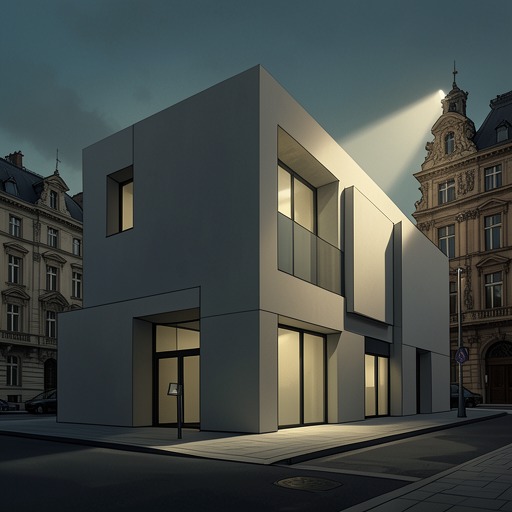
Years later, a Nazi officer recognizes the building from photographs and plans in an architectural journal. To him, the Landauer House is a long, low, nearly featureless pavilion, distinguished by what he calls stylish anonymity. Its understatement stands against the Party’s preference for grandeur and triumph. The contrast makes modernism more than a matter of taste: the building’s refusal of monumental display is already a challenge to the regime’s aesthetic, even before its occupants and architect have been forced from it.
Inside, the same spare design is read through another political lens. The officer admires the great open-plan living room, which occupies almost the whole floor, and the huge windows that admit what he regards as the cold light of reason. He welcomes the absence of Bohemian coziness and folk tradition, disliking the Party’s own nostalgia for the past even as he serves its racial state. The scene makes his supposed allegiance to a future of science and rationality deeply ironic: modernist space can be prized by a regime that turns scientific language into an instrument of persecution.
The future imposed on the house
Under Nazi control, the house’s open domestic plan is converted into the infrastructure of racial classification. Upstairs rooms become offices and the kitchen is adapted as a laboratory; the basement is prepared for an X-ray machine, while an existing room becomes a photographic darkroom. Curtains divide the Glass Room. In front of the onyx wall, scales, a height-measuring stand, callipers, and a dentist-like chair fitted with suspended steel rulers organize bodies for measurement. The dining area becomes a photographic studio, with drapes and lights arranged around the curved Macassar panelling and a Rolleiflex camera set on a tripod. The Bösendorfer piano alone remains as a conspicuous remnant of the former household.
The conversion also brings in machinery for processing records. Large black devices of steel and Bakelite, made by Deutsche Hollerith Maschinen Gesellschaft mbH, are unloaded into the garage that once housed the family’s two cars. One resembles a mangle; another, with its oversized keyboard and bulk, seems almost like a printing press. Soldiers carry in boxes of files gathered in Vienna. The house’s clarity and functional efficiency, once associated with a modern home, now serve a documentary and bureaucratic apparatus. Its open rooms do not prevent coercion; they make room for it.
The officer addresses the researchers as pioneers, urging them to regard themselves first as scientists and presenting their work as the advancement of knowledge alongside the advancing German armies. His rhetoric joins scientific discovery to territorial conquest. The building’s modernist image of the future is thus appropriated: the language of rational design and new knowledge becomes a cover for racial ideology, while its instruments and rooms make that ideology operational.
Exile, memory, and competing futures
For Liesel, the house remains present as a structure she can reconstruct in memory even after the family’s departure. She imagines walking its terrace, picking up the children’s toys, entering Ottilie’s and Martin’s rooms, and seeing the bathroom tiles decorated with a line of rubber ducks following their mother toward the bath. In the Glass Room she remembers the descent—twelve steps to the curve, then nine more—and the space opening around her. The precise remembered route counters the abstraction of exile: this is not simply a lost property but a sequence of rooms bound to family life and happiness.
Her conversation with Rainer von Abt exposes the distance between his confidence and her uncertainty. Viktor claims to belong anywhere, while Liesel says she misses home and friends and does not feel that she belongs where they are. Their prospects for America are constrained by the absence of work and relatives there and by immigration quotas; the suggested route through Cuba offers no reassuring alternative. Rainer briefly proposes that she leave Viktor and go with him to America, but the idea dissolves into shared laughter. The exchange leaves her displacement unresolved rather than turning escape into a new, certain future.
At lunch, the household’s memory becomes a shared subject among Liesel, Rainer, and Viktor, while Katalin sits with the children at the other end of the table. Liesel wonders whether the place ever existed outside her imagination, and Rainer answers that he built it to make her happy. Her question about who the house is meant to make happy now—banks in Zurich and universities in America—brings its afterlife into view: the building and its architect have been redirected toward distant institutions. Her suggestion that they demolish the existing house and let Rainer build another glass house is both a longing for renewed happiness and a recognition that architecture alone cannot restore the lost life that gave the first house its meaning.
As departure for America approaches, Viktor presents emigration as release from Europe’s memories and conflicts and insists there is a future. Liesel counters that memories may be all that remains, and identifies the occupation of their old house for anthropology and race research as that future. The disagreement turns the house into an argument about historical direction: Viktor wants a clean break, while Liesel sees that the violence of the new order is already housed within the modern spaces they left behind.
Public use and the politics of preservation
In a later period, the Landauer House serves as a children’s physiotherapy gymnasium. Tomáš calls it the Glass Room and experiences it as a space of light and stillness, distinct from architectural period or style. The Czech word he uses for room can also mean peace, tranquillity, or quiet; in his usage, the building’s name carries both meanings. After work he can be with Zdenka there, and he sometimes watches her dance classes. The gymnasium therefore remains more than a preserved architectural object: its rooms accommodate treatment, work, and private human attachments, including uses not officially authorized but tolerated because some dancers are children of Party officials.
That lived use becomes controversial when the building attracts attention as a modernist masterpiece. A newspaper article calls the Landauer House an architectural treasure but questions its service as a children’s gymnasium, even while acknowledging the importance of providing sick children with good treatment conditions. The article identifies its Blackfield district setting above Lužánky Park, its history as the work of Rainer von Abt, and its status as his last European building before he fled to the United States in 1938. Its account dwells on the living room’s 230 square metres, two glass walls, and view across the city toward Špilas, as well as its chrome pillars, onyx partition, and cream linoleum.
The article also records how much has changed. The specially designed furniture has disappeared, although examples survive in the Moravian Museum. A bomb blast destroyed the original plate-glass windows during the war, and smaller panes replaced them; the original lowering mechanism, which once allowed two window frames to descend into the basement, reportedly still works. The building’s condition is therefore neither untouched survival nor complete restoration. Its fabric bears war damage, alteration, and the selective return of objects, even as preservation advocates imagine a museum that would make the house accessible to the public.
The proposed restoration brings another conflict over who may define the building’s value. The account of caretaker Josef Laník presents him as a defender of the house through the war and its handover to Soviet forces, while his later position as a local Party official links preservation to the political order that governs its public use. When Liesel returns, she is crowded by visitors in the Glass Room and feels trapped in a space she had never experienced as oppressive. A speech about the house’s place in European architecture continues as Hana leads her toward the terrace. The contrast is sharp: the room once remembered as a private home and later used for treatment has become a public setting where official heritage language can overwhelm the person whose life is bound to it.
The house after its intended future
By 1990 the house is described as fixed in time and space, almost like a fossil. Repairs are poorly done; some original furniture is retrieved from the Moravian Museum and returned approximately to its former places, while updated bathroom fittings have been ruined. The Glass Room’s small replacement panes are removed and plate glass restored, giving the space back its full lucid splendour. Visitors arrive in small groups, first largely from fraternal Soviet states and later as tourists or architecture students interested in Rainer von Abt and modernism. Restoration recovers a visual ideal, but it cannot restore the family’s life or erase the building’s successive occupations.
When Marie Delmas visits from Paris, the building reaches her not as an abstract monument but through recognition. A photograph in a book on modern architecture has drawn her to the house, captioned La Villa Landauer, élévation sud. Inside, an attendant explains that the family left in 1938 and that the house belongs to the city as a museum. Yet the narrative resists the attendant’s definition: the house is not simply a museum. The piano sounds behind the onyx wall, and its chord seems to gather and reverberate with the noise of children and the crying of adults. Modernism’s legacy is therefore neither a sealed style nor a stable public meaning. The house remains alive through the conflicting memories, uses, and human histories that its clean lines cannot contain.