Nazi occupation of Bohemia and Moravia
The Glass RoomThe Nazi occupation of Bohemia and Moravia is rendered not only as a change of government but as a seizure of space and the power to classify human beings. The Landauer House, designed for light and domestic life, is requisitioned in the name of the Reich Protectorate and converted into a centre for biometric research. Its new measuring instruments, files, and checkpoints make occupation tangible: the state claims the house, scrutinizes bodies, and decides whose documents and identities will permit passage. Later transformations of the building do not erase that history; they leave the house as a contested record of power and belonging.
Requisition and the language of legality
The occupation reaches the Landauer family as a blunt change in ownership. Viktor receives a letter informing him that the house no longer belongs to them. He explains to the children that it has become property of the Protectorate, under a decree signed in the name of the Reich Protector of Bohemia and Moravia. The official title and signature give the seizure an administrative form, but to the family the result is dispossession. The possibility that the beautiful house on the hillside might be demolished finally makes Liesel weep—not just for the building, but for her lost life and love and for the unreality of exile. Katalin, rather than Viktor, rises to comfort her.
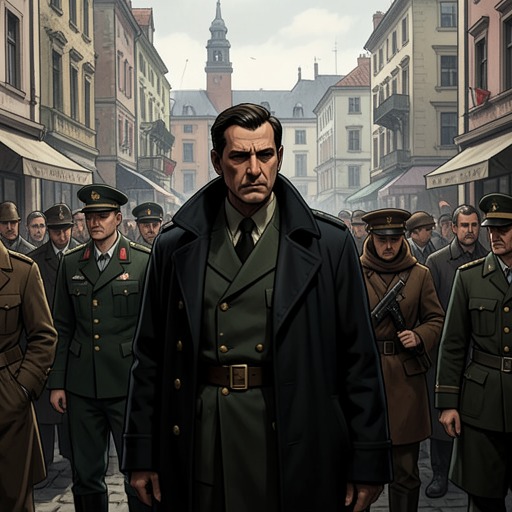
The occupation’s coercion is dramatized again at the gate. Stahl approaches the Landauer House with a requisition order transferring ownership from the Municipality of Město. He insists that the taking is legal, points to the stamps and signature of Karl Hermann Frank, and offers to enter peaceably. Yet his polite persuasion rests on a threat: the occupiers will get inside one way or another. The custodian, Laník, is addressed by an officer who treats the document as sufficient to settle the matter, although its force comes from the armed authority enforcing it. The scene exposes the gap between legality as printed procedure and consent as lived reality.
The house remade as a research centre
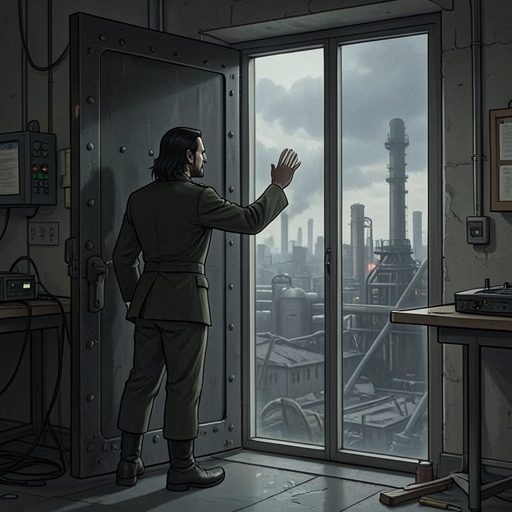
The conversion begins almost immediately. Lorries bring chairs, shelving, desks, and filing cabinets; a guard hut is assembled inside the gate, and a notice bearing a wreathed Hakenkreuz identifies the premises as the Rasse- und Siedlungshauptamt’s research site. The new institution arrives with its own staff and claims to be engaged in scientific work. Stahl presents the researchers as pioneers and insists that they act as scientists, linking their work to the military advance of the Third Reich and describing their time as historic.
The building’s domestic arrangement is reorganized room by room. Upstairs spaces become offices and the kitchens are adapted as a laboratory. A basement room is prepared for an X-ray machine; another becomes a photographic darkroom, retained from the owners’ former use. Curtains divide the Glass Room, while anthropometric equipment is set before the onyx wall: scales, a height stand, callipers, and a chair fitted with suspended steel rulers. The dining area becomes a photographic studio, with drapes before the curved Macassar panelling and lights directed at the centre of the room. The Rolleiflex camera waits on its tripod. Only the Bösendorfer piano remains as a conspicuous survivor of the previous household, restored by a Jewish piano tuner whom Stahl has arranged to employ.
The garage, once used for the Landauers’ two cars, takes on the appearance of a printing works. Heavy machines from Deutsche Hollerith Maschinen Gesellschaft mbH are unloaded, including a contraption like a mangle and a keyboard machine as large as an upright piano. Soldiers carry in boxes of files, the accumulated documentation that supports the centre’s work. The former house is thus not simply occupied by new residents: its rooms and infrastructure are redesigned to make measurement, photography, and record-keeping possible.
Classification, persecution, and movement
The centre’s scientific vocabulary is shown to serve a racial order. Stahl tells Laník that the researchers will measure him and tell him whether he is Jewish, presenting the classification as a result that instruments can establish. His conversation with a woman in the centre makes the political stakes explicit. She lists restrictions imposed on Jews: exclusion from shops at ordinary hours, trams, cafés, hotels, public parks, pets, telephones, and decent employment, as well as the requirement to wear a identifying label. She also points to rounding up and deportation and asks whether the apparatus in the room means that he understands what is happening. Stahl answers that the Jews are a plague affecting everyone and that the advancing German armies bring more people under their control, so a solution must be found. His language converts persecution into a technical problem while her questions name its human consequences.
Occupation also governs who can cross borders and with whom. When Viktor’s family is checked at a station, he lays out passports, French transit visas, a Spanish visa, and tickets for himself, Liesel, their children, the nanny, and her daughter, Marika. The Feldgendarmerie official examines the papers and calls for tickets, turning the family’s escape into a decision made at a desk. Katalin’s documents do not secure her passage. After the soldier examines her passport and visas with another official, a uniformed figure takes her by the elbow and leads her to a nearby hut. Marika cries out for her mother; Liesel pulls the child close and says that she is with them and will be looked after. The border procedure divides mother and daughter even as Liesel attempts to keep Marika within the family’s protection.
A contested house across political change
The house’s later history shows that the end of Nazi rule does not settle the question of ownership. In a later dispute, Martin calls it a house sequestrated first by one illegal government and then by another. He rejects the application of the Beneš decrees to people driven into exile by the Nazi invasion, arguing that the decrees concerned Germans deemed to have been Nazi sympathizers. His claim sets the family’s exile against subsequent legal justifications for taking property, while the official approached about the house declines to offer a legal opinion and says only that the city authorities object to its current use.
Under state socialism, the building serves as a children’s gymnasium. A public account identifies it as the Landauer House in the Blackfield district, overlooking Lužánky Park and the city centre, and describes the house as the celebrated modernist architect Rainer von Abt’s masterpiece. The account praises the living room’s south-facing light and its scale—two hundred and thirty square metres for a family of four, with glass walls and a view toward Špilas—while questioning whether sick children’s treatment must take place in an architectural treasure. The argument makes the building’s public value inseparable from its changing use: it is simultaneously a work of architecture, a medical facility, and a former home whose owners were exiled.
In 1990, after the fall of the Iron Curtain, the house is repaired, though badly; some original furniture returns from the Moravian Museum, and plate glass restores the Glass Room’s clarity. Visitors arrive first from fraternal Soviet states and later from outside, including architectural students interested in Rainer von Abt. Marie Delmas comes from Paris after recognizing a photograph of the house in a book on modern architecture. The restored transparency offers a striking contrast with the building’s conversion into a place of classification and surveillance, but restoration cannot itself return the lost household or resolve the competing claims that have accumulated around the property. Across these changes, the Landauer House remains a physical register of occupation: a home appropriated, an instrument of racial administration, a state institution, and an architectural inheritance still marked by exile.