Nazi occupation of Czechoslovakia
The Glass RoomThe Nazi occupation of Czechoslovakia becomes legible not only through invasion and exile but through the changing fate of a house. The Landauer family’s modernist home is confiscated under the occupation and converted into an institution for anthropometric and documentary work; its owners escape to Switzerland, while other lives are broken by arrest and border enforcement. Decades later, the house is still standing, but its claims to ownership, use, and memory remain unsettled. Its rooms preserve the collision between the language of legal administration and the force of dispossession.
Occupation, Exile, and the House
The Landauer House was built for a prominent capitalist family in the Blackfield district, overlooking Lužánky Park and the city centre. The Landauers commissioned the architect Rainer von Abt in the late 1920s, and the house would be considered his European masterpiece. Its 230-square-metre living room, two glass walls, chrome pillars, cream linoleum, and partition of onyx slabs gave private family life an unusually open, light-filled setting. In the novel’s historical arc, that home becomes a measure of how swiftly occupation can change the meaning of space: a residence that embodied its owners’ life and taste is taken over and assigned a new political purpose.
The family’s departure is recalled as escape at the time of the Nazi invasion. When asked whether the Landauers were killed, a former acquaintance answers that they were lucky, or clever, and got away to Switzerland. This account sharply distinguishes their survival from the fate of those who could not leave, without making escape seem secure or equivalent to rescue. The house remains in Město after its owners are gone, a fixed point around which later authorities and witnesses argue over what happened and what should happen next.
Confiscation and the Manufacture of Legality
The family learns that it no longer owns the house through a letter. The news initially sounds like a death, but the document reports a different kind of loss: the government has confiscated the property. Viktor describes it as taken from them, expropriated, or stolen. The sequence of terms matters. The official act can be named in the language of administration; from the family’s position, its consequence is the violent removal of a home and a legal claim.
The occupation’s method appears in the encounter between Hauptsturmführer Stahl and the caretaker, Laník. Stahl insists that the seizure is legal and points to a German-language requisition order transferring ownership from the Municipality of Město. The paper bears stamps and the signature of Karl Hermann Frank, and Stahl stresses that the house is being taken for purposes connected to the war effort. His meticulous appeal to documents and procedure does not make the encounter consensual: he tells Laník that the occupiers will enter one way or another and proposes that he show them around peaceably. Administrative formality becomes a way to present a fait accompli as orderly business.
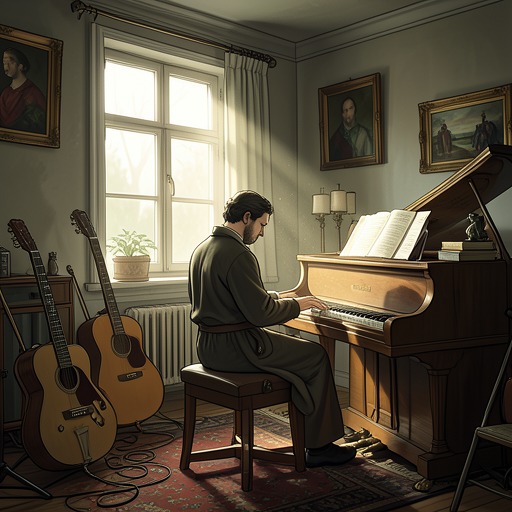
The house is then transformed into a Nazi research facility. Upstairs rooms become offices, the kitchens are converted into a laboratory, and a basement room is prepared for an X-ray machine. A former photographic darkroom remains in use, while curtains divide the Glass Room. Against the onyx wall stand scales, a height-measuring stand, callipers, and a chair fitted with steel rulers; the dining area is turned into a photographic studio, with a Rolleiflex camera positioned before the curved Macassar panelling. The Bösendorfer piano alone remains recognizably from the house’s previous life, its tones restored by a Jewish tuner. In the garage, once large enough for two Landauer cars, workers unload bulky Hollerith machines and soldiers carry in boxes of files. The conversion makes the domestic interior serve a system of measurement, photography, and record-keeping.
Human Costs and Interrupted Lives
The occupation’s reach is not confined to the family’s lost property. At a border checkpoint, Katalin presents her passport and visas while Liesel, Viktor, and Marika are with her. After officials examine the documents and consult, a uniformed figure takes Katalin by the elbow and leads her toward a hut. Marika cries out for her mother; Liesel pulls the child close and tells her she will be looked after. The scene makes the border a place where paperwork can divide a family in a matter of moments, and where a promise of protection cannot erase the separation already imposed.
Hana’s later account gives the occupation another intimate consequence. The Gestapo came to her house at night and took her and her husband, Oskar. She never saw him again. After the war, she learned that he had been sent to Theresienstadt; he spent about a year there before being placed on a transport to Auschwitz in January 1943. Hana says that she does not know why the Gestapo came, or whether her German had led them to the house. Her uncertainty is part of the testimony: what she can establish is the arrest, the separation, and the chain of deportation that ended in the camps. She remembers Oskar as the only man she ever loved, despite having betrayed him many times.
Afterlives: Hospital, Heritage, and Ownership
After the war, the house enters another contested history. A newspaper article presents the Landauer House as an architectural treasure being used as a children’s gymnasium. It praises the light and space of the living room and describes its two glass walls, city view, chrome pillars, onyx partition, and original cream linoleum. The article also notes that the original plate glass was destroyed by a wartime bomb blast and replaced with smaller panes; the mechanism that once lowered two window frames into the basement is said still to work. The building’s survival is therefore neither untouched preservation nor simple ruin: its fabric carries both adaptation and damage.
That article’s account of Laník differs in emphasis from Stahl’s earlier encounter with him. Now a local District Committee member, the former caretaker recalls maintaining the house as bombs fell and defending it with his sister against the Nazis before handing it over to Soviet forces. He hopes that ordinary people will be able to visit a building once reserved for the few. The account turns a figure associated with the occupation’s transfer of control into a postwar custodian and advocate for public access; the house’s successive authorities each tell a different story about legitimate possession and service.
The later proposal to restore the Landauer House as a museum provokes a further dispute. A State Committee for Architectural Heritage representative treats it as a major work of modernist architecture, while the building is still serving as a children’s physiotherapy gymnasium. The question is not simply whether an architectural masterpiece deserves preservation, but whether preservation should displace the children being treated there. In 1990 the house is repaired, original furniture is brought back from the Moravian Museum, and the Glass Room’s small replacement panes are removed so that plate glass can restore its lucid openness. Yet restoration does not restore the family’s home or settle the history of its seizure.
A House That Cannot Be Reduced to a Museum
When Liesel returns, crowds press around her in the Glass Room as the chief of urban planning begins a speech about the house’s place in European architecture. She feels trapped and asks Hana to take her outside. The scene contrasts the official celebration of the building with the bodily experience of the person whose family once lived there. Laník is present as a public official; Liesel recalls that he had always made her uneasy and thinks he used to spy on her. Hana, in turn, sees his promotion as part of the country’s continuing political inheritance. The house’s public recognition cannot make its past politically neutral.
After the fall of the Iron Curtain, the house is presented as a fixed object, almost a fossil, repaired and opened to visitors. But its history resists that stillness. It has been a family dwelling, a seized research centre, a hospital gymnasium, and a proposed museum; the same light-filled room has accommodated domestic life, Nazi instruments, children’s treatment, and official speeches. Near the end, when Marie Delmas hears that the family left in 1938 and that the house now belongs to the city, the narrative refuses to leave it at the level of property or display: the piano sounds in the shadows behind the onyx wall, and the building seems vibrantly alive with echoes of children and adults crying. The house records occupation not as a completed episode but as a struggle over what can be preserved, who may use a place, and whose loss its public story will contain.