Nazi policy of confiscating Jewish property in occupied territories
The Glass RoomNazi policy of confiscating Jewish property in occupied territories turns the Landauer House from a family home into an object of state appropriation. The novel shows the seizure not as an abstract decree but through its impact on the Landauers: an official letter, the explanation that Viktor is Jewish, and the later production of a stamped requisition order. Its language of legality masks a coercive transfer of ownership, while the house’s changing uses and the unresolved claims to it carry the consequences beyond the occupation itself.
Confiscation and the family’s loss
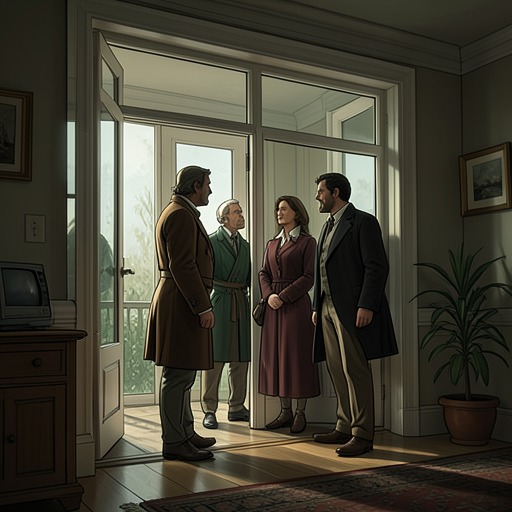
The Landauers learn that they no longer own their house through a letter from Procházka. Viktor explains to Liesel that the government has confiscated it, describing the transfer plainly as theft. When she asks why, he answers that it is because he is Jewish. In this domestic conversation, the policy’s racial basis is made explicit: ownership, construction, and family inheritance offer no protection once the state defines the owner by a targeted identity.
Liesel insists that the house belongs to them and to their children, Ottilie and Martin. Viktor then explains the loss to the children at breakfast: the house is now the property of the so-called Protectorate, under a decree issued in the name of the Reichsprotektor of Bohemia and Moravia. Ottilie protests that it is still their home. Liesel asks whether there is any redress, but Viktor dismisses the possibility: the authorities make laws to suit themselves. The children’s questions and Liesel’s appeal for a remedy expose the gap between the family’s continuing sense of ownership and the regime’s power to erase it administratively.
Administrative legality and coercion
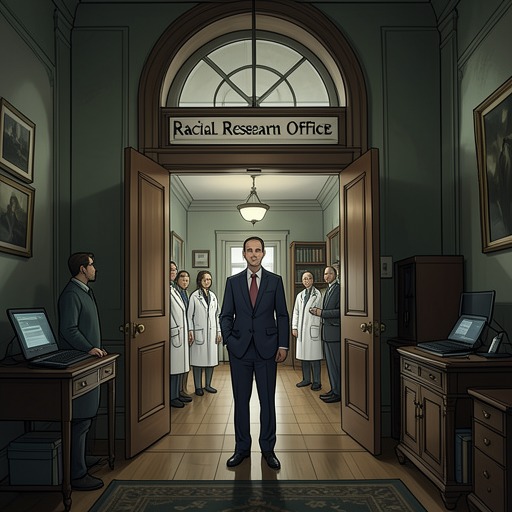
The seizure is also presented from the perspective of the officials who carry it out. Hauptsturmführer Stahl arrives at the Landauer House and tells the caretaker, Laník, that possession is being taken for purposes connected with the war effort. He emphasizes that the action is legal and points to the written order, which transfers ownership from the Municipality of Město. The order is in German and bears stamps and a signature, including that of Karl Hermann Frank. These details give the confiscation the appearance of a regular administrative process, even as the official uses the threat that they will enter the house one way or another to press Laník to cooperate.
That language of procedure contrasts with Viktor’s description of the same act as theft. The state’s paperwork does not answer the family’s claim that they built and owned the house; instead, it supplies a mechanism by which that claim is overridden. In this way, the narrative makes formal legality part of the coercion: the order documents the transfer while the occupation authorities control the conditions under which it is enforced.
Dispossession beyond the house
The policy’s reach appears in another encounter at a border. When soldiers examine Katalin’s passport and visas, Viktor says that she is in the family’s employ, but a soldier refuses to let him speak for her. Officials consult over the documents, then take Katalin by the elbow and lead her away. Liesel pulls Marika close and tells the child that she is with the family and they will look after her. The scene is not itself a property seizure, but it echoes the same structure of power: official scrutiny of identity and papers overrides personal relationships, and administrative decisions have immediate consequences for a family’s ability to remain together.
After the war, the Landauers’ claim to the house remains entangled with successive governments and competing legal accounts. Martin describes the property as having been sequestered first by one illegal government and then by another. He rejects the application of the Beneš decrees to people who, he argues, were driven into exile by the Nazi invasion, rather than being Nazi sympathizers. The dispute shows that the original confiscation does not end with the occupation: the house’s ownership becomes part of a longer argument about exile, responsibility, and the laws used by governments to define who may reclaim property.
Return, recognition, and memory
Decades later, the authorities of Město invite Liesel to witness a handover of the house, offering to pay her expenses. Martin warns that accepting could amount to de facto recognition of the city’s legal ownership. The city’s representative, Veselý, presents the invitation as part of a political opening: the country wants to resume normal relations with its neighbours and acknowledge past errors. Martin sees the invitation as an attempt both to validate the city’s claim and to use his mother in a political cause. The exchange makes clear that a public ceremony cannot by itself settle the difference between legal possession and the family’s understanding of what was taken.
The history of the house is also reframed through its changing use. In a newspaper feature, a member of the State Committee for Architectural Heritage identifies it as a masterpiece by Rainer von Abt, while the article notes that it is serving as a children’s physiotherapy gymnasium. It describes the south-facing windows, the room of 230 square metres, the chrome pillars, the onyx partition, and the original lowering mechanism for two window frames, while recording that the original plate glass was destroyed by a wartime bomb and replaced with smaller panes. The article celebrates the building’s architectural survival, but its attention to the structure sits alongside the history of dispossession and the people whose home it was.
At the later gathering in the Glass Room, Liesel feels crowded and asks Hana to lead her outside. Laník, now a Party official, recounts his wartime role in maintaining the building and defending it before it was handed over to Soviet forces. Liesel remembers him with distrust, while Hana sees his rise as emblematic of a country governed by people like him. The house is thus not simply recovered as an architectural treasure: its successive custodians and political uses remain part of what the family encounters when they return.
The novel finally places the policy’s consequences within a larger history of loss and attempted recovery. In a conversation about the proposed handover, Liesel recalls that her family had believed Hana dead after hearing of her arrest and deportation in 1942. Exile, the postwar expulsion of Germans, the deaths of Viktor’s Jewish relatives in the camps, and the Iron Curtain all obstructed knowledge and reunion. When the house is later called a museum, the word cannot contain the lives remembered within it. The Glass Room is described as a place that seems to deny time, yet its space holds the successive histories of family home, seizure, wartime damage, public use, and return. The confiscation policy therefore persists in the narrative not only as the initial loss of property but as an unresolved struggle over law, belonging, and who has the authority to tell the house’s past.