Nazi policy of killing disabled children
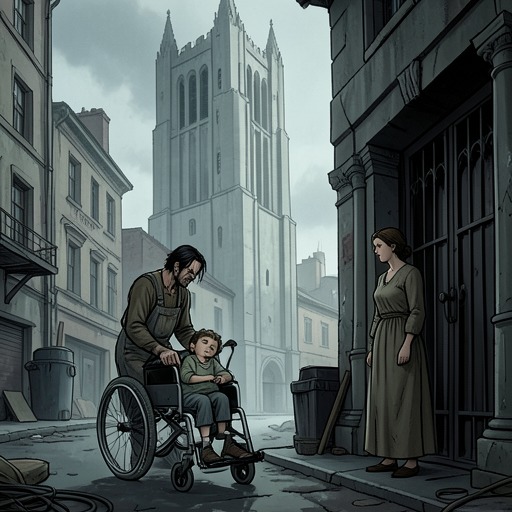
The Glass RoomThe Nazi policy of killing disabled children enters the narrative through the intimate account of Erika, the four-year-old daughter of Rainer von Abt and Hedda. Rainer describes an inherited disease that progressively took Erika’s abilities, then recounts how the family brought her to a facility in Upper Austria and left her there to be killed. Presented as a clinic visit, complete with paperwork and a waiting room, the episode shows administrative procedure and medical language giving a lethal policy the appearance of care.
Illness and diagnosis
Rainer explains that Erika seemed healthy during her first six months: she grew, smiled, recognized her parents, and reached toward them. Her development then reversed. She stopped smiling and responding, lost the ability to grasp toys, and became increasingly unresponsive. The account makes the progression central: an infant who had acquired skills gradually lost them, as if her development were being wound backward.
The condition is identified as infantile amaurotic congenital idiocy, with blindness among its symptoms. Rainer describes a cherry spot on Erika’s retina, loss of head control and hearing, and later spasms and convulsions. Doctors told the family that the disease would eventually remove her bodily functions and prove fatal; Rainer says that children with the condition typically lived four or five years and that there was no cure. These particulars establish the circumstances in which the family faced her care and death, without making the diagnosis itself an explanation for the killing.
Inheritance and family history
Rainer links the condition to a recessive genetic mutation shared by both parents. He explains that a child must inherit one copy from each parent to develop the disease, and says that the mutation was present in both his and Hedda’s family. He believes it entered their family through a Jewish ancestor four generations earlier, and describes it as a disease associated with Jews. His explanation exposes the racialized meaning he attaches to the illness, while his account also makes clear that the condition results from an inherited mutation carried by both parents.
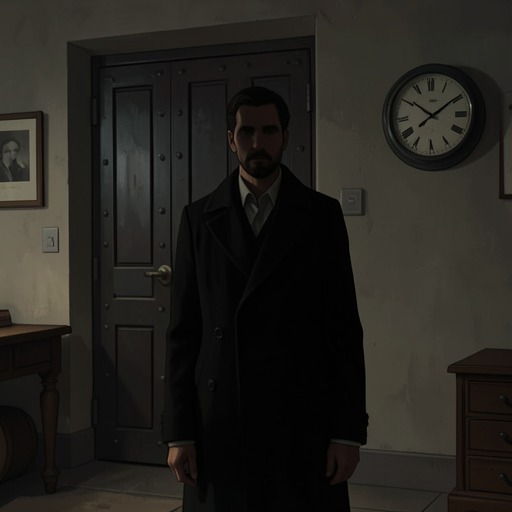
The disclosure takes place in the Glass Room, amid objects associated with scientific measurement. Rainer’s attempt to explain the disease in biochemical and genetic terms sits alongside the disturbing limits of what such knowledge can do: it names the condition and its inheritance, but offers no cure and does not make Erika’s death any less consequential. His confidence in science’s capacity to solve problems is placed beside an experience in which scientific description coexists with irreversible loss.
The journey to Hartheim
When Erika was four, Rainer and Hedda drove from Munich to a castle in Upper Austria. The family arrived in winter, with snow covering the grounds. An orderly answered their bell almost immediately; Rainer reflects that the staff must have known they were coming. Although he calls the establishment a kind of clinic, the family’s visit had already been prepared for them.
The procedures were quick and efficient. Rainer and Hedda signed a few forms, which had largely been arranged in advance, and were shown to a waiting room where they could pray or do as they wished. They tried to say goodbye to Erika, but Rainer says that, by then, they had already said goodbye to their child months earlier, as her illness had progressively changed her. After five minutes, a nurse took Erika away. The ordinary sequence of arrival, identification, paperwork, waiting, and separation makes the facility’s operation legible as a system rather than an isolated private tragedy.
Killing and aftermath
Rainer tells Hana that Erika was taken away to be killed. He says she was given an injection of morphia and scopolamine, which he understood as a means of ending her suffering quickly and painlessly. He adds that he thought it was for the best. The account presents this judgment as Rainer’s response to the illness and the circumstances of Erika’s death; it does not turn the killing into a cure or erase the coercive reality of the policy behind it.
Hedda returned from the conservatory a few days later and died by suicide. Rainer recounts her death immediately after telling Hana what happened to Erika, placing the loss of their child alongside the destruction of their family life. His disclosure is framed as something he has never told anyone else. In the present, he resents Hana’s compassion when it becomes pity, and the story of Erika becomes part of a charged encounter between them. The episode therefore connects the policy’s institutional violence to enduring grief, secrecy, and the difficulty of receiving another person’s sympathy.
Narrative significance
The account’s force lies in the contrast between the precision of its details and the moral horror they disclose. A diagnosis, an explanation of inheritance, forms confirming identity, a brief wait, and an injection describe the machinery surrounding Erika’s death. The clinical language does not soften the outcome: a disabled child is taken from her parents and killed, while the family is left to live with the loss.
By centering Rainer’s testimony, the narrative gives the killing a specific family history and a remembered sequence of decisions, without making Erika’s illness merely an abstraction. Her lost abilities explain the family’s desperation and Rainer’s reasoning, but the account also distinguishes that suffering from the organized act that ends her life. The policy appears not only as a public system but as a private rupture, followed in this case by Hedda’s death and by Rainer’s long silence.