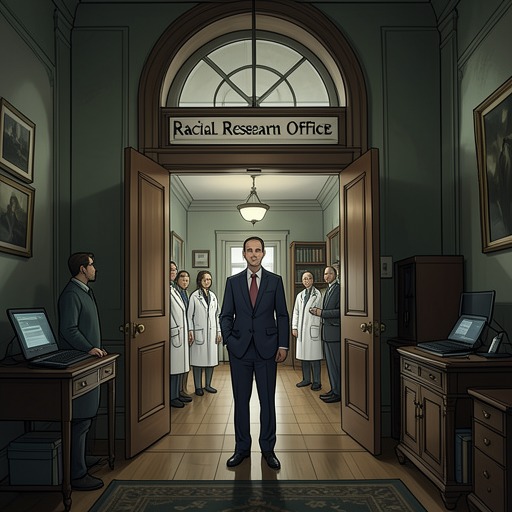
Nazi race science and anthropometry
The Glass RoomNazi race science and anthropometry are the organizing rationale of the biometric centre installed in the Landauer House: a regime’s political demand for racial categories is recast as a scientific problem of measurement, documentation, and statistical sorting. The centre’s immaculate procedures make the contradiction visible. Its instruments promise objectivity, but its categories are imposed in advance, its subjects are placed under occupation, and its records are meant to support decisions about human beings that its research cannot reliably distinguish.
From racial doctrine to research programme
The centre’s director, Werner Stahl, describes his work to Laník as anthropology and biometrics: the measurement of humanity, with the stated aim of determining whether Laník is Jewish. The threat is embedded in the definition. Measurement appears to be a neutral way of knowing, but the question it serves is an administrative one—who belongs to which racial category, and what may be done to them. The claim that the work is simply scientific does not remove its political purpose; it gives that purpose an institutional vocabulary.
Stahl’s account to Reinhard Heydrich makes the ambition—and its uncertainty—more explicit. Heydrich asks whether the centre can identify Jews. Stahl mentions hair colour and inherited conditions associated with Jewish people, including infantile amaurotic idiocy, but concedes that the diseases do not map neatly onto Jewish identity: not all Jews have them, and people who have them are not necessarily Jews. The centre therefore turns to minute variations of phenotype and searches for combinations of characteristics that might yield a racial diagnosis. The admission undermines the promise of a simple biological test even as Stahl presents further measurement and data processing as a route toward one.
The house converted into an apparatus
The Landauer House is not merely the centre’s setting; its domestic rooms are remade to make the research possible. Offices occupy the upper floor, the kitchens become a laboratory, and a basement room is prepared for an X-ray machine. A photographic darkroom already in the house remains in use. Curtains divide the Glass Room, while scales, a height-measuring stand, callipers, and a steel construction of rulers above a chair are arranged against the onyx wall. The dining area becomes a photographic studio, with lights directed at the curve of the Macassar panelling and a Rolleiflex camera waiting on its tripod.
The conversion preserves a disquieting remnant of the home it displaces: the Bösendorfer piano. Stahl has a Jewish piano tuner restore its tones, so the instrument remains in a building whose other rooms have been refitted for racial research. The contrast is not a return to ordinary domestic life. The piano survives incongruously beside the apparatus, a trace of the house’s former purpose inside a system that has taken possession of it.
The garage, once used for the Landauers’ two cars, is occupied by heavy Hollerith machines made by Deutsche Hollerith Maschinen Gesellschaft. Their scale and industrial presence extend the centre beyond the examination room: the machines are designed to process documentary records, not simply to store them. The former home becomes at once laboratory, photographic studio, office, and data-processing site, joining the inspection of individual bodies to a larger administrative operation.
The examination and its subjects
People arrive by bus in groups of about twelve, divided by sex and approximate age. Staff escort them inside without shouting or overt military force. Stahl’s instruction that human subjects should be treated with the respect zoologists show animals gives the procedure a veneer of civility, while the comparison exposes the subjects’ position as objects of examination. In the lower-level Glass Room, their details are entered on forms: date and place of birth, languages, religion, race, and nation, as well as medical conditions and traits attributed to their ancestry, including alcoholism, criminality, and mental retardation. The records are called confidential and the process is said to serve pure science.
The forms are followed by tests matching shapes, completing sequences, and identifying patterns. Subjects change into medical gowns, have blood taken by needleprick, and have their blood pressure measured. In the measurement areas, workers operate in pairs: one records while another positions the subject against the stadiometer. The prescribed posture—heels, buttocks, and shoulder blades against the board, chin level—turns a person into a standardized set of measurements. Height, hip and chest diameter, and seated arm and leg measurements are recorded; callipers measure the head, while skin and eye colour are compared against charts and models.
The procedures are repeatedly described as exact and painless. Examiners reassure people that there is nothing to worry about, then ask them to remove their gowns for photographs. The claim that everything is confidential sits uneasily beside the files, photographs, and measurements being gathered into a system of classification. The novel’s image of scientific objectivity is deliberately cold: the procedure’s precision resembles the balanced dimensions of the Glass Room, but exact technique cannot validate the racial meanings assigned to its results.
Records, numbers, and the limit of classification
The centre’s paper and machine systems make individual examinations part of a much larger flow of information. Stahl reviews returns from other units alongside monthly totals. One report concerns 193 Roma people, aged thirteen to eighty-seven, examined in the Carpatho-Ruthenia zone. The April returns list 672 people assessed: 316 classified as Slav, 239 as Aryan, and 112 as Mischlinge of varying degrees, while Roma people and Jews are counted separately in an addendum. These figures enact the appearance of comprehensive knowledge, even as the categories and their boundaries remain unstable.
The data are transferred onto punched cards and duplicated in boxes for a courier to Prague; from there they are to be sent to Berlin. The Hollerith machines are expected to sort, assemble, and analyse the cards at a rate of 150 per minute, revealing patterns and correlations that will supposedly unlock race and identity. Even the maintenance schedule of the machines enters Stahl’s paperwork. The routine detail makes the centre’s ambition feel operational rather than abstract: classification is being built into an administrative network, maintained and supplied like any other institutional process.
Yet the research does not deliver the distinction the regime insists must exist. The Reichsprotektor’s office orders the Biometric Centre closed because its work cannot scientifically distinguish Nordic, Slav, and Semitic groups. The explanation preserves the ideology by blaming the scientists: if common sense supposedly makes the difference obvious, then a failure to measure it is treated as a defect of research, not evidence against the racial categories. Instruments, furniture, and files are packed up; the Hollerith machines are removed from the garage and sent to a new camp complex near Oświęcim, where they are expected to be put to more fruitful use.
Political function and human cost
The centre’s logic appears beside the lives it claims to classify. When refugees are brought before an audience in the Glass Room, Kata stands with her young daughter, Marika, among people whose clothes and circumstances mark their immediate vulnerability. Elsewhere, Kata explains that Viktor helped her when she could not find work or pay rent, and that she was not ashamed to accept money when she had to find food, shelter, and clothes for her baby. Such circumstances do not fit the centre’s fantasy of identity as a measurable essence: lived conditions shape what people can do, while the centre records bodies as if categories could explain them.
The same gap between paper classification and lived danger recurs at the border. Katalin and Marika are taken away despite Katalin travelling on a Nansen passport with the papers and visas that Viktor insists are in order. An official orders Viktor back onto the train and warns him against detention. The episode shows the human consequence of systems that make movement and safety depend on documents, categories, and discretionary enforcement; the centre’s ambition to define identity belongs to the same world in which an official can make a family’s papers insufficient.
Stahl’s own attention further unsettles the image of detached observation. While processing population statistics, he requests the file for Hana Hanáková and waits for it to be prepared. Bureaucratic records and personal interest occupy the same workspace; the act of filing a person is not shown as morally neutral merely because it takes place amid forms and numerical returns. In another scene, Hana tells Stahl that her husband is Jewish, directly confronting the man who has described the isolation of Jews as a solution. The declaration makes the political stakes intimate: the racial categories are not distant abstractions, but instruments aimed at people connected by marriage, family, and ordinary dependency.
The centre’s definitive failure is not a humane rejection of racial persecution. Its closure follows from the regime’s impatience with research that cannot supply the distinctions ideology demands, and its machinery is redirected toward a camp complex. In that ending, the novel separates the falsity of racial science from the persistence of racial violence. Measurement cannot make the categories objectively true; the administrative appetite for classification remains, and the machines continue on to another destination.