Oskar Hanák
The Glass RoomOskar Hanák, the Jewish husband of Hana Hanáková, is mostly absent from the scenes in which his story is told. Yet the traces he leaves—a missing flower, a yellow cloth star, and reports carried across borders—make him a measure of how persecution enters domestic life and turns the ordinary act of going outside into a test of danger and dignity.
Identity and Domestic Life
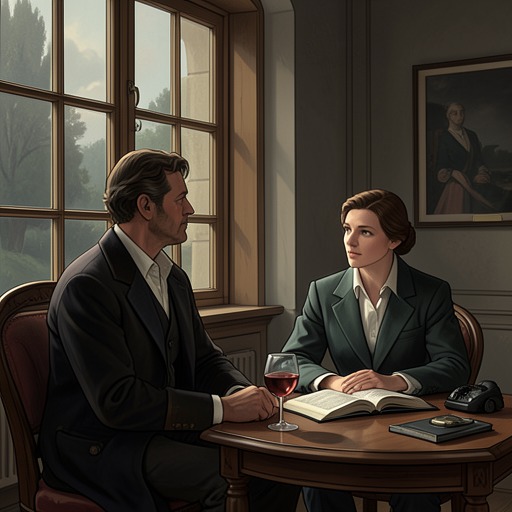
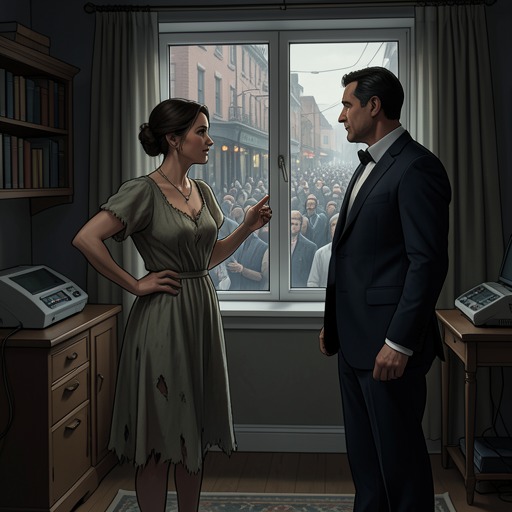
Oskar appears through Hana’s account of their life together and through other people’s letters. Hana refers to him as her husband while speaking to Viktor Landauer, making her Jewish husband’s identity central to a confrontation in the Glass Room. His own voice is not heard in that exchange; instead, the statement exposes the gulf between the room’s ideal of rational order and the political reality threatening their household.
A later letter from Hana describes the daily deterioration of his circumstances. Oskar had always liked to wear a buttonhole—a rose or a carnation—but flowers had become impossible to find. The only substitute available was a poor imitation of the Star of Bethlehem made from yellow cloth. He refuses to go out if he cannot dress properly, leaving Hana to do everything for him. The detail is at once intimate and coercive: a preference for a well-dressed appearance becomes entangled with the imposed mark of Jewish identity, while exclusion from public life is registered in the smallest routines of the home.
Persecution and the Yellow Star
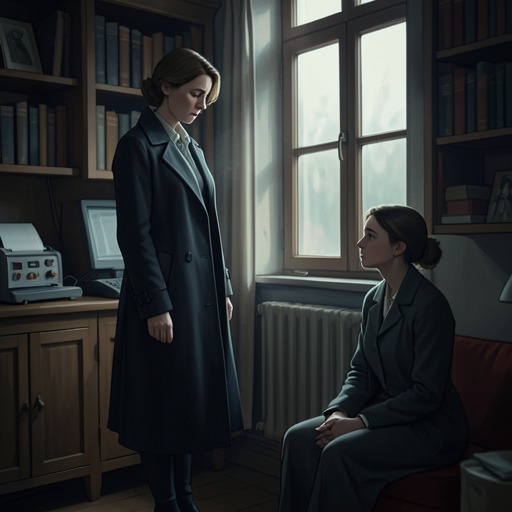
When Liesel Landauer reads Hana’s letter aloud to the children, she stops at the description of the yellow star and recognizes its significance from recent newspaper reports. The emblem is no longer an abstract political notice: Oskar now has to wear it. Ottilie asks whether her father would have had to wear one if they had remained at home, and Liesel answers yes. The exchange brings the danger close to the children’s displaced family, joining Oskar’s experience to the choices and losses that exile has imposed on the Landauers.
The letter does not describe a single arrest or public confrontation. Instead, it records the restrictions through their domestic consequences: Oskar stays inside, and Hana assumes the work he can no longer manage. The buttonhole gives the account its particular force. A rose or carnation once completed his clothes; the yellow cloth imitation is all that can be found, and its presence makes dressing properly inseparable from the persecution that has narrowed his life.
Arrest and Uncertain Fate
The later news of Oskar reaches Liesel through a letter that stresses its uncertain chain of transmission. The writer has heard the story fourth- or fifth-hand: Oskar and Hana have both been arrested, and Oskar, identified as Jewish, has been sent to Theresienstadt, where Jews are being gathered. The account offers no direct testimony from either of them and no certainty about Hana. Some reports place her in Germany, others in Austria, in what the letter describes as a kind of work camp; the writer cannot say more precisely.
The same letter reports that the Landauer House had been used as a scientific laboratory and now stands empty, in the authorities’ possession, though Laník and his sister look after it. The news of Oskar’s arrest therefore arrives within a wider account of dispossession and wartime uncertainty. A house, a marriage, and a family’s whereabouts all persist only as incomplete reports passed between people separated from home.
Narrative Role and Significance
Oskar’s story is conveyed through mediation: Hana’s letter, Liesel’s reading, a child’s question, and rumors repeated by someone who admits they are several tellings removed. That form keeps his fate from becoming a fully witnessed scene. The reader encounters not an explanation from Oskar but the diminishing possibilities available to those trying to speak about him: first his life is described through the absence of flowers, then his public isolation through the yellow star, and finally his arrest through uncertain news.
This withheld, fragmentary presence makes Oskar’s domestic detail carry historical weight without turning it into spectacle. His wish to dress properly remains recognizably personal, while the cloth star imposed on that ordinary wish exposes the power that has entered his home. The last report confirms that he has been sent to Theresienstadt, but it does not supply a later outcome. His narrative endpoint is therefore both specific and unresolved: arrest and deportation are reported, while what happened to him afterward is left unknown.