Ottilie Landauer
The Glass RoomOttilie Landauer’s life is shaped by two encounters with the Glass Room: as a child, she loses the family home and leaves Europe amid war and separation; decades later, she returns to that room as an adult and is recognized by Marie Delmas. Between those moments, she becomes a keeper of family memory and a companion to her mother, carrying the past not as an intact picture but as something that can unexpectedly become present again.
Identity and childhood
Ottilie is the daughter of Liesel and Viktor Landauer, and Martin’s sister. The family calls her Otti, while the children address their father as Tatínek. Her childhood belongs to the world of the Landauer House, but its security is already precarious when the Protectorate claims the property. At breakfast, she asks what has happened to the house; when Viktor explains that it is no longer theirs and now belongs to the Protectorate, she answers with anger: it is their house. Her protest is immediate and possessive, a child’s insistence on the simplest truth of belonging against a decree that has made that truth legally powerless.
The scene also shows how quickly the adult world’s political language enters family life. Ottilie asks whether the official who has taken the house is Hitler. Viktor distinguishes Hitler from his representative, but the distinction offers no comfort: the family has lost its home all the same. When Liesel asks whether there is any redress, the question remains open in the supplied scene, while Ottilie’s cry makes the human cost of the seizure plain.
From home to exile
Ottilie’s childhood is marked by the contrast between ordinary family talk and the escalating restrictions surrounding the family. Hearing that Oskar must wear a yellow star, she asks whether her father would have had to wear one if they had stayed at home, and then whether the children would have had to wear one too. Her questions turn an abstract discriminatory measure into a direct counterfactual about the family they might have remained: leaving has not erased the danger, but it has altered who must bear it and where.
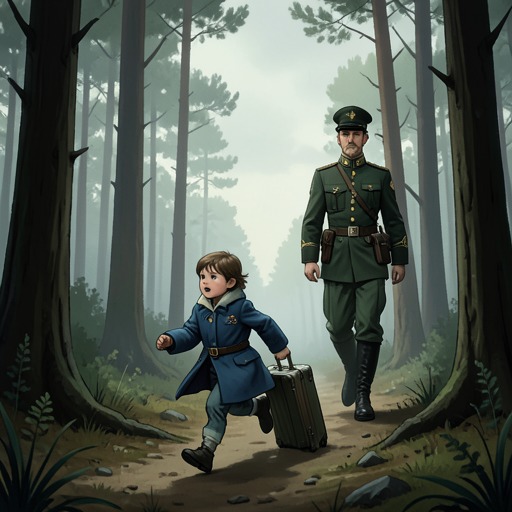
The family’s flight is experienced through practical details that make exile a physical condition rather than an abstraction. On the train, Ottilie asks whether they will all sleep together in the compartment. The six bunks, cases on the floor, missing restaurant car, and crowded corridors are far removed from the family’s former life. Martin tries to make the top bunk resemble camping, while Viktor acknowledges that nothing is as they are used to. Ottilie’s question seeks reassurance in the arrangement of bodies: at least, she hopes, the family will remain together.
That expectation is broken at the station when Katalin and Marika are held back. In the compartment, Martin cries; Ottilie tells him not to worry and calls the separation a procedural issue, although she does not know what the words mean. Their polished official sound briefly gives her something to hold on to. Outside, gulls seem to jeer above the family’s wait, while Liesel comforts both children and Viktor argues with officials. Liesel tells them that documents can be muddled and that their father will sort things out, even as she herself feels no assurance.
The train finally moves without Katalin and Marika. Ottilie cries out for Marika and asks her mother where she has gone, but there is no answer. The departure turns the earlier promise of traveling together into an irreversible separation at the moment the carriage begins to leave the station. Viktor, his face streaked with dried blood, asks Liesel what else he could have done; she looks away, enclosed by the compartment. For Ottilie, the journey is not only flight from danger but the loss of someone she expected to be beside her.
Memory and return
As an adult, Ottilie is part of the family’s deliberations over an invitation to witness the handover of the house in Město. Martin warns that accepting could amount to recognizing the city’s legal ownership. Their mother, now known as Mrs Landor, answers that the city does own the house in practice: they have not lived there since Martin was a little boy, thirty years earlier. The dispute brings the family’s old attachment into collision with the long fact of exile. Ottilie is not present in the quoted exchange about legal recognition, but she becomes central when a personal letter arrives.
The letter is from Auntie Hana. Ottilie recognizes its handwriting and is astonished; her mother, by contrast, thought Hana was dead. Ottilie reads Hana’s affectionate Czech words aloud and recalls the letters her mother used to receive in Switzerland. In this moment she acts as a bridge between the family’s obscured past and its living present: the correspondence makes a lost relationship tangible, and her recognition helps her mother understand that Hana may still be reachable.
Ottilie wants to travel with her mother. She is eager to see the country again and to meet Hana, whom she remembers as a distinctive presence, though her memories belong to childhood. She describes the distortion that time has made in those recollections: in memory, everything is the wrong size, and the house is huge. Her response places the return between two scales—the adult’s actual journey and the child’s remembered world. The house may be visited again, but the remembered house cannot simply be recovered unchanged.
Recognition in the Glass Room
Years later, Ottilie is with her mother when Liesel recognizes her by turning toward the place where she knows her daughter will be. The moment is grounded first in touch and familiarity: an embrace, a cheek against a cheek, and a hand extended to touch the people holding one another. Hana asks to look at Ottilie, as though placing the younger woman in perspective against the distant past. For Liesel, the reunion clears the curtain of time. She sees again the children on the terrace, Viktor in the library, Hana beside her in the garden, and, beyond them, Katalin arriving with Marika.
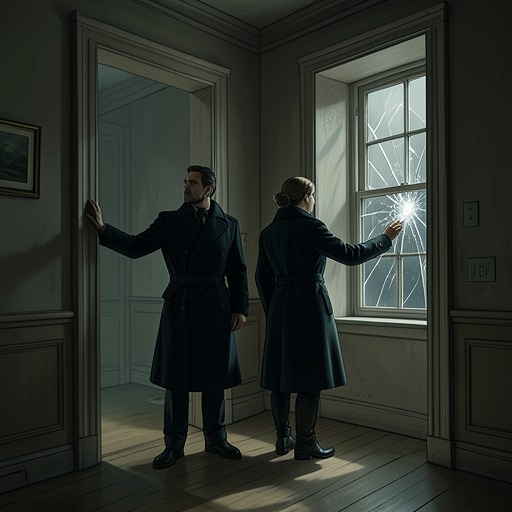
The adult Ottilie’s own return to the Glass Room completes a different act of recognition. Marie Delmas remembers having lived in the house before the war, when her mother was a nanny and there were children there. When Ottilie and Martin are named, Marie responds with surprise; when Marika’s name is raised, the American woman identifies herself as Ottilie. The recognition seems impossible to Marie because the Ottilie she remembers is a twelve-year-old child fixed in the past. Yet the weather-beaten, older woman insists on her identity, laughing and crying as she takes Marie’s hands. Around them, the Glass Room is described as a place that seems to deny time. The encounter gives that architectural impression human form: a childhood identity preserved in another person’s memory meets the adult who has lived beyond it.
Family continuity and narrative role
The family’s life in exile continues through changes of name, citizenship, and place. Liesel’s account says that Viktor died in a boating accident in 1958, after the family had settled in the United States and become American citizens in 1948. The family changed its surname from Landauer to Landor because the original seemed difficult for Americans to spell. Viktor established Landor Marine in Falmouth, and Liesel says she lives there with Ottilie, who is an angel to her. Ottilie has a son, Charlie, born after Viktor’s death, and Liesel is a grandmother. These details locate Ottilie in a later family life formed after displacement, while also emphasizing what the change cannot restore: Viktor never knew his grandson.
Ottilie’s narrative importance lies in the way she connects childhood loss to adult recognition without making the intervening decades disappear. As a child, she protests that the house belongs to the family, tries to reassure Martin when their companions are detained, and asks where Marika has gone as the train pulls away. As an adult, she helps recover Hana’s letter, chooses to return, and is recognized by Marie as the child who once belonged to the house. Her memory is incomplete and altered by time, but it is also relational: others remember her, and through those memories the lost house and the people associated with it become present again.