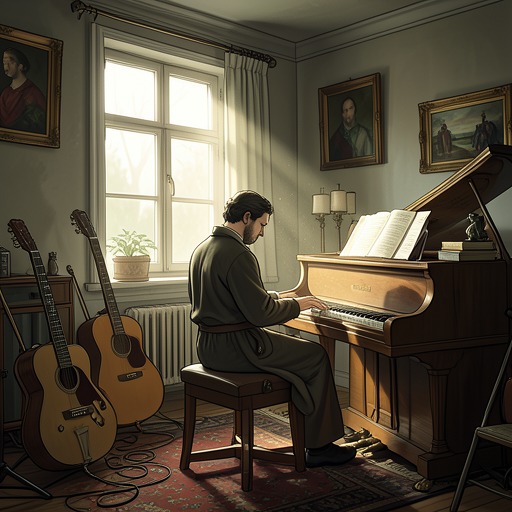
Pavel Haas
The Glass RoomPavel Haas is a Jewish composer whose absence from a concert becomes more eloquent than an appearance could have been. Through a speech by his friend Miroslav Němec and Hana’s explanation of why Haas is missing, the novel makes his exclusion a personal fact within a public culture of antisemitism; later, a confrontation over Felix Mendelssohn’s music echoes the same effort to judge art through the identity of its creator.
Identity and Introduction
Haas enters the narrative not in person but as the name that survives a speech. Miroslav Němec walks onto a concert stage and stands beside the piano’s black, coffin-like case, under spotlights that make the scene resemble an interrogation. He addresses the audience in Czech; Werner Stahl, who is present with Hana, understands little beyond the name Pavel Haas. The staging sets music beside a conspicuous absence: the person named is not there to speak for himself.
When Stahl asks what the speech meant, Hana reports that Němec said he was ashamed of his name. She explains the wordplay: Němec means German, so his name makes him, in effect, Miroslav German. The joke carries a serious burden. Němec’s public shame is tied to a German identity at a moment when German power and antisemitic exclusion shape who can appear on stage and who cannot.
The Concert and Haas’s Absence
Němec’s speech also tells the audience that his friend, the composer Pavel Haas, cannot be present, and asks that they think of him. Stahl’s question about Haas’s absence receives Hana’s concise answer: he is a Jew. The explanation is not elaborated into biography or a full account of Haas’s circumstances; its force comes from the abruptness with which Jewish identity explains exclusion from this gathering.
The concert proceeds with Němec sitting down to play and silence falling again. At its end, Hana and Stahl leave before the applause for the final piece has finished. In the square outside, ranks of policemen and army lorries filled with troops turn the concert’s appeal to collective feeling into an encounter with visible military power. The audience streams out with thoughts of national redemption and collective shame, while Hana and Stahl stand uncertainly about one another’s motives. Haas has no stage presence, but his absence connects the cultural event to the coercive world waiting beyond it.
Music, Jewish Identity, and Power
A later scene at the biometric research centre returns to the question of whether a composer’s Jewishness changes the standing of his music. Reinhard Heydrich opens the piano and plays the beginning of Spring from Felix Mendelssohn’s Songs Without Words. When Heydrich asks whether Werner Stahl plays Mendelssohn, Stahl says that he does not, because Mendelssohn was Jewish. Heydrich responds by asking whether being Jewish makes the music any worse and remarks that he could have tested it by playing Mendelssohn with Stahl on his violin.
Haas and Mendelssohn are not conflated: the narrative gives them different roles in different scenes. But the echo is pointed. At the concert, Hana identifies Haas’s Jewishness as the reason he is absent; in Heydrich’s presence, Jewishness becomes the stated reason to reject Mendelssohn’s music. Heydrich’s question briefly exposes the prejudice embedded in Stahl’s answer, even as the encounter remains an exercise of power: after the musical exchange, he tells Stahl to show him the measuring methods. Art, identity, and racial classification occupy the same room without becoming equivalent.
Narrative Significance
Haas’s characterization is deliberately mediated through other people. The reader learns of his friendship with Němec, his work as a composer, his Jewish identity, and his inability to attend, but receives no direct speech or account of his fate. That narrow presentation makes the request to think of him an act of public remembrance rather than a substitute biography. His name is spoken in a concert hall, then linked to a question the scene cannot resolve: who is permitted to participate in cultural life when persecution governs public presence?
The novel’s contrast between applause and the troops outside prevents the concert from functioning as a self-contained gesture of resistance or redemption. Its appeal to remember Haas persists alongside the uneasy departure, the police presence, and the later exchange about Mendelssohn. Across these scenes, music is neither protected from political violence nor simply reduced to it. Haas’s absence gives that tension a human focus: a composer is remembered by name, while the reason he is missing is stated with chilling economy.