Refugees' lack of documents and unstable status
The Glass RoomRefugees' lack of documents and unstable status turns flight into a chain of uncertain permissions. In the novel, papers are not merely records of identity: they determine who may cross a border, who can secure assistance, and whether a mother and child can remain together. Katalin and Marika’s passage from displacement to temporary refuge, and then into danger again, shows how practical aid can make movement possible without making anyone secure.
Displacement and the value of papers
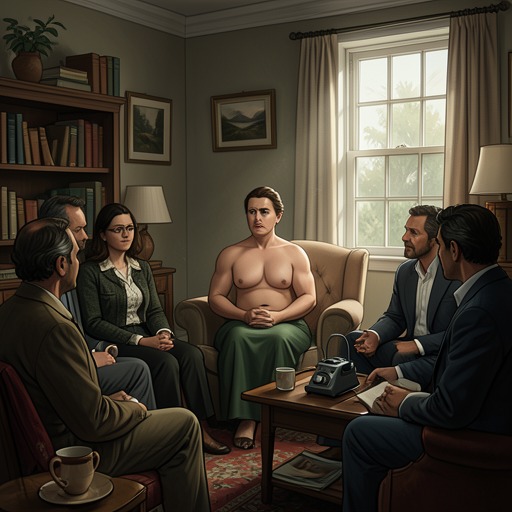
At the Glass Room committee meeting, refugees are brought before an audience as though they were performers, exposed to people who are deciding what the government should do. Among them are a middle-aged couple and their children, and a widow with her daughter, Marika. Katalin is identified as a seamstress who can find work only intermittently. She explains that she had money in the bank, but fears it is gone; the scene presents the loss of financial resources alongside the uncertainty of legal status. Her voice is quiet and clear, but her circumstances are being discussed in a room where others hold the power to assess and assist her.
Later, when Viktor visits Katalin, she makes the documentary problem explicit: Marika has a birth certificate, but Katalin herself has no papers. Viktor proposes seeking documents for people without them through the refugee office. He also tells her that a Nansen passport may be available and that he has already spoken in Prague with people who can help, including the Human Rights League. His aid offers a route out of immediate uncertainty, but the exchange makes clear that refugee status has to be actively assembled through institutions and intermediaries; it is not secured simply by being displaced or by having a child with documented identity.
Aid, employment, and unequal security
Viktor’s assistance is entangled with the Landauer household’s own needs. When Liesel tells him that Liba, the children’s nanny, is leaving to join her fiancé, she raises the possibility of Katalin taking her place. Liesel points to the children’s affection for Katalin and Marika, and to Katalin’s ability as a mother. The proposed arrangement offers Katalin a position within a household as well as a possible means of refuge, but it also makes the family’s help dependent on domestic work and personal relationships.
The arrangement is shaped by inequalities of class and security. Katalin tells Liesel that she had once accepted money from Viktor because she could not always find work, pay rent, secure somewhere to sleep, or buy clothes for her baby. She refuses to treat that survival choice as a source of shame. Her explanation gives economic precarity its concrete stakes: the lack of reliable income threatens shelter and the care of a child, while those who have never had to worry about their next meal can mistake dependence for a personal failing.
The novel also distinguishes Katalin’s precariousness from the cultivated social world of the Landauers and their friends. Liesel recognizes that Katalin does not share the same education and cultural reference points, yet says they get on well. In exile, the women shop together in Zurich, take a steamer trip on the lake with the children, and spend time swimming. These scenes show companionship developing across differences, but they do not erase the uneven resources that brought Katalin into the Landauers’ orbit or the fact that her freedom to move depends on documents others help arrange.
Crossing borders: permission without certainty
At the departure from Město, Katalin and Marika are traveling with Nansen passports. Their papers are checked at the aircraft doorway and returned without incident, while Hana, who has no passport, explains that she and the others are the people left behind. The contrast makes documentation a dividing line within a circle of friends: the Landauer family can leave with Katalin and Marika, but Hana cannot accompany them. The passports enable one departure, though they do not promise lasting security.
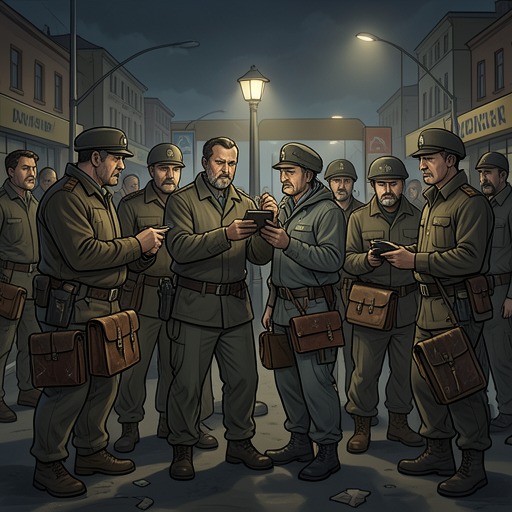
That distinction becomes stark during the later train journey. At a border checkpoint, officials inspect the passengers’ documents and tickets; Viktor presents papers for himself, Liesel, their two children, the nanny, and her daughter. When Katalin is questioned, her refugee passport and visas are examined, yet an official takes her by the elbow and leads her away. Marika cries for her mother. Liesel keeps the child close and tells the officials that Marika is with the family and that they will look after her.
Viktor protests that Katalin’s papers are in order and that her Nansen passport had been accepted for entry into France and was valid for Spain. The official tells him to return to the train or risk detention. He urges Viktor to move on, suggesting that the separation may only be temporary, but offers no assurance. Soldiers push the family back toward the carriage and take Katalin and Marika’s suitcases. The moment exposes the gap between formal documentation and effective protection: the same papers that had enabled travel cannot prevent officials from detaining their holders at a new checkpoint.
Unstable freedom and the border’s power
The novel presents borders as newly imposed obstacles as well as places of immediate human consequence. On his return from Vienna, Rainer remarks that passport control now exists where previously there had been no border control. Liesel answers that change has brought some losses of freedom alongside freedoms gained. His question about whether she herself is free gives that exchange a personal edge, while the conversation also frames mobility as a political condition rather than a simple matter of distance.
Across Katalin’s story, the meaning of a document changes with each encounter. Her lack of papers first makes her dependent on the refugee office and on Viktor’s contacts; a Nansen passport then allows her and Marika to leave with the Landauers; later, officials’ discretion makes that apparent permission fragile. The episode does not resolve their detention in the evidence presented here. Instead, it ends with the family pushed back onto the train, separated from Katalin and Marika, and left to wait on an official’s uncertain suggestion that the delay might be temporary. Legal identity thus appears as both a possible instrument of rescue and a vulnerability exposed to the border’s power.