Sudetenland
The Glass RoomThe Sudetenland is the border region at the center of the novel’s gathering political crisis, where the Sudeten German Party’s demands and German military pressure make invasion seem imminent. For Viktor Landauer, the region is not a distant diplomatic question: its upheaval forecasts the danger to his family, business, and home. Its eventual separation from Czechoslovakia is presented as part of a violent dismemberment that produces refugees before war has formally begun, making the borderlands a place where political decisions are experienced as threatened movement, lost security, and the breaking apart of a country.
The border crisis and Viktor’s response
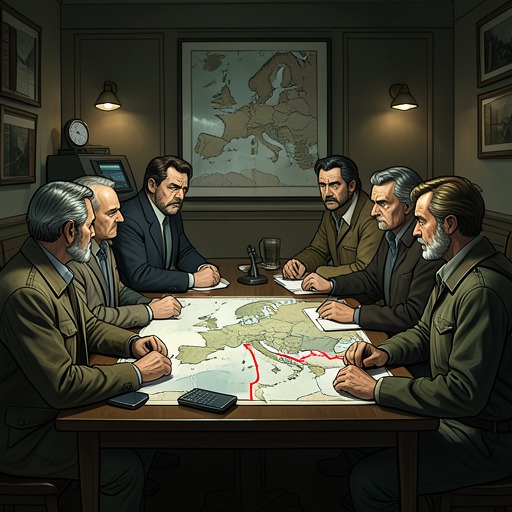
Viktor warns that the border territories are already showing what may happen next. He rejects the idea that the danger can be left to chance, arguing that the family should make plans in case of war and invasion. As the Sudeten German Party makes what he calls absurd demands and the Hitler government encourages them, he sees German troops massing at the frontier and fears that conflict may come within days. His attempt to persuade Liesel to take the danger seriously exposes a divide between his political alarm and her relative inattention to the news.
His analysis becomes more specific when he explains the dilemma facing the Czechoslovak government. He believes Henlein has made a secret pact with Hitler and is demanding self-rule for the border regions. If the government grants the demand, Viktor fears Henlein will invite German forces in; if it refuses, he expects Germany to use alleged oppression of the Sudeten Germans as a pretext for invasion. In his view, either course leads to German intervention, as in Austria. He is not proposing an immediate departure in this conversation, but says he is already making arrangements so the family will be prepared.
A threatened home and a divided attention
The crisis reaches into the Landauers’ ordinary life as well as their political conversations. That summer, the Czechoslovak army becomes Landauer Motors’ largest customer, commissioning military vehicles: the Popular is adapted for army use, and one production line is converted to make lorries. The family nevertheless keeps its customary holiday at Marienbad, staying at the Hotel Fürstenhof. The resort’s familiar promenades and music briefly sustain an illusion that the settled world of the past might continue, even as calls for Anschluss appear as graffiti and the flags over the spa gardens display the colours of the Sudetenland.
The threat becomes visible on the road to the monastery at Teplá, where the Landauer party encounters a column of army trucks heading toward the border. Martin asks his father whether they are going to fight. The question brings the military crisis into the family’s shared holiday: the future that Viktor has tried to explain is now passing before his child’s eyes, while the adults’ surroundings still offer the appearance of an undisturbed summer.
Dismemberment and displacement
The novel widens the consequences beyond the Landauers. It describes the autumn partition of Czechoslovakia as the dismemberment of a body, contrasting a deliberate, calculated operation with a frenzied attack but emphasizing that both leave the same result. The Czechoslovak army stands down as German forces enter towns including Eger, Karlsbad, Teplitz, and Liberec. Poland takes part of Czech Silesia, and Hungary takes parts of Slovakia. The Sudetenland crisis is therefore set within a wider dismantling of the state, carried out by several powers rather than confined to a single border dispute.
Refugees flee ahead of advancing troops, travelling along roads and across fields with handcarts and bundles, while trains fill and roads crowd. The narration calls this the effect of war without the fighting, a rehearsal for what is to come. By the end of autumn, the Republic of Czechoslovakia has ceased to exist, replaced by a short-lived, hyphenated CzechoSlovakia. The account makes the political consequence inseparable from its human one: territorial decisions redraw the map, while ordinary people are forced to move through the spaces those decisions leave behind.
The border as a mechanism of exclusion
Later episodes make the consequences of new borders concrete through the Landauers’ journey. At a station, German officials inspect the family’s documents and tickets, and the uncertainty of passage spreads through the waiting passengers. Viktor lays out passports and French transit and Spanish visas for himself, Liesel, their children, their nanny, and her daughter. Yet a document check does not ensure that the whole group can continue: Katalin and Marika are taken away for further examination despite Viktor’s insistence that Katalin’s refugee passport is valid.
The official tells Viktor to return to the train and warns that he too may be detained if he does not move back. He protests that the papers had been accepted for entry into France and are valid for Spain, but the crowd presses onward, anxious not to draw attention or become the next group removed. The episode turns the political remaking of borders into a personal test administered through papers, uniforms, and discretionary authority. The Sudetenland crisis thus belongs not only to the history of territorial loss but also to the novel’s account of how changing borders can make safety provisional and separate people who had travelled together.