The eternal present
The Glass RoomThe eternal present is Tomáš’s philosophy that time consists only of an unbroken now, while past and future are illusions. It gives his attention a precise, recurring setting in the hospital’s Glass Room: a cigarette, the city beyond the window, Zdenka moving among the children. But the apparent serenity has a cost. By treating the future as unreal, Tomáš can set aside both suffering and responsibility; when Zdenka asks what will become of them, his philosophy leaves him cold where she needs him to be loving and committed.
A philosophy anchored in the Glass Room
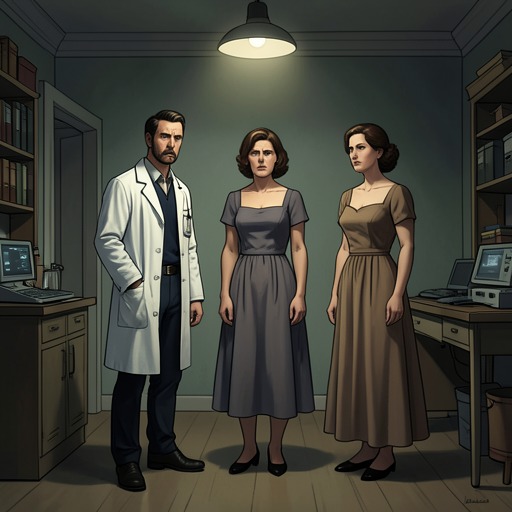
Tomáš is a paediatrician at the children’s hospital, but the narrative locates a philosopher at the hard core of his mind. While Zdenka leads the children through their exercises, he stands at the window smoking and looking out over the city. The present, for him, is not an abstract point in a theory of time: it is this view, this cigarette, and Zdenka’s milky reflection as she urges the children onward. The passage makes a philosophical proposition out of the scene’s immediate particulars, as though attention could hold the moment in place.
The room matters because it returns as the setting in which Tomáš can most completely inhabit that belief. He calls the hospital gymnasium the Glass Room, and imagines remaining there forever at the pinnacle of time, without either past or future. The ideal is not simply freedom from memory: it is attachment to a narrowly bounded present, composed of the open window, the view, and the cigarette. Its stillness depends on excluding what might disturb it.
The future as suffering
Tomáš’s rejection of the future touches the lives of the children exercising behind him. They are polio victims whose limbs are described as twigs and sticks, their hospital faces pale. At the hospital down the road, Alenka lies in an iron lung. Her future may mean machinery breathing for her, other people feeding her, and a world seen inverted in a mirror. Tomáš recognizes the irony of her name: Alenka is Alice, whose life will be lived through a looking glass.
He imagines that if there is no future, Alenka’s life ought to be more bearable. The thought reveals both the appeal and the limitation of his philosophy. The eternal present can be imagined as relief from anticipating a life shaped by illness and dependence, but it does not alter Alenka’s circumstances. Tomáš’s response makes time itself, rather than the machinery or the body, the object he can mentally set aside. His doctrine offers a form of consolation by refusing the prospect of what cannot be remedied.
Regulations and the maternal image
The philosophy also governs his response to ordinary rules. When Tomáš lights a cigarette in the Glass Room, Zdenka tells him that smoking there is against regulations. He lets the smoke out through an opened window, then treats regulations as an attempt to control the future. If everyone lived in an eternal present, he argues, regulations would be powerless. Zdenka answers with an impatient sigh and warns that he will get himself into trouble one day. Their exchange places his abstract resistance beside her practical awareness of consequences: he sees rules as projections into a nonexistent future, while she expects his conduct to have effects.
Their relationship further complicates the boundary between present intimacy and imagined time. Zdenka is slight, five foot three, with the body of a dancer, yet Tomáš imagines her giving birth to him. When he touches her intimately, she becomes in his imagination both mother and lover. His own mother died during the war, and the paired image of mother and lover gives their intimacy a private, startling symbolism. Yet imagining Zdenka in a maternal role does not mean that Tomáš accepts the future she later describes: the image remains something he experiences in the present, not a commitment to become a father.
Paris and the collapse of intimacy
After their five days in Paris, the present becomes a fault line between Tomáš and Zdenka. He thinks of Paris as already past and returns mentally to the Glass Room, which he calls not only the eternal present but also Glass Tranquillity. When Zdenka asks what will happen to them, he questions the word now, insisting that now is all there is. In his view, a thing can be spoken of only in contrast with other things; even a white canvas with a white square, the example he invokes through the Russian painter Malevich, depends on a distinction.
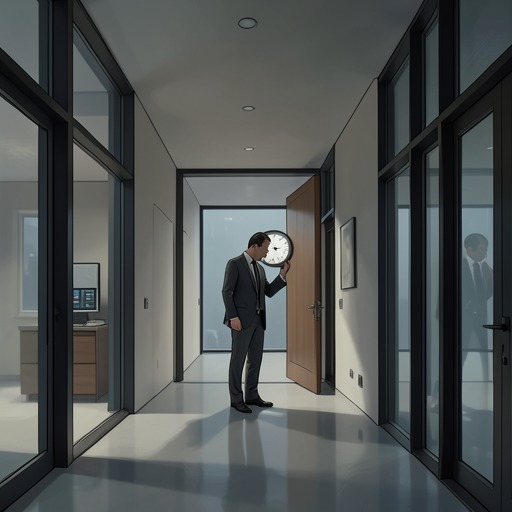
Tomáš tries to make the room itself an answer. He points to its bare space, chromium pillars, white walls, cream floor, curved wooden panels around the individual-treatment area, and the patterned stone wall—the room’s sole irregularity. He proposes making love there because it has no points of reference, memories, or illusions. Zdenka weeps. The carefully described room, which promises Tomáš a present without context, cannot make the relationship feel equally self-contained to her.
She tells him that in Paris he was warm and loving, whereas here he is cold, and that she wants the loving version of him. She suspects there is another woman and that he keeps her uncertain because of it; Tomáš dismisses the suspicion as absurd. Their first argument follows. Zdenka speaks of a future in which she becomes a mother and he a father, they join the housing list and make a home, and they grow old together. Tomáš says there is no future. What he experiences as freedom from illusion, she hears as the absence of any shared prospect.
A present that cannot answer
Zdenka proposes that they take a break, spend time apart, and gain perspective on what each wants. To Tomáš, this is an unbelievable way to lose Ondine: not through the terrifying curse he imagines, but through a commonplace discussion of commitments and obligations. The contrast shows how thoroughly he has turned away from ordinary temporal consequences. He can imagine a mythic loss, but resists the practical language through which Zdenka tries to describe the relationship’s possible end.
They continue to speak by telephone, exchange words at the hospital, and eventually meet for a drink. As Paris recedes, each remembers it differently: Tomáš recalls a visit to the Panthéon that Zdenka denies, while she insists they visited a market on the Île de la Cité, with tropical fish, caged birds, mice, and a sleek rat—an episode he cannot recall. They laugh at the discrepancy. For Tomáš, however, their incompatible memories support his belief that memory and imagination are alike. His account of the present is thus sustained not by a shared, stable past but by his willingness to treat recollection as uncertain.
The eternal present remains both a distinctive way of seeing and a means of refusing what other people ask of him. It makes the Glass Room seem complete: window, smoke, city, and Zdenka in motion. But the room cannot erase the difference between Tomáš’s wish to remain outside time and Zdenka’s desire for a home, children, and a life that continues. The philosophy that steadies his attention also exposes the limit of his intimacy: he can name the present, but he cannot use it to promise a future.