The illusion of scientific objectivity
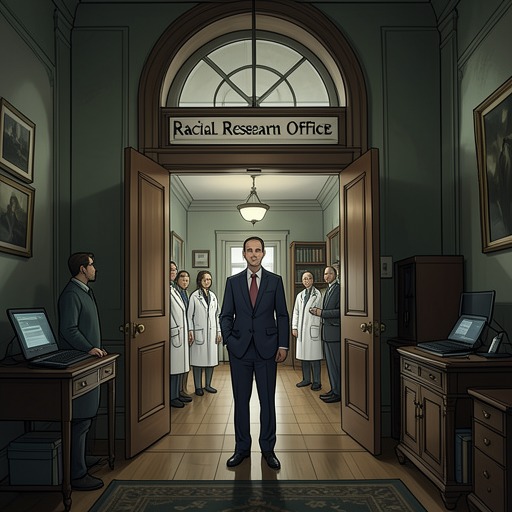
The Glass RoomThe illusion of scientific objectivity takes institutional form in the biometric centre installed in Landauer House: an orderly sequence of forms, tests, measurements, photographs, and records presented as dispassionate inquiry. Its language promises precision and confidentiality, but its racial categories are politically charged, its procedures reduce people to data, and its own director’s attention reveals how little the measurements can contain. The centre’s authority rests not on neutrality but on the appearance of neutral method.
The Performance of Scientific Neutrality
The centre’s director, Stahl, instructs his researchers to regard themselves first and foremost as scientists. He casts their work as a pioneering effort at the frontiers of knowledge, even as he links the advance of science to the advance of the German Reich. The contradiction is present from the outset: scientific discovery is presented as a universal pursuit while being placed in the service of a racial and imperial project. Calling the work delicate and emphasizing professional comportment does not remove its political purpose; it helps furnish that purpose with a respectable institutional language.
That language governs the treatment of the people brought to the centre. Groups arrive by bus, generally a dozen at a time, divided by sex and approximate age. Soldiers watch at the gate, but staff guide the visitors inside with quiet, polite instructions rather than visible violence. Stahl’s analogy is that zoologists treat animals respectfully and anthropologists should show the same respect to human subjects. The comparison is revealing: courtesy is made a substitute for recognizing the visitors as people with authority over what is being done to them. Their calm reception does not make the process voluntary or neutral; it makes classification appear routine.
Turning People into Records
The examination begins with a form that requests a person’s birth date and birthplace, languages, religion, race, and nation. It also records diseases and conditions attributed to the family line, including alcoholism, criminality, and mental retardation. The form’s tidy fields make unlike kinds of information look commensurable: a language, a religious identity, a diagnosis, and a racial label can all be entered as data. Calling the records confidential and insisting that the work serves pure science presents the collection as benign, while the categories themselves place the subjects within a racial scheme.
The subjects then complete tests matching shapes, finishing sequences, and identifying patterns. In medical gowns, they give blood through a needleprick and have their blood pressure measured. The bodily examination proceeds through carefully divided tasks: one staff member positions the subject while another records the result. At the stadiometer, the subject’s heels, buttocks, and shoulder blades are placed against the backboard; the head is held and the chin aligned. The examiner kneels, adjusts, and cajoles until the pose meets the standard. Height, hip and chest diameters, leg and arm measurements, and head dimensions are recorded. Skin tone is compared with a von Luschan chart, while eye colour is matched against rows of model eyes. The procedure’s exactness depends on turning a living body into a reproducible arrangement for measurement.
Photography extends that conversion from measurements to images. In the dining area, lights and drapes turn the curved Macassar-panelled space into a studio, with a Rolleiflex camera ready on a tripod. After the examination, subjects are told to remove their gowns for photographs and reassured that the process is scientific and the records confidential. Meanwhile, curtains divide the Glass Room into sections, and the former home’s rooms have become offices, a laboratory, and an X-ray room. Only the Bösendorfer piano remains from the house’s previous life. The physical transformation makes the point with particular force: a domestic space is reorganized as machinery for examining, recording, and classifying its occupants and visitors.
Exact Measurement, Inadequate Knowledge
The narrative calls the method’s promise “Precision, the cool gaze of scientific objectivity.” Yet the phrase’s composure sits beside the physical intrusiveness of the examination and the subjects’ anxious faces. Standardization can make a measurement repeatable; it cannot establish that the resulting categories describe an essential human identity. The procedures lend the centre an air of disciplined certainty, but their apparent objectivity depends on decisions about which characteristics count, how they are measured, and what conclusions those measurements are supposed to authorize.
Stahl’s attention to Hana Hanáková brings the limits of the method into view. In his ordinary dealings with subjects, he expects them to yield to medical authority, as patients might submit to treatment when anxious about illness. Hana is different in his estimation: distrustful, sardonic, and intelligent. He assures her of his discretion, but she answers that discretion may not be what she wants. Her response unsettles the institutional script. The researcher’s promise of confidentiality cannot settle the question of what the research is for, nor does his professional assurance make her trust him.
Afterward, the file reduces Hana to centimetres, kilograms, cranial and facial indices, eye and hair colour, and features such as attached earlobes and a widow’s peak. The catalogue is designed to make each subject one item among thousands, a unit in a statistical total. But the form contains nothing that gives the essence of the woman. Her photograph seems to return a faint smile from the glossy surface, as though the moment of exposure has become an encounter across time: Stahl is no longer simply looking at a specimen but looking at a particular person whose expression exceeds the file’s classifications.
He compares Hana with Hedda, contrasting the features he identifies as Slav with those he identifies as Nordic. He wonders whether measurements such as Hana’s cranial index of 88.3 and facial index of 83.5 can account for the distinction he insists on seeing. His attention wanders from indices to remembered scent, and from scent to the possibility that race might be identifiable through chemistry. The sequence exposes a desire to make the categories total: when visible features do not settle racial identity, he imagines another scientific measure might. His speculation does not confirm the racial scheme; it shows how readily uncertainty becomes an invitation to extend it.
Classification and Its Political Use
The centre’s administrative output gives the project a scale beyond the examination room. In one monthly return, Stahl sees 672 people assessed: 316 classified as Slav, 239 as Aryan, and 112 as Mischlinge of various degrees, with Roma and Jews accounted for separately in an addendum. The totals give the impression of comprehensive knowledge, but they are products of prior decisions about identity and classification. A separate report celebrates the processing of 193 Roma, aged thirteen to eighty-seven. These figures make clear that the scheme’s reach is not confined to individual cases: people are sorted into populations and rendered legible to an administration.
The records move onward as punched cards. Duplicated and boxed for a courier to Prague, they are then sent to Berlin, where machines sort, assemble, and analyze them at a rate of 150 cards per minute. The narrative’s language of patterns and correlations carries the promise that the data will reveal the keys to human race and identity. But the speed and volume of processing do not repair the weakness of the underlying categories. Mechanical efficiency can amplify a classification system without making its premises true. Here, the machinery lends the racial project the aura of mathematical inevitability.
During a visit, Reinhard Heydrich asks whether Jewish diseases are what the researchers have been looking for. Stahl names inherited conditions, including Sachs’s infantile amaurotic idiocy, and describes Jews as a degenerate race. He then qualifies the claim: not all Jews have these diseases, and not everyone with them is Jewish. The qualification exposes a gap between the racial assertion and the evidence, but it does not end the inquiry. Stahl explains that the laboratory instead measures minute variations in phenotype and searches for combinations that might yield a racial diagnosis, with the Hollerith machines assigned to sort the collected data. When Heydrich looks around the Glass Room and remarks on the former Jewish owners, the setting joins the research to the seizure and repurposing of a home. Scientific procedure is not outside political power: it is being developed inside a house taken from the people its classifications target.
The Human Remainder
The centre’s recurring assurances—that the examination will cause no pain or discomfort, that the work is scientific, that the records are confidential—describe the process as a controlled encounter between neutral experts and compliant subjects. Yet the details show how the system works on bodies and lives: a sharp intake of breath at the needle, a head held in position, anxious eyes matched to chart samples, personal histories compressed into boxes on a form. Politeness and precision do not cancel the pressure of being examined under a classification system one did not design.
The contrast between the expansive ambition to discover racial identity and the limitations of the individual file is the concept’s central irony. Data can preserve a height, an index, a colour, a family history, and an image; it cannot make those fragments into an essence simply by arranging them in a catalogue. Hana’s file is at once a record of the centre’s method and evidence of what the method leaves out. The Glass Room’s transparency likewise offers no guarantee of truth: visibility, measurement, and documentation can serve concealment when their political assumptions pass as objective fact.