The wheel of fate motif
The Glass RoomThe wheel of fate motif gathers Viktor Landauer’s encounters with Kata around the great Ferris wheel in Vienna. First seen above the Prater, the wheel becomes more than a landmark: it binds the chance meeting that begins their attraction to the later rendezvous when they ride together again. Its circular motion gives Viktor an image for recurrence and consequence, while the affair makes that image intimate and morally charged.
First Encounter in Vienna
Viktor’s first meeting with Kata begins with an ordinary request for a light. He has paused in the Prater amid the fairground’s children, stallholders, and noise, with the Nordbahnhof and his train home ahead of him. Kata holds an unlit cigarette; her pale blue eyes seem almost transparent, and her grey cloche hat, short dark hair, and amber brooch make an impression that is at once precise and difficult for him to place. He guesses that she is a Slav, but the encounter offers no certainty about her identity or destination.
Kata’s manner appears impatient, as if she is hurrying to an appointment. After she lights her cigarette, she asks whether she can do anything for him. Viktor’s decision not to dismiss her and catch his train arises from several impulses together: curiosity, sexual attraction, the mystery of a stranger, and what he reads in her as youth and incongruous innocence. He proposes a ride on the wheel. Kata is startled by the suggestion and says she will not go up, while Viktor challenges her fear. The wheel thus enters the story at the point when a passing exchange turns into a choice to prolong their meeting.
The Wheel Returns
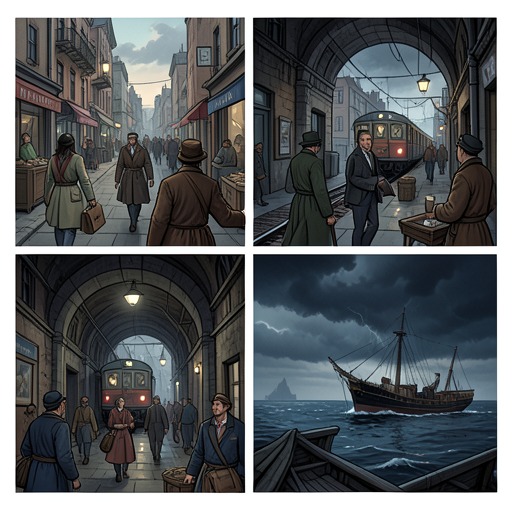
Months later, during an autumn visit to Vienna with Liesel to settle the interior of their new house, Viktor wonders whether he might see Kata at the Nordbahnhof, perhaps collecting her mail. He imagines the possibilities of such an encounter: a secretive smile, embarrassment and guilt, or disgust at his own susceptibility. None of these imagined outcomes occurs at the station. Vienna is vast, and his time in the Leopoldstadt is only temporary; nevertheless, as the taxi pulls away, the Riesenrad rises above them, turning slowly in the cool autumn air.
The wheel’s reappearance makes the city’s scale and Viktor’s private memory coexist in a single image. The visit is ostensibly devoted to practical decisions about the nearly completed house: wall coverings, flooring, and furniture discussed with Rainer von Abt and his assistant. A chair designed for Liesel is presented as an homage, while Viktor sits in the prototype Landauer chair. Against this domestic future, the wheel silently recalls the earlier encounter and the unresolved affair. The motif does not require Kata to appear in person; the sight of the wheel is enough to bring her back into Viktor’s thoughts.
Recurrence, Desire, and Guilt
When Viktor later meets Kata beneath the wheel, she is waiting in the crowd, a small bright figure in cheap clothes. Their greeting is a kiss, and her laughter carries something close to happiness. Viktor asks whether she received his note; she confirms that it brought her there. When he asks what they should do, Kata takes his hand and pulls him, protesting, towards the queue, asking whether he remembers their first ride.
The invitation converts recollection into action. The wheel is no longer merely the setting of an accidental meeting or a distant object glimpsed from a taxi: the lovers deliberately return to it, and Kata leads Viktor toward the ride he had once proposed. His memory is immediate. He thinks of the Riesenrad as a talisman, and whenever its arc appears above the city’s houses, he thinks of her. The association is personal before it becomes interpretive: the wheel’s visible recurrence summons the woman and the past attached to her.
Viktor names the image to himself as the wheel of fate, recognizing that its metaphor is obvious. That recognition does not make the affair impersonal or absolve him of responsibility. When Kata recalls how stern he seemed during their first meeting, believing she had done something wrong, Viktor answers that he is the one doing wrong. The wheel gathers together attraction and guilt: their renewed ride offers the pleasure of repeating an intimacy, but Viktor understands that the relationship violates obligations elsewhere in his life.
Narrative Significance
The motif’s force lies in the contrast between the wheel’s public visibility and the secrecy of Viktor and Kata’s relationship. It stands above the city, available to anyone who looks up, while the lovers’ meetings and Viktor’s choices remain private. In the first encounter, the wheel helps turn a chance interruption into a deliberate excursion; later, its appearance reactivates a memory even when Kata is absent; finally, the pair return to it together. Each recurrence changes the image’s charge without changing the wheel itself.
The wheel can suggest repetition, but the story does not present Viktor as trapped in a mechanical cycle. He repeatedly recognizes his agency: he chooses to stop for Kata, later imagines seeing her, and agrees to meet her beneath the familiar landmark. Calling the wheel a talisman or a figure of fate expresses how memory organizes his experience, not proof that fate has dictated his conduct. Its turning makes the past feel present, while Viktor’s admission of wrongdoing keeps the moral consequence of choice in view. The motif therefore joins chance, desire, recollection, and responsibility in a single recurring shape.