Treaty of Saint-Germain
The Glass RoomThe Treaty of Saint-Germain functions in The Glass Room as a political promise whose meaning changes with the fortunes of the states it helped shape. Liesel cites it against proposals to restore a monarchy, while Viktor treats the treaty system as a foundation for an independent, stable Czechoslovakia. When Nazi Germany annexes Austria, however, the treaty appears less like an enforceable safeguard than a rule that aggression can render powerless.
The Treaty as a Postwar Settlement
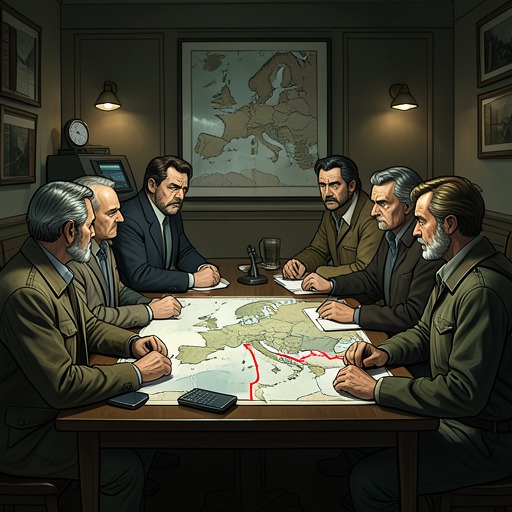
In a discussion at the Landauer home, Fritz Mandl dismisses the treaties as pieces of paper. Liesel counters that restoring a monarchy would violate the Treaty of Saint-Germain, which she connects to the postwar settlement created by the victorious powers as they formed countries from the wreckage of empires. The treaty thus represents more than a restriction on one political proposal: it belongs to the new national order that emerged after imperial collapse.
Viktor answers Mandl’s scorn by defending the country that order has made possible. The treaties, he argues, mean the creation of their own country and help ensure a stable democracy in the heart of Europe. His confidence rests on a distinction between an imperfect political reality and the more dangerous prospect of undoing the settlement. Yet the conversation takes place amid uncertainty, and the guests’ competing political hopes make clear that the treaty’s authority is already being contested.
A Law Without Effective Force
After Austria’s annexation, Viktor calls the act illegal and paces through the Glass Room with a newspaper, invoking both the Treaty of Saint-Germain and the Treaty of Versailles. His protest sounds impotent even to him. The agreements that had once seemed to govern the European order now feel remote, like historical documents belonging to another time and place. His question about what might happen next registers the practical consequence of the treaty’s failure: once aggression goes unanswered, further violations become imaginable.
The novel places this collapse of confidence beside the arrival of refugees fleeing across the southern border from Vienna and other cities. Viktor recognizes that legal protest does not shelter those forced from their homes. The Glass Room’s openness and abundance become a reproach because the refugees cannot find refuge there. The treaty’s diminished force is therefore measured not only in constitutional danger, but also in the human displacement unfolding around the Landauers.
Political Memory and the Limits of Guarantees
The treaty recurs as part of Viktor’s attempt to understand a rapidly changing Europe. Before Austria’s annexation, he speaks of the settlement as support for Czechoslovak democracy; afterward, he invokes it while recognizing that its language cannot stop a fait accompli. This contrast gives the treaty a double role: it is a legal foundation for national independence and a measure of the widening gap between international rules and political power.
The episode also frames the novel’s broader concern with the instability of home and belonging. A country established within a postwar settlement can still face the arrival of refugees, the threat of expansion, and the failure of protections on which its citizens rely. The Treaty of Saint-Germain remains important in the characters’ political reasoning, but the events surrounding Austria’s annexation show that a legal guarantee has no sheltering force by itself when those capable of enforcing it do not act.