Venice
The Glass RoomVenice is a recurring setting in the Landauers’ story: first a honeymoon city where Liesel and Viktor encounter competing visions of modernity and architectural space, and later the destination of a return trip that exposes a new distance between them. The city’s beauty and its buildings frame both their early intimacy and the effort to recover it after Ottilie’s birth.
Honeymoon and the city’s contested future
Liesel and Viktor spend three days in Venice on their own, visiting churches and palaces and exploring the calle and canals. Viktor photographs Liesel with his new Leica. The holiday’s historical setting becomes pointedly unsettled when they attend a party in an old palazzo on the Canal Grande. Under faded frescoes by pupils of Tiepolo, Venetian nobility mingle uneasily with young people who seem to embody a more dangerous modernity.
One of the guests speaks to Liesel in broken English about Fascism and the virtues of modernity, declaring that the old city and more besides will be swept away. His rhetoric echoes Viktor’s political enthusiasm for sweeping change, but its object is far more radical: not simply an old order, but Venice itself and the country’s artistic inheritance. Liesel recognizes the absurdity of a modernity that treats an entire storehouse of art and history as something to destroy. The episode makes the city more than a picturesque backdrop; it is where the promise of the new confronts the value of what has endured.
Architecture shown in the open
During the honeymoon, Rainer von Abt arranges a surprise meeting with the couple and takes them by water taxi to an exhibition. In a garden containing newly built pavilions and a monumental neoclassical building, they enter an exhibition space filled with designs and models. There, von Abt reveals his Austrian Pavilion project, identified on its display as a 1928 design.
The encounter connects Venice with the modernist architectural world in which von Abt works. His description of his work as visible in the full light of day contrasts with his earlier air of mystery, while the exhibition itself presents architecture through drawings, models, and viewers shifting their positions around them. Venice thus holds two different arguments about modernity at once: the destructive futurism voiced at the party and the architectural experiment made available for careful inspection.
Return after Ottilie’s birth
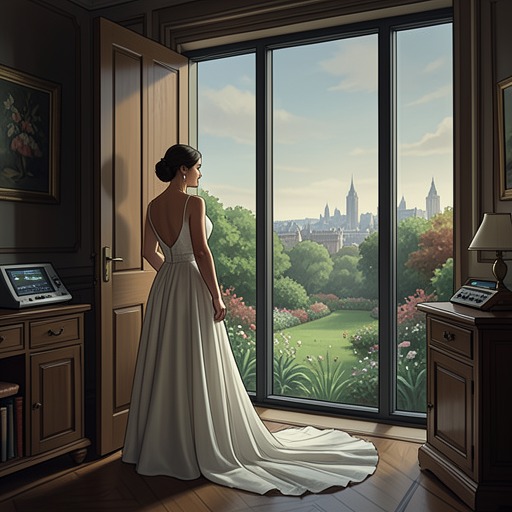
In the spring, Liesel and Viktor return to Venice for their first holiday alone since Ottilie’s birth. They stay at the same hotel and in the same suite as on their honeymoon. Their purpose is never openly stated, but the repetition of the place and room suggests an attempt to recover the past. The setting makes comparison unavoidable: what was once a beginning now serves as a test of whether their former intimacy can be resumed.
Beneath the surface of affection, however, the couple have become more remote. The narrative leaves the cause uncertain, allowing that the difficulties of Ottilie’s birth and Liesel’s subsequent illness may have contributed, or that distance in Viktor’s mind may matter even when he is physically close. Their sexual relationship, once marked by intense feeling in that same room, now seems to Liesel comparatively undisturbed. The return to Venice therefore does not restore the honeymoon; the familiar room gives the changed quality of their marriage a precise measure.
A city among changing uses
Across the novel’s wider history, Venice’s artistic inheritance resonates with the fate of the Landauer House. That house passes from a private family home to a biometric research centre, later a children’s gymnasium, and eventually a preserved architectural landmark. The contrast between these changing uses and Venice’s threatened artistic past sharpens the book’s concern with how buildings hold memories while remaining vulnerable to political and social appropriation.
Venice’s significance rests in this double role. It is a place of artistic and architectural history, where the desire to erase the past is made explicit, and a landscape of personal recollection, where returning to a familiar room exposes rather than reverses change. Its beauty does not guarantee preservation: neither a city’s inherited culture nor a couple’s earlier closeness can be recovered simply by returning to where they once encountered it.