Viktor's Jewish identity
The Glass RoomViktor's Jewish identity is not a late discovery of ancestry but an inherited fact he gradually learns to acknowledge—and that Nazi Germany turns into a legal and material threat. The story traces the distance between that recognition and the safety Viktor hopes the border will provide: laws that mark Jews as outsiders, a public challenge to his right to define himself, and the helplessness of his protest when officials remove Katalin. His identity brings into focus the collision between the Glass Room’s ideal of rational order and a world organized by racial classification.
Inheritance Made Visible
At breakfast, Liesel notices the newspaper Viktor is reading: Jewish doctors in Germany are being forbidden to treat non-Jewish patients. She initially treats the news as something distant, happening across the border in another country and another world, and reassures herself that it will blow over. Viktor does not answer. For him, distance does not make the story irrelevant: the restrictions are being imposed on fellow Jews at that very moment.
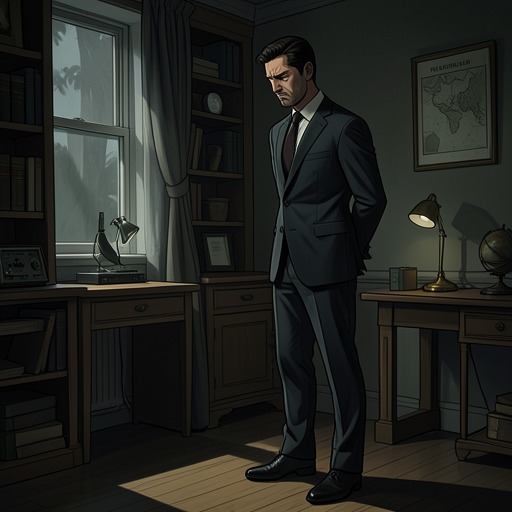
His silence registers a change that has developed over the years since the house was built. He has come to feel his Jewishness, not through an atavistic return to origins but through acceptance of inheritance, compared to a distinctive family trait such as a Habsburg lip. The comparison makes identity sound ordinary and involuntary; the social response makes it dangerous. Some people, including members of the Deutsches Haus, already mark him as a Jew. Now the German state has written that classification into law.
The consequences are concrete even when Viktor is not in Germany. There, he would have to rearrange the ownership and management of Landauerovy Závody so that only Aryans held executive posts or board seats. His family doctor, a gentile, could no longer treat the family. His marriage to Liesel would remain valid, but marriages of the same kind between Aryan and non-Aryan people would be illegal in future. Ottilie and Martin would be officially classified as Mischlinge, or half-breeds, and treated as lesser beings. The passage’s repeated conditional—what would happen if they were there—does not soften the danger. It exposes the imagined security of geography: the laws are already being made, and the category they impose already attaches to Viktor.
Refusing the Assigned Category
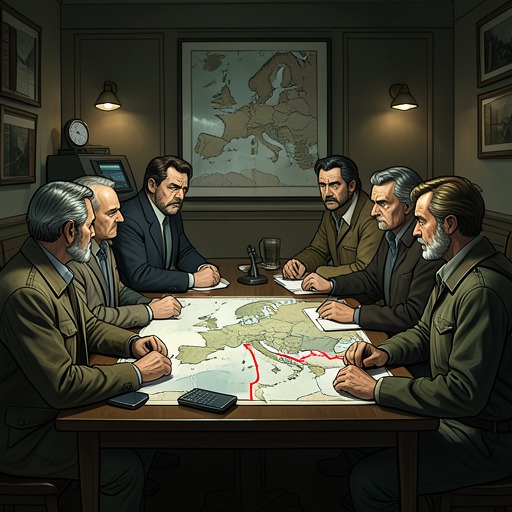
At a dinner-table exchange, Schreiber presents National Socialism as a duty to German blood and asks whether Czech Germans owe the same duty to their national culture. Viktor first asks whether Schreiber means that this duty applies to him too. When Schreiber answers that it applies to all Germans, Viktor rejects the premise: he is not a German, he says, but a Jew. The exchange makes his self-definition an answer to an attempt to claim him for a racial-national identity he refuses.
That refusal does not remove the power of the classification. Schreiber’s argument treats culture and ancestry as obligations that override democratic rights; the laws described earlier show what follows when such claims are made enforceable. Viktor’s distinction between being German and being Jewish is therefore both a personal declaration and a confrontation with a political language that insists it can assign belonging from outside.
The Glass Room and the Refugees
The problem of classification reappears in the Glass Room when a human-rights committee brings six refugees before its audience: a middle-aged couple with a ten-year-old boy and a fifteen-year-old girl whose spectacles have a cracked lens, and a woman with her young daughter. Their clothes are crumpled, as if they may have travelled through the night in a third-class railway compartment. The girl’s cracked glasses, the children’s shuffling entrance, and the adults’ exposure to the room’s gaze make their precarious circumstances visible before the committee has done anything to help them.
The room takes on the quality of an intimate theatre. The refugees are directed into position while the audience looks on, and the small girl blushes under its attention. The woman, whose pale eyes meet the spectators with faint disdain, is Katalin. For Viktor, the Glass Room embodies reason: proportion, dimension, balance, and the austere clarity of a classical temple or a Mondrian painting. Katalin’s presence a few feet away unsettles that composed ideal. The scene places the refugees’ actual vulnerability inside a space designed to make order seem transparent and complete.
The episode also complicates the idea that exposure is the same as understanding. The committee’s claim that the refugees’ story could be anybody’s story gives way to their physical presence before an audience; they are made visible, but also turned into a performance. The difference between humanitarian concern and the power to control another person’s appearance is written into the staging itself. Viktor’s identity belongs to this same problem: he is increasingly conscious that the labels imposed on people do not describe them neutrally but shape the treatment they can expect.
Private History and Public Vulnerability
When Liesel presses Katalin about her past with Viktor, Katalin admits that he helped her from time to time when she was living in Vienna and struggling to get by. She refuses to apologize for accepting money. She had to find somewhere to sleep, obtain her next meal, and buy clothes for her baby, while lacking work and being unable to afford rent. The account locates the earlier relationship in material need rather than reducing it to a simple question of shame. It also places Katalin’s vulnerability alongside Viktor’s increasingly dangerous public identity: both are exposed to conditions that cannot be captured by a polite account of choice alone.
In another confrontation, a woman asks whether the proposed solution to Jews is persecution. When the answer is that it is to isolate them, she explains that she is concerned because her husband is Jewish. The disclosure brings the policy into a marriage rather than leaving it as abstract political talk. The response is not reassurance: the exchange exposes how easily a discussion of isolation can deny the human relations that the category threatens to divide.
The Limits of Protection
At a checkpoint, Katalin presents her passport and visas while officials examine her documents. She watches with terrified eyes. Viktor says that she is in his employ, but the soldier politely tells him that he was not asked to speak and summons another official. After a brief consultation, a uniformed figure takes Katalin by the elbow and leads her toward a nearby hut. The speed of the decision makes the papers and the officials’ procedure more powerful than Viktor’s standing as employer.
Marika cries out for her mother. Liesel pulls the child close and tells her that she will be looked after. Viktor’s protest has failed to stop the removal; the scene ends with the child left with Liesel and Katalin taken away. It makes the stakes of identity and documentation immediate. The political power that classifies people is not only a distant law or an argument at dinner: it can separate a mother and daughter in a few moments, while those who try to help can offer comfort without being able to reverse the decision.
The arc of Viktor’s Jewish identity thus moves between recognition, declaration, and exposure to consequences. The house’s ordered geometry cannot reconcile the rational ideal it represents with laws that convert ancestry into a hierarchy of rights. Nor can Viktor’s money, employment, or public position guarantee safety for those caught in the same machinery of classification. His declaration that he is a Jew gives voice to what he has come to accept; the checkpoint shows how little control that declaration—or any other person’s—can exert once officials claim the power to decide who belongs and who may remain together.