Yevgeniya
The Glass RoomYevgeniya is a Soviet sergeant-major whose arrival at the Landauer home marks the transition from battle to occupation by the Red Army. Introduced through Laník’s alarmed perspective, she appears armed and in command; within the same encounter, she accepts his offered drink, exchanges names with him, and draws him into her company. Her brief presence makes the end of the fighting feel less like a return to safety than a change in who holds power in the house.
Identity and Arrival
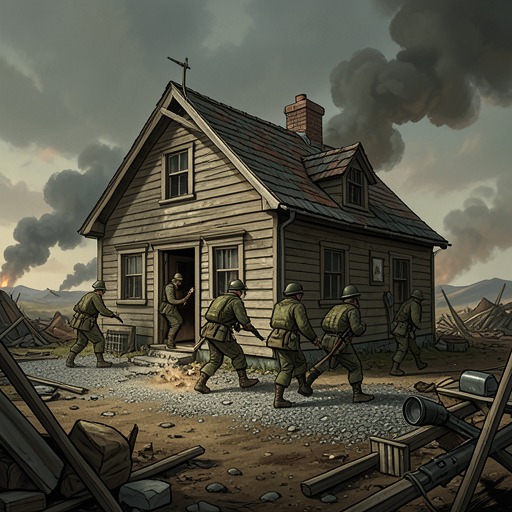
Yevgeniya appears at the front door while Laník cautiously investigates the sounds outside. She wears a green forage cap marked with a red star, a khaki blouse with medal ribbons, and the shoulder boards of a senior non-commissioned officer. A pistol is pointed at Laník, making her authority immediate and practical rather than ceremonial. Behind her are other Soviet soldiers and horses tethered at the railings: the household’s first view of the new force that has reached the city.
Laník tries to meet the armed stranger by offering a bottle to the victorious Red Army. Language initially obstructs the exchange, but they recognize shared words and the brandy helps establish a point of contact. Yevgeniya advances, embraces him, and kisses him on both cheeks before kissing him on the mouth. The gesture abruptly changes the encounter’s register: Laník has approached her as a frightened caretaker negotiating with soldiers, while she treats him as someone she has chosen for personal attention.
A Soldier’s History
Yevgeniya identifies her rank as sergeant-major. When Laník’s sister is mistaken for his wife, Laník corrects the misunderstanding, and Yevgeniya distinguishes the words for wife and sister. She tells him the names of places on the army’s route westward, from Rostov and Odessa through Bucharest, Budapest, and Bratislava, describing a long advance in which people die and others keep coming. She calls the journey patriotic duty, and Laník agrees while she holds his hand and nods as though the matter is settled.
Her account places her at the end of a vast military movement, but the narrative offers it through an improvised, uneven conversation rather than a formal history. The list of cities compresses distance into a spoken itinerary, while her remark about repeated deaths gives the advance a human cost. Yevgeniya is at once an individual who singles out Laník and a representative of an army whose arrival has carried its members across thousands of miles.
The Glass Room and Its New Occupants
Yevgeniya and the other soldiers move into the house. They bring weapons into the Glass Room, including machine guns, a mortar, grenade launchers, and rifles, and clean them there; oil marks the floor. The room that had embodied the Landauers’ carefully ordered domestic life is now a military workspace. Yevgeniya’s arrival thus belongs to a larger transformation of the house, in which its rooms acquire new uses under successive occupants.
After the soldiers finish, they eat together at the circular dining table by candlelight and toast political leaders, including Stalin, Churchill, Truman, and the recently deceased Roosevelt. An accordion accompanies dancing in the Glass Room. The scene combines the soldiers’ ordinary social rituals with the disorientation of their setting: the former center of a private household has become a place to sleep, maintain weapons, and celebrate. Yevgeniya’s place within this gathering is both commanding and convivial; she directs Laník to join her, and the soldiers’ laughter makes clear that the encounter has become a spectacle for them as well.
Laník and Yevgeniya
During the dance, Yevgeniya gives Laník her name and asks him to use it. She asks whether he is rich and owns the large house, then accepts his insistence that he is only the caretaker and a poor proletarian. She calls him a child of the revolution and holds him close. The exchange links his precarious position in the house to the new political order, but it also becomes a means by which she presses for greater intimacy.
When the evening ends, Yevgeniya first calls the soldiers to rest before the work ahead. Laník attempts to withdraw, but she catches his wrist and asks him to show the group the rooms. He leads the two other young women to a bedroom, then takes Yevgeniya into another. It had been Liesel Landauer’s room, once furnished with her dressing table, wardrobe, clothes, cosmetics, and jewellery; now only bare walls and a bedframe without a mattress remain. Yevgeniya’s choice of this room brings her encounter with Laník into direct contact with the absence of the former owner.
Yevgeniya tells Laník that she has killed many men but will not kill him. He laughs, although the remark is not funny to him. In the scene’s closing account, her physical hold leaves him feeling trapped and overwhelmed. The narrative does not present his response as a secure or mutual romance: military authority, her command of the situation, and his difficulty getting away all shape the encounter. The house has passed from a family’s possession into the hands of an army, and Laník’s personal vulnerability unfolds inside that larger imbalance.
Narrative Significance
Yevgeniya’s scene gives the end of the war an unsettled ending. The battle has receded, but the household has not returned to its former life: soldiers sleep in the Glass Room, the family’s rooms are empty, and Laník is left uncertain about what has replaced wartime danger. Her arrival concentrates this reversal in a single figure who is at once an armed officer, a veteran of the westward advance, a guest at the table, and a force Laník cannot simply refuse.
The contrast between the Glass Room’s former order and its use by the soldiers is central to her role. Weapons, shared meals, dancing, and the occupation of Liesel Landauer’s old bedroom successively displace the room’s earlier domestic meaning. Yevgeniya does not restore the home or explain what will come next. Instead, her brief encounter with Laník closes on uncertainty: the war appears to be over, yet its end has left the house and its caretaker exposed to a new and unpredictable order.