Zdenka Vondráková
The Glass RoomZdenka Vondráková is a physiotherapist and former aspiring ballet dancer whose most consequential performances take place not on a stage but in the Glass Room, a hospital gymnasium associated with the Landauer family. Her arc joins physical care to thwarted artistic ambition: she helps children learn to walk, yet the room’s transparent walls and onyx partition also become the setting where she dances, falls in love with Tomáš, confronts his unfaithfulness, and receives Hana’s declaration of love. Dance gives visible form to relationships and losses that the characters cannot resolve through words alone.
Identity and Introduction
Zdenka meets Tomáš two years before the later events in the Glass Room, when he visits the physiotherapy department to follow one of his patients. She is a new member of staff, at her first job since abandoning her childhood ambition of becoming a ballet dancer. She jokes that the leap from classical dance to recuperative physiotherapy is not very large: she now helps children walk when she had once wanted to fly. Her humor and energy contrast with Tomáš’s weariness and despair, and their conversation quickly moves beyond his patient to her ambitions and his lack of them.
She comes from Hranice, a northern town whose name means border. She tells Tomáš that it stands at the watershed between streams flowing north toward the Baltic and those flowing south toward the Danube and the Black Sea. This account of a place divided between watersheds becomes part of the way he imagines her: he associates her with water and thinks of her as a nymph. Within minutes he invites her for a drink; within days they are seeing one another regularly, and within a week they are making love.
Physiotherapy and the Glass Room
Zdenka’s working life is organized around the children receiving treatment in the gymnasium. She is responsible for much of the remedial work with the polio patients, and she encourages them through the effort of rehabilitation: urging the reluctant onward, restraining those who risk overdoing their efforts, and praising their progress. Tomáš’s first encounter with her takes place in this practical setting, where her optimism about the future differs sharply from his despair.
The gymnasium is also where Zdenka teaches dance twice a week in the evenings. At first she refuses Tomáš’s request to dance for him, saying that this part of her life is behind her and that teaching is all she allows herself. Later, after work, she brings out the gramophone she uses in her classes and chooses Ravel’s “Ondine,” from Gaspard de la Nuit, the piano suite she danced for her final ballet-school presentation. She changes from her white coat and trousers into a translucent green silk shift and dances barefoot beside the onyx wall. The clinical room, with its transparent walls and chromium pillars, seems to Tomáš like a tank holding a nymph: she moves as though seeking an exit but repeatedly returns to its centre, near the onyx wall and the chair where he sits. He is entranced and sexually aroused; this performance is the moment he falls in love with her.
The story of Ondine, in which a betrayed water nymph curses her lover so that he will stop breathing if he falls asleep, supplies a pattern for Tomáš’s imagination of Zdenka. He knows the tale through a patient’s affliction, while Zdenka knows it through Ravel’s piano piece. But the story does not dictate what happens between them. The novel gives Zdenka a working life, an artistic past, and choices that exceed the role of the mythic figure Tomáš would like her to play.
Tomáš and the Contingencies of Their Relationship
Tomáš uses his position to help Zdenka attend a conference in Paris. When the opportunity arises, he suggests to a professor that the physiotherapy department should send her because she is responsible for much of the work with polio patients. The professor agrees, noting that her Party membership may help her obtain an exit permit. Tomáš does not tell Zdenka that he arranged her attendance. He prefers her to believe in the fortunate coincidence of events, preserving her trust in contingency while keeping his own intervention hidden.
After the five days in Paris, Zdenka asks what will happen to them. Tomáš responds by returning to the present rather than addressing their future. He wants to remain at what he imagines as the pinnacle of time, a cigarette in hand and the city beyond the Glass Room, without the claims of past or future. That outlook leaves Zdenka’s question unanswered. For her, the relationship has a history and therefore consequences; for him, the past can be treated as though it no longer exists.
The difference becomes harder to ignore when Zdenka learns of Tomáš’s connection with Eve. Tomáš’s brief silence when she raises the subject tells her what he will not say: he and Eve are still sleeping together, despite his attempt to present the relationship as over. Zdenka does not confront him with the knowledge. Instead, his betrayal alters how she understands their earlier intimacy and whether she can return to the role he once gave her as his water nymph.
Dance, Memory, and Hana
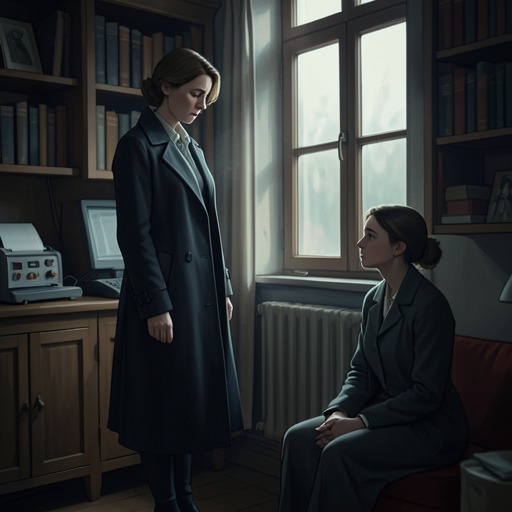
Hana asks Zdenka to dance for her in the Glass Room, hoping to be reminded of what beauty can be. Zdenka takes Hana’s hand and agrees. The promise leads to a performance that is not a return to the erotic dance she once performed for Tomáš. With the curtains drawn and pale-gold light on the floor, she improvises a slow, sorrowful dance to Janáček’s music on her gramophone, before the onyx wall.
The performance gathers several kinds of mourning. Zdenka dances for the Landauer family who lived in the house, for Hana’s husband, who died in Auschwitz, and for her own love of Tomáš, now belonging to the past. She imagines this as the great performance she never gave on a stage in Prague, Leningrad, or Moscow: the career that might have been was ended by circumstances that led her to fall and break her ankle. The dance makes that lost possibility present without pretending it can be recovered. When the music ends, Hana does not applaud. Zdenka runs to her, kneels, and takes her hands as if to comfort her.
Hana then tells Zdenka that, through their conversations and meetings in the house, she has fallen in love with her. She makes the confession plainly, while acknowledging the age difference and the possibility that it might repel Zdenka. Zdenka is shocked but not repelled. She says that she finds the declaration strange, and tells Hana that she thinks she is beautiful. Hana answers that Zdenka is the one who frightens her, then refuses to turn her confession into a demand: they can remain friends without becoming lovers, and she leaves the choice to Zdenka.
Change and Narrative Significance
Hana’s declaration unsettles Zdenka. For several days she works in a haze of confusion, finding her principal distraction in the children she treats. When Tomáš calls, she keeps the conversation neutral and short, unsure how to act while considering the choice Hana has placed before her. The familiar Ondine story offers no adequate script: its pattern of a nymph’s love and a man’s betrayal cannot account for the possibility of affection between two women, or for Zdenka’s uncertainty about what she wants.
Zdenka’s importance lies in the way she makes the Glass Room more than an architectural ideal or a space for clinical treatment. Her first dance there lets Tomáš project a water spirit onto her; her later dance for Hana turns the same room into a place of remembrance for the Landauers, Hana’s dead husband, Zdenka’s broken artistic ambition, and her own ended relationship with Tomáš. She cares for children’s bodies in the gymnasium even as dance carries desire and grief through it. The narrative leaves her response to Hana unresolved in the supplied scenes, preserving the difference between receiving a confession and deciding what it will mean.