“God’s Own Country”
The God of Small Things“God’s Own Country” is a brochure slogan for Kerala that turns a damaged landscape into a luxury destination. Its polished promise of paradise sits beside a river carrying garbage and factory effluent, and a hotel that screens nearby poverty from view; the phrase distills the novel’s critique of tourism that sells the appearance of paradise while treating its costs as an inconvenience to manage.
The Slogan and the River
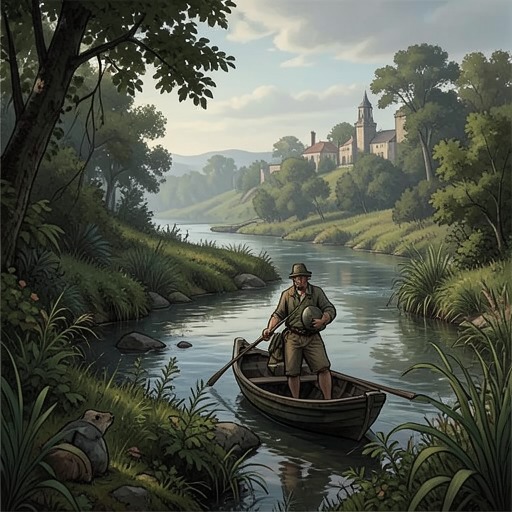
The Meenachal River was once powerful enough to evoke fear and change lives. By the time of the hotel’s arrival, it had become a slow, green ribbon carrying fetid garbage toward the sea. Plastic bags drifted over its weedy surface, and the old stone steps to the water stood exposed, leading nowhere. Across the river, children defecated on the exposed mud, while people bathed and washed in polluted water. The river’s daily movement carried human waste toward the sea, leaving thick white scum behind; on warm days, the smell hung over Ayemenem.
This pollution is not confined to one visible stretch. Upstream, people washed clothes and pots in factory effluent, and the river’s old uses—for bathing and fishing—had been overtaken by contamination. The landscape makes environmental damage a lived condition rather than a distant abstraction: the people who depend on the river encounter its waste directly, while the hotel can offer visitors a carefully arranged view of it.
A Paradise Arranged for Visitors
A five-star hotel chain had bought the History House, a place once approached from the river and associated with Ayemenem’s past. The hotel guests came instead by speedboat from Cochin, the engines leaving a film of gasoline on the water. The river view remained beautiful, but the water was toxic enough for the hotel to put up No Swimming signs in stylish calligraphy. A tall wall screened the slum from the estate; the smell, however, could not be kept out.
The resort supplied its own alternatives: a swimming pool, fresh tandoori pomfret, and crepe suzette. The contrast turns environmental degradation into a problem of presentation and consumer choice. Guests could swim in controlled water and eat appealing food while the polluted river and the people living beside it remained outside the experience the hotel sold.
The hotel also renovated Kari Saipu’s house and made it the centerpiece of a complex threaded with artificial canals and bridges. Small boats bobbed in these constructed waterways. Older wooden houses, bought from families and transplanted around the colonial bungalow, were arranged as “Heritage”—a picturesque display of the past for tourists. The history embodied in lived places became scenery, curated to appear deferential to the central house.
The Work of the Phrase
The brochure’s “God’s Own Country” names a paradise that the surrounding evidence repeatedly unsettles. The trees remain green and the sky blue, details that help the hotel justify selling the view despite the toxic water and persistent odor. Its operators treat smelliness, like other people’s poverty, as something visitors can get used to: a matter of discipline, rigor, and air-conditioning. The slogan does not simply conceal the damage; it reveals the logic that permits the damage to remain while the destination is still advertised as idyllic.
That logic links environmental inequality to social hierarchy. The wall separates the resort from the slum, but it cannot erase the odor or the conditions that produce it. The tourist paradise and the polluted river occupy the same landscape, yet the resort’s design distributes their consequences unevenly: comfort is purchased and enclosed, while pollution remains part of local life.
Paradise and Power
The phrase’s irony resonates beyond the hotel. In a later account of the police response to the family crisis, Baby Kochamma presents Velutha as a dangerous Paravan and invokes the family’s past support of his education and training. Inspector Thomas Mathew responds that privileged people first carry such people around like trophies and then seek police help when they misbehave. His remark exposes a related structure of possession and control: those with power claim the right to define both the dependent person and the terms on which he may be accepted.
The novel describes the violence witnessed by Estha and Rahel as a demonstration of humanity’s pursuit of ascendancy, structure, order, and monopoly, with history performing itself before children who cannot yet understand what they see. “God’s Own Country” belongs to the same vocabulary of disguise: an attractive public image overlays systems of inequality and damage. The slogan’s paradise is not separate from those systems; it is a product made possible by managing what visitors are permitted to see, and by leaving the costs with others.