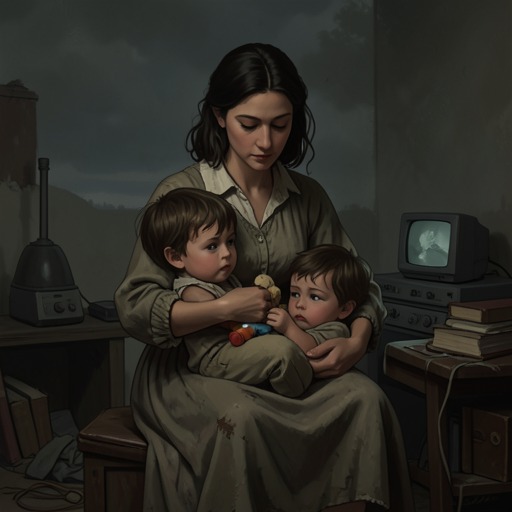
Ammu and Rahel
The God of Small ThingsAmmu and Rahel’s relationship joins intimate maternal care to a separation neither can repair. Affection is made tangible in routines and remembered words, but it is also exposed to the pressures surrounding Ammu’s status as a divorced daughter, the family’s response to her choices, and the children’s precarious place within the household. Their story ends not in reconciliation but in Rahel’s memory of her mother, which preserves the small gestures that death cannot return.
A bond shaped by family judgment
Ammu is a divorced daughter living in her parents’ home, a position Baby Kochamma regards as illegitimate: in her view, a married daughter has no place there, while a divorced daughter has no place anywhere. A divorced daughter whose marriage began in love provokes still greater outrage; an intercommunity love marriage leaves Baby Kochamma speechless. This judgment makes Rahel’s home a place where maternal attachment exists under the pressure of rules that deny Ammu a secure position. The family’s condemnation is not simply an opinion about marriage: it defines how welcome Ammu is allowed to be, and therefore shapes the ground on which she raises her children.
The novel also sets this family hierarchy against the caste order surrounding Velutha. His grandfather Kelan was among the Paravans, Pelayas, and Pulayas who converted to Christianity under British rule in the hope of escaping untouchability. The converts received separate churches, services, and priests, and after Independence were excluded from benefits reserved for disadvantaged castes because official records classified them as Christians without caste. This history helps explain the unequal social world in which Ammu’s choices are judged, although the available scenes do not present Rahel as an interpreter of that history. The mother-daughter bond is caught within a society where caste, class, and a woman’s marital status distribute security unevenly.
Hurt, affection, and the household
Ammu tells Rahel that careless words can make people love the person who hurt them a little less. The warning follows a moment when Rahel freezes, regrets what she has said, and realizes she cannot take the words back. The narration gives the words a lingering presence on the red staircase, as though they had become visible occupants of the house. The scene presents affection not as an unbroken reassurance but as something the children can fear losing through an impulsive act.
The fear acquires an immediate practical consequence at bedtime. The original arrangement would have placed Estha with Chacko and Rahel with Ammu and Baby Kochamma. After Estha becomes unwell and Ammu’s love is described as having been apportioned differently, the sleeping places are switched: Rahel must sleep with Chacko, while Estha sleeps with Ammu and Baby Kochamma. A change in who shares a bed becomes a measure of how a child experiences maternal love—something intimate and real, yet vulnerable to household tensions and capable of seeming to diminish.
At Cochin Airport, Rahel wears new, crisp polka-dotted knickers on the Day of the Play, after a week of rehearsals organized around what Sophie Mol might think. The detail places the children inside a carefully prepared welcome, where attention is directed toward the visiting cousin. In that charged family setting, Rahel feels the moth on her heart lift one downy leg and set it down again, cold; the image accompanies her sense that Ammu loves her a little less. The contrast between the rehearsed welcome and Rahel’s private unease shows how an occasion designed around family performance can also sharpen a child’s fear of being displaced in her mother’s affections.
Separation and its everyday aftermath
The last time Ammu returns to Ayemenem, Rahel has been expelled from Nazareth Convent, while Ammu has lost yet another job, this time as a receptionist in a cheap hotel. She has missed too many days because of illness, and the hotel says it needs a healthier receptionist. The parallel setbacks leave both mother and daughter with diminished security: Rahel has been removed from school, and Ammu has lost work. Their connection is present in a shared period of instability, though the evidence does not describe a rescue or a new household arrangement that reverses it.
Later, Rahel continues eating fish while pretending not to hear someone; thinking of phlegm nearly makes her retch. The passage records that she hates her mother then, with the feeling repeated for emphasis. It does not turn that moment into a final judgment on their relationship. Instead, it preserves the uncomfortable coexistence of attachment and resentment: Rahel’s feelings toward Ammu are not made pure by the later tragedy, and a painful reaction remains part of their history alongside tenderness.
Ammu’s death and Rahel’s memory
Ammu dies alone at thirty-one in a grimy room at the Bharat Lodge in Alleppey, where she has gone for a job interview as someone’s secretary. The account emphasizes the absence of Estha, who would otherwise have lain behind her and talked to her. For Rahel, the loss is therefore bound not only to Ammu’s death but to the family’s long separation: the children are not beside their mother, and the ordinary closeness associated with bedtime cannot be restored.
At the cremation, the incinerator’s steel door rises and its muted hum becomes a red roar. The narrative then gathers the particular things that make Ammu present to her children: her hair, skin, smile, and voice; the way she used Kipling to express love before bed; her goodnight kiss; the hand that steadied their faces while she combed and parted their hair; and the knickers she held out for Rahel to climb into, one leg at a time. These memories give the relationship its most concrete account. Maternal love is carried by repeated acts of care rather than by a promise of safety or a final reunion.
The cremation closes the possibility of physical return, but the remembered routines resist reducing Ammu to the circumstances of her death. Rahel’s relationship with her mother contains hurt, anger, dependence, and love, and its ending leaves those experiences unresolved. The novel’s attention to small acts—bedtime, hair, clothing, a child’s changed sleeping place—shows why the separation matters: the ordinary forms through which Ammu loved Rahel remain vivid precisely because they can no longer be repeated.