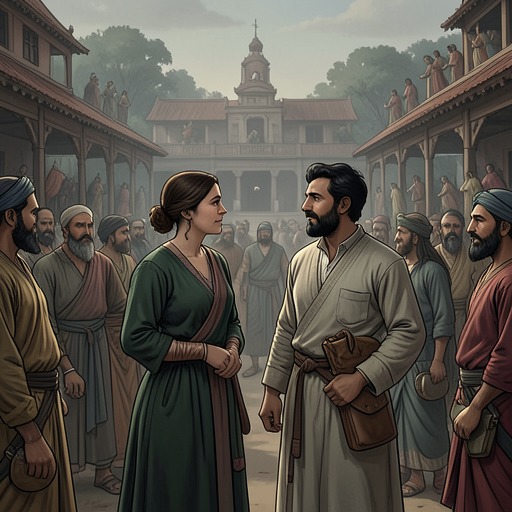
Comrade K. N. M. Pillai
The God of Small ThingsComrade K. N. M. Pillai is Ayemenem’s printer, Communist organizer, and aspiring politician: a practiced negotiator who turns revolutionary language into local influence while keeping his own interests carefully insulated. He encourages Paradise Pickles workers to organize, yet depends on Chacko’s printing business; when the police ask whether Velutha has Party protection, he denies him that support. The contrast between his public politics, private dealings, and earlier generosity to the twins makes him both a guide to their imaginative world and a participant in the machinery that abandons Velutha.
Identity and Political Position
Comrade K. N. M. Pillai operates Lucky Press, a printing press that had once been the Ayemenem office of the Communist Party. It had hosted midnight study meetings and printed and distributed pamphlets bearing rousing Marxist Party songs. By the time Estha walks past it years later, the flag on the roof has grown limp and old, its red faded away: a small, visible measure of the distance between the press’s former political purpose and the diminished present.
Pillai’s own account of political responsibility is notably elastic. He does not consider himself personally responsible for what happened, dismissing it instead as the inevitable consequence of necessary politics. The narration describes him as a professional omelette-maker who moves through the world like a chameleon, never quite revealing himself and never appearing not to. In this portrait, adaptability is not an incidental trait but his governing political skill: he survives upheaval by adjusting his position while treating its consequences as somebody else’s necessity.
His domestic circumstances register the passage of time around him. His wife, Kalyani, has died of ovarian cancer, and his son Lenin has moved to Delhi, where he works as a services contractor for foreign embassies. Years later Pillai shows Rahel photographs of Lenin and his family with unmistakable pride. Lenin has adjusted his name to Levin, or P. Levin, to reassure clients who might be wary of his political associations. Even this change makes the family’s pragmatism visible: political identity can be softened when a livelihood requires it.
Organizing Workers and Seeking Office
Pillai’s political ambitions gain an opening when two local Party members, Comrade J. Kattukaran and Comrade Guhan Menon, are expelled as suspected Naxalites. Guhan Menon had been tipped as the Party’s candidate in the Kottayam by-elections to the Legislative Assembly. His expulsion leaves a vacancy that several hopefuls—including Pillai—want to fill. Pillai therefore watches Paradise Pickles not only as a workplace with grievances, but as a possible foundation for his electoral career. A new labor union, however small, in the constituency he hopes to represent would be a useful beginning.
After factory shifts, he waylays the workers and shepherds them into Lucky Press, where he urges them toward revolution. His speeches combine local demands with Maoist rhetoric: yearly bonuses, provident funds, and accident insurance become practical claims wrapped in an expansive vision of popular struggle. He delivers them in a high, piping voice whose grand cadence seems aimed less at the small room and the smell of printer’s ink than at the millions he imagines addressing as a future legislator.
The workers have reason to consider their position. The factory is in debt, and they are paid below the minimum rates specified by the Trade Union. Chacko tells them so and promises that wages will be revised when the business improves; he believes they trust him and understand that he has their interests at heart. Pillai challenges their acceptance of the existing pay, pointing out that their own government is in power. His organizing turns economic hardship into a political opportunity, even as the factory’s precarious finances make the consequences of a transfer of authority potentially severe.
Pillai’s ambitions also shape the staging of private encounters. When Chacko visits his house, Pillai ensures that villagers who have asked him to use his connections at the Kottayam hospital to find nursing jobs for their daughters are waiting outside. Their presence makes him appear busy and influential; seeing the factory’s owner come to meet him on his own ground adds another useful signal. He also insists on speaking to Chacko in English. Political credibility, in his hands, is built through an audience, a setting, and the appearance of access—not only through speeches.
Chacko, the Party, and Double Bookkeeping
Pillai is careful not to attack Chacko directly. In public speeches he turns the employer into an abstraction, referring to him as the Management rather than by name. That language lets workers hear a class critique while allowing Pillai to keep Chacko the customer separate from Chacko the employer. Pillai prints the labels for Paradise Pickles, and the contract provides income he badly needs. He tells himself that Chacko-the-client and Chacko-the-Management are separate figures, apart from Chacko-the-Comrade.
The separation is politically useful and personally protective. Pillai can encourage workers to challenge the factory’s labor arrangements without openly endangering his printing income or his relationship with Chacko. When Chacko says he intends to organize the workers formally into a union and let them elect their own representatives, Pillai insists that Chacko cannot stage their revolution for them; he can only create awareness. The statement places workers’ agency at the center of his public argument, even as Pillai’s own strategy depends on steering their discontent toward a union and a constituency he hopes to command.
Velutha complicates that strategy. He is the only Paradise Pickles worker who holds Party membership, and therefore an ally Pillai would rather not have. Pillai knows that the other Touchable workers resent Velutha for ancient reasons of their own. Rather than confront that contradiction openly, he waits for an opportunity to remove the obstacle. His politics mobilize workers against an employer while leaving entrenched caste hostility among those workers intact; the one worker whose Party membership might make him a genuine comrade is also the one Pillai finds inconvenient.
Velutha and the Police
Velutha comes to Pillai late at night, trying to explain what has happened. Pillai tells him that this is a small village and that people talk; he has heard what has been going on. Velutha hears his own voice returning as though it had struck a wall, slipping into incoherence as the man he is addressing seems distant and unreachable. The encounter makes the difference between political access and actual protection stark: Pillai knows the situation, but knowledge does not become help.
After Baby Kochamma’s accusation, Inspector Thomas Mathew has Pillai brought to the police station to determine whether Velutha has political support or is acting alone. The inspector, a Congress man, does not want to risk a confrontation with the Marxist government. He shows Pillai the First Information Report, and the two men exchange a brief, cryptic conversation. Though they do not trust one another, the narration presents them as men who understand how the system works because they work it, each servicing a different part of the same machine.
Pillai admits that he knows Velutha but omits the crucial facts that Velutha is a Party member and had come to his door the previous night. Nor does he refute the attempted-rape accusation, though he knows it to be false. Instead, he tells the inspector that Velutha has neither the Party’s patronage nor its protection, leaving him to face the police alone. The omission is not a failure to know; it is a deliberate withdrawal of the political support that could make Velutha less isolated.
The Twins and the Stories He Taught
Pillai’s relation to the twins is more complicated than his political conduct alone suggests. Against Baby Kochamma’s better judgment, he took the children, along with Lenin, to all-night Kathakali performances at the temple and stayed up until dawn explaining the language and gestures. When the twins were six, he had sat with them through the story of Bhima. As the normally good-natured hero turns furious and bloodthirsty in search of death and vengeance, Pillai tells the frightened children that Bhima is searching for the beast within him.
The narration observes that Pillai does not specify which beast. Perhaps, it suggests, the search is for the man within Bhima, since no beast can equal the boundless inventiveness of human hatred. The observation gives the children’s lessons a shadow their guide does not explain. Pillai opens for them a world of gesture, story, and violence, yet his own later choices show how readily human beings can make harm seem like the impersonal consequence of politics.
Years later, Pillai is the first person in Ayemenem to hear that Rahel has returned. The news excites his curiosity: he knows Rahel well, having watched her grow up, whereas Estha’s expulsion from Ayemenem was so abrupt and so long ago that Estha is almost a stranger to him. He wonders what has brought Rahel back. Their altered positions reveal the uneven survival of old relationships: Pillai retains a recognizable connection to the returning Rahel, while Estha, walking past his press in silence, remains distant.
When Pillai calls out to Estha on his daily walk, he cannot tell whether Estha recognizes him and does not particularly care. Estha passes neither rudely nor politely, simply quiet. The old organizer who once supplied the twins with explanations now receives no answer from one of them. His political composure survives, but the damaged human connection is left unbridged.
Narrative Role
Pillai’s contradictory roles bind intimate memory to public power. He is at once a political organizer who can give workers a language for their grievances, a businessman dependent on the employer he criticizes, an aspiring legislator arranging appearances of influence, and the person who withholds support when Velutha most needs it. These are not separate phases so much as connected uses of the same talent for managing positions and appearances.
The novel sets his grand revolutionary cadence against the small press where he rehearses it, his talk of workers’ rights against his acceptance of caste resentment, and his childhood instruction in the story of human hatred against his later evasion of responsibility. That irony does not erase the real value of his teaching or his organizing; it shows their limits. Pillai can teach the twins to read a performance and teach workers how to make demands, yet when political solidarity carries a cost, he makes Velutha appear to stand alone.