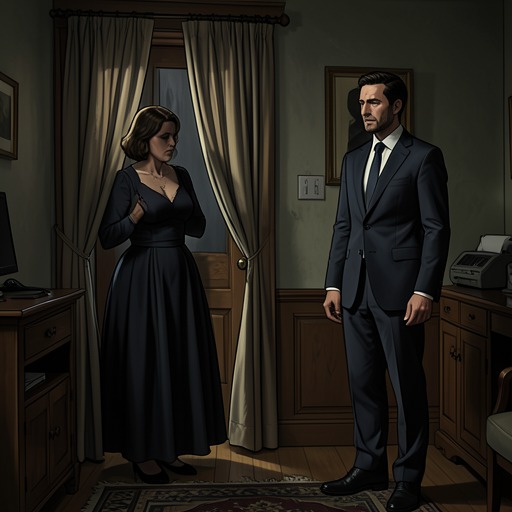
Estha
The God of Small ThingsEstha is Rahel’s two-egg twin brother, older than her by eighteen minutes, and one of the novel’s central figures in its account of childhood, silence, and the lasting consequences of violence. His story turns on the pressure imposed on a child to cooperate with an adult account of events: at the police station he confirms Velutha’s identity, and the single word “Yes” persists in his memory long after he has stopped speaking. His later return to Ayemenem brings him back into Rahel’s presence, but not out of the quiet and guilt that have shaped his life.
Identity and Background
Estha and Rahel are dizygotic twins, born from separate eggs fertilized at the same time. Estha is the older twin by eighteen minutes. They do not look especially alike, and their family’s uncertainty about them is not the ordinary confusion of distinguishing twins; the deeper connection between them lies elsewhere. Estha’s identity is also unsettled in the practical terms of a child’s life: in a school exercise book, he rubs away his surname with spit and writes “Un-known.” The book lists his age as six and its subject as story-writing; the erased name records a family situation in which his surname has been postponed while Ammu chooses between her husband’s name and her father’s.
The novel gives Estha a particular relationship to records and small documents. He is described as the natural custodian of bus tickets, bank receipts, cash memos, and checkbook stubs, a keeper of evidence and particulars. The contrast is consequential: he preserves ordinary records, but the most burdened fact in his own life is the one-word answer he cannot dislodge. When Ammu dies, Estha is not with Chacko and Rahel; the family decides it is better this way, and writes to him instead. His absence from that moment is one more instance in which separation is managed through practical decisions and messages rather than reunion.
Silence and the Return
Estha’s silence has no sharply defined beginning. He had always been quiet, and his withdrawal is described as a gradual winding down rather than a single moment when he stopped talking. The change is so subtle that no one can name a year, month, or day. His silence is not presented as a noisy protest or an accusation; it is a dormancy that appears to last indefinitely. Over time, he becomes adept at blending into whatever surrounds him—bookshelves, gardens, curtains, doorways, streets—until strangers may fail to notice either his presence or the fact that he does not speak.
The adult Estha is thus both present and difficult to reach. During the storm, he walks along the riverbank in a drenched pink T-shirt, already knowing that Rahel has returned. Later, in the old house, he does not look up while she discovers a packet of their childhood exercise books. His silence frames their reunion not as an easy restoration of the past, but as contact between siblings whose shared history remains difficult to put into words. After twenty-three years, Rahel turns toward him in the dark and whispers his long, accumulated name, “Esthapappychachen Kuttappen Peter Mon.” The scene ends in a whisper rather than a spoken response from Estha.
The Word That Remains
The burden most directly attached to Estha is his coerced identification of Velutha. The novel returns to the memory of a young man’s face and the scene in which Estha looked at it and said, “Yes.” The answer confirms that Velutha is the man the authorities are asking about. In Estha’s recollection, the word becomes the one thing his inner “octopus” cannot reach or remove: it remains lodged in him, beyond the reach of the mental effort he makes to dislodge it. His habitual quiet is therefore not simply a personality trait. It exists alongside a specific memory in which a child’s brief answer has been made to carry terrible consequence.
The station scene places the child within an adult machinery of power. Baby Kochamma gives Inspector Thomas Mathew a false account, representing Ammu and Velutha’s relationship as an attempted assault and connecting Velutha to the disappearance of the children. The Inspector prepares a First Information Report and consults Comrade K. N. M. Pillai about Velutha’s political backing. Though Pillai knows that Velutha belongs to the Communist Party and had sought his help, he withholds that information and tells the Inspector that Velutha has no party protection. The adults’ accounts and omissions shape the official version; Estha, by contrast, is chosen for his practicality and tractability and sent into the station to identify Velutha. His brief confirmation occurs within that unequal arrangement, where a child’s response is taken into a process controlled by adults.
The larger violence is later described as neither accidental nor an isolated personal dispute. What Estha and Rahel witness is framed as a demonstration of the pursuit of ascendancy, order, and monopoly: history acting upon an underage audience. That framing clarifies why Estha’s “Yes” cannot be treated as a free-standing choice detached from its circumstances. The novel connects his memory to a system in which caste, authority, family reputation, and political calculation converge, while the child who is required to speak must live with what his speech has been made to mean.
Family Separation and Guilt
Estha’s childhood is shaped by the family’s treatment of him as someone who can be sent away. Rahel remembers the word “Returned,” which is used for Estha’s removal as though twins were borrowed and returned like library books. His place in the family is made provisional in language as well as action. The old exercise book’s erased surname and “Esthappen Un-known” similarly register a child whose family identity has not been securely settled.
On the night of the children’s flight, Estha believes that Ammu no longer wants them. He decides that the time has come to run away, despite the darkness and rain. This decision belongs to the sequence of events that ends with Sophie Mol’s death and Velutha’s arrest and death, but it begins in a child’s understanding of rejection. The novel makes the gap between what Estha knows and what the reader knows part of the tragedy: his action is driven by the belief that he and Rahel have lost their mother’s love, while the consequences extend into a wider catastrophe shaped by adult choices and social power.
After Sophie Mol’s death, Margaret Kochamma’s grief turns toward Estha. Though she does not know his role in the children’s flight, she blames him in her fevered state and, several times, seeks him out and slaps him before others intervene. She later writes an apology to Ammu, ashamed of her conduct; by the time the letter arrives, Estha has been sent away and Ammu has left, so Rahel is the one who receives it on his behalf. The episode adds another imposed meaning to Estha’s childhood: he is treated as responsible for a death without the adults around him knowing the facts of his actions.
Reunion and Narrative Significance
When Rahel returns to Ayemenem as an adult, the house appears empty and locked, but Estha is still there. She has come to see him, not Baby Kochamma. Their reunion is narrated through recognition, absence, and objects rather than conversation: Rahel finds the packet of exercise books labeled in Ammu’s handwriting, and Estha remains silent while she reads. The books preserve traces of the children’s school lives, including Estha’s erased surname, but they cannot repair the separations recorded in his history.
The novel also places the twins’ eventual closeness beside the story of Karna and Kunti at the temple performance. As Karna promises his mother that she will always have five sons, something alters in the air and Rahel knows that Estha has arrived. The performance joins them across the breadth of the hall through a story about another mother and son, making their recognition intimate without requiring speech or physical proximity. It is one of the clearest instances in which the novel lets a shared story carry a connection that the characters cannot readily express.
Estha’s narrative role is consequently bound to the difference between speaking and being heard. The adults who file reports, weigh political risk, and protect family reputation control the public account of events; Estha’s one answer is drawn into that account, while his later silence leaves its consequences largely unspoken. His return does not resolve the past. Instead, the final whisper of his full name makes the enduring bond with Rahel audible for an instant, against the long silence that has separated and accompanied them.