History House
The God of Small ThingsHistory House is an abandoned mansion across the Meenachal River, once the home of the Englishman Kari Saipu and later the place where the twins witness history’s violence at close range. First encountered in imagination as a locked house full of whispers, it becomes the destination of their forbidden crossing and the scene where the novel’s private tragedy is exposed as an operation of social power.
Identity and setting
The house stands in the middle of an abandoned rubber estate on the far side of the river from Ayemenem. It belonged to Kari Saipu, the Englishman known as the Black Sahib, who had gone native, spoke Malayalam, and wore mundus. The narrative compares him to Kurtz: Ayemenem’s own figure from Heart of Darkness. Ten years before the twins’ story, Kari Saipu shot himself after the parents of his young lover took the boy away and sent him to school. Litigation between his cook and secretary followed, and the property remained empty for years, rarely seen by anyone.
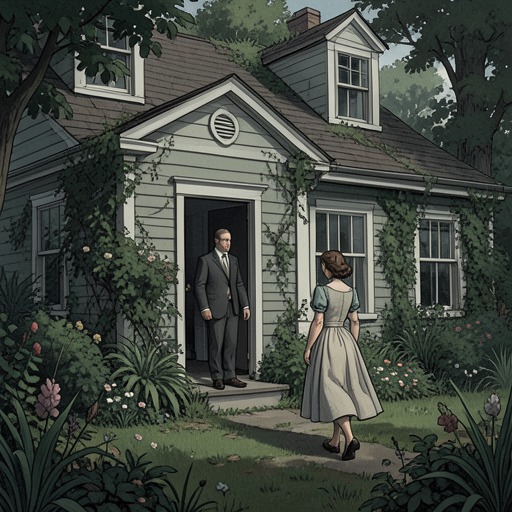
The house’s material details make it feel at once intimate and estranged. Its floors are cool stone; its dim walls carry billowing, ship-shaped shadows. Plump, translucent lizards live behind old pictures, while the imagined ancestors seem waxy and crumbling, their whispers papery and their breath scented with yellow maps. Later, the house is described as white-walled once and red-roofed, but weathered into moss-green, earth-brown, and crumble-black. Its doors are locked even as its windows stand open: access appears visible, yet remains barred.
The house imagined as history
Chacko teaches the twins to think of history as an old house at night, with lamps lit and ancestors whispering inside. To understand it, he says, one must enter, listen, examine books and pictures, and smell the smells. Estha and Rahel immediately associate this account with Kari Saipu’s empty house. Chacko’s metaphor gives a physical address to a past they have been told they cannot enter: the History House, looming in the Heart of Darkness, is close at hand but still inaccessible.
The barrier is not simply a locked door. Chacko explains that his family has been locked out of its own history, left to peer through windows and hear whispers without understanding them. Their minds, he says, have been invaded by a war that they have both won and lost: a war that captures and remakes dreams, teaching the conquered to adore their conquerors and despise themselves. The house thus embodies a historical inheritance that is present but distorted, visible but not possessed. Its name turns the twins’ curiosity into a question of power: who is permitted to enter the past, and who is made to look in from outside?
The twins return to the imagined house in their thoughts, even before they know they will cross the river and enter it. The narrative foreshadows that they will be where they are not supposed to be, beside a man they are not supposed to love, and that they will watch history reveal itself on the back verandah. Their education in history will not come from Chacko’s explanation alone. They will learn how it negotiates its terms and collects its dues from those who break its laws, and they will hear and smell its violence in a way they will never forget.
The crossing and the night of the Terror
The river crossing brings the imagined place into the twins’ lives as a real, dangerous destination. After Sophie Mol drowns, Estha and Rahel make their way through the swamp to the house in the dark, muddy and exhausted. They lie on the back verandah on a grass mat with an inflatable goose and a Qantas koala bear. Their arrival is framed as a ghastly fairy tale: like Hansel and Gretel, they have entered a place where dreams will be captured and remade, but they wait there numb with fear rather than anticipating rescue.
Velutha reaches the house by swimming across the river after the rain. He descends thirteen stone steps into the water, crosses the current, and emerges on the other bank before following the path through the swamp to the History House. The crossing gives the building its charged position between worlds: it is separated from the family home by water and marsh, but it is also the place where concealed love and public punishment converge. In the morning, the twins witness police violence there. The house’s back verandah, foreshadowed as the place where history will disclose itself, becomes the setting of that disclosure.
The scene refuses to treat what happens as accidental or merely personal. The novel describes the beating as a demonstration of human beings pursuing ascendancy, structure, order, and complete monopoly, with human history masquerading as God’s Purpose before an under-age audience. The contrast between the house’s haunting, storybook atmosphere and the controlled violence enacted there makes its historical meaning concrete: power is not a whisper from the past but an organized force acting upon vulnerable bodies in the present.
Concealment, aftermath, and the buried past
The History House is also linked to the competing accounts that follow the night there. Vellya Paapen tells Mammachi that he has seen the lovers cross the river and meet at the house. He says that their small boat is tethered by the path to the abandoned estate, rocking on the water while it waits for them to return. His disclosure turns the house from a private refuge into evidence used to expose the relationship. What the twins had imagined as a forbidden chamber of history is already being watched, reported, and converted into a family crisis.
At the Kottayam police station, Baby Kochamma recasts Ammu and Velutha’s relationship as an attempted assault. She tells Inspector Thomas Mathew that a Paravan had tried to force himself on her niece, and her account misrepresents the relationship in order to contain scandal and protect the family’s reputation. The Inspector consults Comrade K. N. M. Pillai about Velutha’s political support; Pillai withholds that Velutha belongs to the Communist Party and had sought his help, and does not challenge the false allegation. The house is not the location of this official account, but the lovers’ crossing there is the secret around which the police and political narratives form. Private history is overwritten by a version that institutions can act upon.
In the years that follow, the Terror is described as buried in a shallow grave at the History House, beneath the humming of hotel cooks, the humbling of old Communists, the slow death of dancers, and the toy histories played out by rich tourists. The phrase “buried in the ground” returns to the image of a small forgotten thing lying under grass and twenty-three years of June rain. The house’s later quiet is therefore not an absence of history but its concealment beneath ordinary activity and a new use of the place.
Narrative significance
The house binds colonial memory, family secrecy, forbidden love, caste power, and state violence in one setting. Kari Saipu’s past gives it the lingering presence of a colonial ghost; Chacko’s account makes it a model of a people estranged from their own history; the twins’ arrival turns that model into an ordeal. The repeated contrast between locked doors and open windows captures the difference between seeing traces of the past and having the power to understand or change what they mean.
The twins do not arrive as historians capable of interpreting the scene. They are children who witness what adults and institutions make happen, and the house becomes the place where their earlier fascination with whispers gives way to an unforgettable encounter with history’s costs. The river, swamp, locked doors, verandah, and later buried ground make the mansion more than a backdrop: its changing significance traces the movement from imagined past, to dangerous crossing, to witnessed violence, to public forgetting. History House remains beautiful in the narrative, but its beauty is inseparable from the silencing and harm concealed within it.