Inspector Thomas Mathew
The God of Small ThingsInspector Thomas Mathew is the Kottayam police officer whose decisions help turn Baby Kochamma’s false accusation into official action against Velutha, and whose authority later helps force the children into a version of events that serves the police and the family. He is not simply an instrument of procedure: he understands the caste and political stakes, calculates his own exposure, and uses police power to impose order while the truth is being suppressed.
Identity and Exercise of Authority
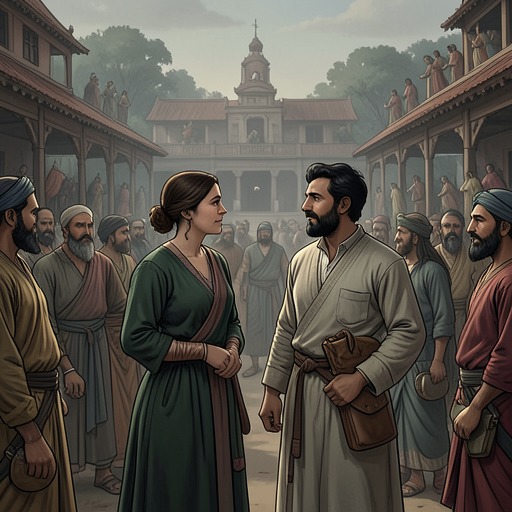
The novel introduces Thomas Mathew through a sharp contrast between reassuring appearance and predatory conduct. His mustaches recall the friendly Air India Maharajah, but his eyes are described as sly and greedy. When Ammu comes to the Kottayam police station after Sophie Mol’s funeral, she tells him that a terrible mistake has been made, asks to make a statement, and asks to see Velutha. He dismisses her appeal as too late and says the police have heard all they need to know. His response is not an inquiry into her correction: he looks at her breasts, approaches with his baton, and orders her to go home quietly.
The encounter exposes how his authority operates. He taps Ammu’s breasts with the baton, a deliberate act of sexualized intimidation rather than an accidental lapse of professional conduct. The narration later clarifies that he already knew the alleged assault was false: what mattered to him was that a Paravan had crossed the boundary of the Touchable Kingdom by being loved, not that he had forcibly taken anything. His gesture is therefore presented as a calculated attempt to humiliate and terrorize Ammu and to restore an order he considers disrupted.
The False Report and Political Calculation
Before Ammu’s visit, Baby Kochamma gives Thomas Mathew an account designed to make Velutha appear dangerous. She says that a Paravan factory worker tried to force himself on her niece, a divorcee with two children. In her version, Velutha came to the house at about seven on a rainy evening, when the lights had gone out and three women were alone because Chacko was away in Cochin. She claims that he said Ammu had consented, challenged the family’s grounds for dismissing him under labor laws, and insisted that workers could no longer be treated like dogs.
Baby Kochamma’s account is not a reliable recollection of what happened. She has recast the relationship between Ammu and Velutha to contain scandal and protect the family’s reputation, and as she tells the story she begins to believe it. She also folds into it her memory of being humiliated during the Communist march, attributing that other man’s insolence to Velutha. Thomas Mathew listens courteously and helps her put the account into a First Information Report. The distinction between what she knows, what she has invented, and what the report records is central: a family’s effort to protect its standing is converted into a police document that can direct an arrest.
Thomas Mathew does not accept the complaint without considering political consequences. He remarks that families first spoil people by treating them like trophies, then turn to the police when they misbehave. He also hears Baby Kochamma’s mention of rumors that Velutha was or had been a Naxalite, and the possibility makes him uneasy. Though he is a Congress man, he does not want a confrontation with the Marxist government. He therefore sends a jeep to bring Comrade K. N. M. Pillai to the station and shows him the report, seeking to establish whether Velutha has political backing.
Pillai says he knows Velutha but withholds that Velutha is a Communist Party member and that he came to Pillai’s door late the previous night. He does not challenge the false rape allegation; instead, he assures the Inspector that Velutha has no Party protection and is on his own. Thomas Mathew and Pillai are not friends and do not trust one another, but their brief, guarded exchange lets each understand what the other will and will not do. The Inspector then reviews their conversation for loopholes and instructs his men. The police operation thus proceeds not from an impartial test of the accusation, but from the combination of a false family report, an opponent’s strategic silence, and the officer’s assessment of political risk.
Ammu’s Appeal and the Limits of Procedure
After the funeral, Ammu returns to the station with the twins to correct the account. The children know the place from the previous day and anticipate its unpleasant smell before they enter. Ammu asks for the Station House Officer, explains that there has been a terrible mistake, and asks to make a statement and see Velutha. Thomas Mathew refuses to treat her as a credible complainant. He tells her that the police do not take statements from women he calls prostitutes or from their illegitimate children, then approaches her with his baton and warns her to go home quietly.
His behavior makes the gap between legal process and justice explicit. The station contains the means to record Ammu’s correction, yet its officer uses both sexist and caste-inflected contempt to shut it out. The later account explains that he has learned the real nature of the relationship and knows that what was given had been falsely represented as something taken. His assault on Ammu is therefore not an impulsive response to a difficult visitor. It is intended to silence a witness who might expose the report on which his force has acted.
The Arrest’s Aftermath and Estha’s Identification
Once the children’s account and the evidence gathered by the police begin to undermine Baby Kochamma’s story, Thomas Mathew recognizes that the situation has changed. He summons her to the station and keeps the children out of the room. He tells her that the police acted on her First Information Report, that Velutha has been caught and badly injured, and that he is unlikely to live through the night. The children, however, say that they left of their own accord, that their boat capsized, and that Sophie Mol drowned accidentally. The Inspector now faces the prospect that the police have a death in custody involving a technically innocent man.
He sets out the choices in stark procedural terms: either the alleged victim must file a complaint, or the children must identify Velutha as their abductor in front of a police witness, or Baby Kochamma can be charged with filing a false report. He knows that the political climate could place him in serious trouble and that Pillai might exploit the case. Baby Kochamma offers to speak to the children alone and says they will do as they are told. The scene shows procedure being made into leverage: the possibility of a false-report charge gives her a reason to secure the children’s testimony, while the officer’s own concern is also shaped by the risk of accountability.
At the final identification, Thomas Mathew asks Estha a question while Velutha is present, gravely injured and unable to answer for himself. Estha’s mouth says yes. The narrative places that answer beside the departure of childhood and the arrival of silence. The Inspector’s question is the immediate official form of the demand, but its force rests on the prior chain of decisions: the false report, the police pursuit, the suppression of Ammu’s correction, and the pressure placed on a child to confirm the accusation.
Narrative and Political Significance
Thomas Mathew embodies a police system that can distinguish technical innocence from social power yet still act against the vulnerable. He knows that Velutha is a Paravan, understands that caste and political affiliations affect the case, and recognizes the danger created by a death in custody. These recognitions do not lead him to protect the truth. Instead, he calculates the available risks and uses official authority to keep control of the account.
The episode is framed as more than an individual officer’s misconduct. What the children witness is described as a demonstration of the pursuit of ascendancy, structure, order, and monopoly, with human history presenting itself as divine purpose. In that account, Thomas Mathew’s station is one working part of a larger arrangement: family reputation, caste hierarchy, party politics, labor-law claims, and police procedure converge to make the powerful version of events actionable. His importance lies in that convergence. He helps make the false story official, blocks its correction, and turns Estha’s answer into a final instrument of institutional power.