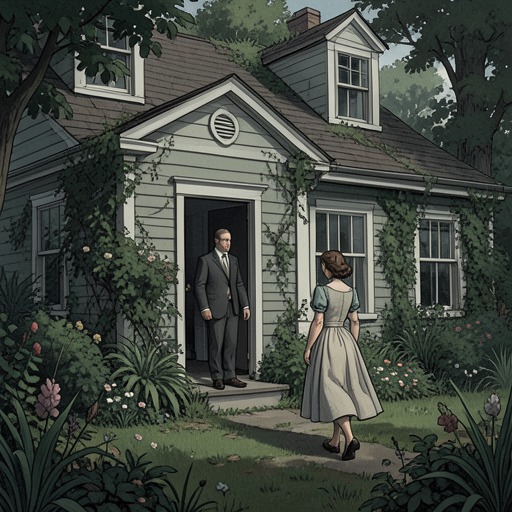
Kari Saipu
The God of Small ThingsKari Saipu is the absent Englishman associated with the History House, whose supposed ghost circulates in Vellya Paapen’s story even as the house itself becomes a place where the novel’s buried history remains consequential. The children hear of a ghost that can be pinned by a sickle; the reader is also shown a house whose historical meaning exceeds the legend told about it. Kari Saipu’s character is therefore built from rumor, place, and the gap between what people believe they know and what has happened there.
The House and Its Vanishing Past
Kari Saipu’s former house is identified with the History House, an old estate across the river from Ayemenem. In the later landscape, a hotel chain has bought the property, and it can no longer be approached from the river as it once could. Guests are ferried directly from Cochin, while a wall screens the neighboring slum from the hotel grounds. The house has turned its back on Ayemenem: its history is overlaid by tourism, restricted access, and a polished view that cannot make the surrounding water clean.
The old house is not simply an empty setting. Its doors are locked while its windows remain open, and the narration imagines ancestors whispering there. That image places Kari Saipu’s estate between physical abandonment and continuing presence. The building has been repurposed, but the past it holds has not been neutralized; the modern resort’s new function makes the distance between the site’s historical weight and its tourist presentation especially visible.
Vellya Paapen’s Ghost Story
The twins learn about Kari Saipu through Vellya Paapen, who claims to be the last person to have seen the house. He calls it haunted and recounts an encounter from two years earlier. While crossing the river to search for a nutmeg tree, he smelled cigar smoke, which reminded him of the brand Pappachi used to smoke. He turned and hurled his sickle toward the smell, believing he had pinned Kari Saipu’s ghost to a rubber tree.
The episode is told with the confidence and theatrical detail of a tale Vellya Paapen has rehearsed. He never finds the nutmeg tree and has to buy a new sickle, but he takes satisfaction in believing that he stopped a dangerous ghost. His version makes the supernatural encounter both boastful and faintly absurd: an unseen presence is treated as an enemy that can be struck, even though the weapon has been thrown at a smell.
Vellya Paapen’s account also shows how little he knows about the place to which he has crossed. He does not realize that Kari Saipu’s house is the History House, or that the house is tied to the reckoning that will fall on the people around the twins. The ghost story supplies an explanation for the cigar smoke, but not for the house’s deeper role. Its local logic and the novel’s wider historical logic coexist without becoming the same account.
Dreams and Historical Reckoning
The narration gives Kari Saipu a further, uncanny association: he is said to capture dreams and dream them again, taking them from passersby, especially the tender dreams of twins. This image links the ghost to the children’s imaginative lives without establishing him as a literal actor in the events that follow. Kari Saipu remains a figure at the boundary between a story told to the twins and the novel’s own language of memory, anticipation, and historical consequence.
That boundary matters because the History House is where the past is figured as negotiating its terms and collecting its dues. The twins will eventually cross the river and enter a place they are not supposed to be; the novel associates what they witness there with a history that leaves a lasting mark. Vellya Paapen, unaware of this larger pattern, unknowingly becomes part of the chain of events that helps set the catastrophe in motion. The children’s ghost story does not explain that chain, but its setting gives the haunting an ominous resonance.
A Haunting That Outlasts the Legend
Kari Saipu’s presence is conveyed through traces rather than a direct encounter: cigar smoke, the abandoned estate, Vellya Paapen’s replacement sickle, and the dreams he is said to appropriate. The story of the sickled ghost gives the twins a vivid explanation for a deserted house, while the novel’s other scenes attach that same house to violence and a reckoning that cannot be contained by folklore.
The contrast persists after the house has become a resort. Guests arrive by speedboat and find a swimming pool, restaurant, and carefully framed scenery; beyond that presentation, the river remains polluted, and the property’s history is not erased. Kari Saipu is consequently less a fully narrated biography than a spectral figure through whom the novel connects colonial-era residue, local storytelling, the twins’ dreams, and the persistence of history in a transformed landscape.