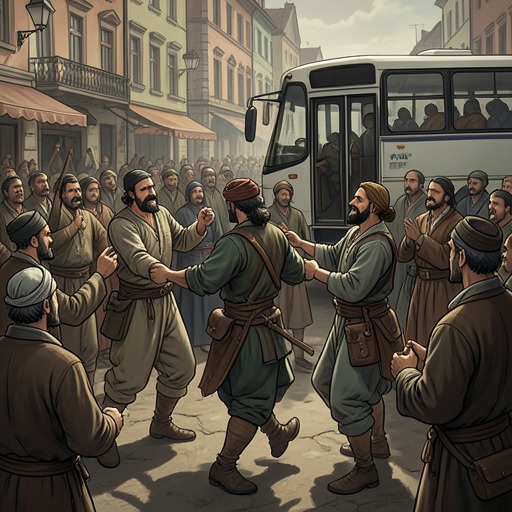
Kunti
The God of Small ThingsKunti is both a character in the Mahabharata story performed within the novel and the figure embodied by a male Kathakali performer. In the performance, she reveals to Karna that she is his birth mother, explaining his abandoned infancy and asking him not to fight the Pandavas, his brothers. The encounter binds maternal recognition to political calculation: the truth arrives only when Kunti needs Karna’s allegiance to spare her other sons.
Identity and the embedded story
The Kunti scene belongs to a performance by the Kathakali Men. The performer playing her is a man who has spent years in female roles; the narration describes him as having become soft and womanly through that work. In the scene he and Karna are both intoxicated, and Kunti comes to tell a story. The novel thus presents Kunti through two layers at once: as a figure in the epic and as a role enacted by a performer whose body and movements carry the part into the present.
Kunti’s tale begins with a young woman who receives a secret mantra that lets her choose a lover among the gods. Curious to test it, she recites it alone in an empty field. Surya, the God of Day, appears, and she gives herself to him. Their son is born with gold earrings and a gold breastplate bearing the sun’s emblem. This account supplies Karna’s divine parentage and identifies the origin of the distinctive signs associated with his birth.
The abandoned child and the revelation
Kunti says that she loved her firstborn son, but, unmarried, could not keep him. She placed the baby in a reed basket and sent him down a river. Adhirata, a charioteer, found the child downstream and named him Karna. The story links Karna’s later identity as a charioteer’s son to the circumstances of his infancy: he was not born to the family that raised him, but was cast away by a mother who says she loved him.
Karna asks who Kunti is and presses her to tell him where his mother is and take him to her. Kunti bows her head and tells him that she is standing before him. His reaction combines elation and anger. He asks where she was when he needed her, whether she held or fed him, whether she searched for him, and whether she wondered where he was. Her disclosure answers the question of his origin, but it cannot undo the years of absence that make the recognition painful.
Kunti responds by taking Karna’s face in her hands and kissing his brow. The performance presents the moment as an abrupt reversal: the warrior is reduced to the vulnerable position of a child receiving a mother’s affection. Rahel watches the scene, and the narration makes the kiss’s emotional force part of what the twins witness in the temple performance. Yet this tenderness is short-lived. Karna realizes that Kunti has disclosed herself in order to secure the safety of her other five sons, the Pandavas, who are about to fight their cousins.
The plea and the divided obligation
Kunti invokes the Love Laws and asks Karna to recognize the Pandavas as his own brothers and promise not to go to war against them. Her appeal rests on newly revealed blood ties, but it also serves an immediate purpose: protecting the five sons she has raised from the son she abandoned. The novel therefore makes kinship both a genuine bond and an instrument in a desperate negotiation.
Karna cannot grant the request without breaking another promise. The next day he is to fight the Pandavas, including Arjuna, who publicly reviled him as a lowly charioteer’s son. Duryodhana, by contrast, came to Karna’s aid and gave him a kingdom; Karna pledged him lasting loyalty in return. Kunti’s appeal places maternal kinship against a debt of gratitude and an oath made to the person who publicly supported him when others rejected his status.
Karna is described as unable to refuse his mother entirely, but equally unable to promise that he will not fight. He modifies the oath rather than abandon his pledge to Duryodhana. The compromise preserves both obligations only in altered form: Kunti’s request changes what Karna will promise, but does not persuade him to join the Pandavas or cancel the coming war.
Performance and narrative significance
The episode’s force depends on the difference between what Kunti tells Karna and why she tells him now. The birth story restores a hidden fact about his identity; the ensuing request exposes the strategic urgency behind her disclosure. Maternal love is present in her account of the child she could not keep and in her gesture of affection, while her attempt to protect her other sons reveals the unequal timing of her care. Karna receives the truth he has sought only on the eve of battle, when it can be used to influence his choice.
The embedded performance also reflects the novel’s interest in roles and stories as structures that contain people without freeing them from their circumstances. The performer’s Kunti tells Karna a tale that changes his understanding of himself, but the revelation does not erase his history as an abandoned child or his loyalty to Duryodhana. His altered oath is not a resolution of the conflict so much as a measure of its force: recognition arrives, affection is briefly exchanged, and the obligations formed before that moment still shape what follows.