Local Communist Politics and Class Struggle
The God of Small ThingsLocal Communist Politics and Class Struggle in Ayemenem is presented not as an abstract contest of doctrines but as a network of workplace organizing, constituency-building, political calculation, and uneven protection. Comrade K. N. M. Pillai speaks in the name of workers and revolution, yet his conduct also reflects the pursuit of influence and the limits of solidarity. The gap between political language and practical action becomes especially consequential for Velutha, the factory’s isolated party member, and later for the fate of Paradise Pickles & Preserves.
Organizing and the Factory
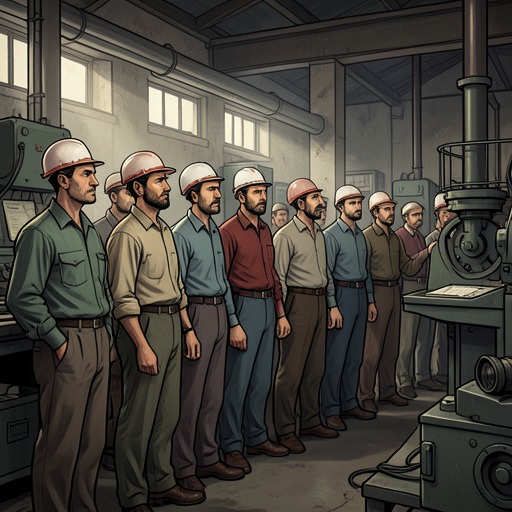
After the factory shift, Comrade Pillai gathers workers from Paradise Pickles & Preserves at his printing press and urges them toward revolution. His speeches combine local grievances with Maoist rhetoric, whose effect is heightened when delivered in Malayalam. The meetings establish a real channel for collective political language: workers are brought together after work, and their circumstances are placed within a broader account of class struggle.
That mobilizing project is compromised from the outset by the position of Velutha. He is the only worker at the factory who holds a party card, making him a potential ally but also an obstacle to Comrade Pillai’s plans. Other workers, all described as Touchable, resent Velutha for longstanding reasons. Comrade Pillai recognizes this tension and waits for an opportunity to resolve it, rather than confronting the exclusion directly. The arrangement reveals how caste prejudice can structure relations even inside a movement that speaks in the name of class solidarity.
Constituency, Patronage, and Party Authority
Comrade Pillai’s politics also operates through constituency-building and the management of public appearances. When Chacko visits him, Pillai wants local supplicants and party workers to see the factory owner coming to his home. Two villagers, Pothachen and Mathukutty, are waiting to ask him to use his connections at the Kottayam hospital to obtain nursing jobs for their daughters. Their presence makes Pillai look busy and influential; Chacko’s visit, on Pillai’s own turf, adds a further signal of access and standing.
The conversation turns to the previous day’s march and the organization of the factory workers. Comrade Pillai presents the Union as the proper forum for grievances and argues that workers should join the Party struggle, particularly because their employer is himself a comrade. Chacko says he intends to form a union formally, with workers electing their own representatives. The exchange sets two models of political organization beside each other: workers’ representation through an institution they elect, and party leadership that seeks to direct grievances into its own channels.
Ideological Lines and Material Interests
Comrade Pillai answers Chacko by invoking Chairman Mao’s distinction between revolution and a dinner party, defining revolution as an insurrection in which one class overthrows another. The speech is not detached from immediate economic dealings: Pillai has secured the contract for the labels of Synthetic Cooking Vinegar. In the same political encounter, he recasts Chacko from a fellow comrade into a member of the class to be overthrown. Ideological categories therefore shift with the distribution of power and advantage; the rhetoric of class conflict can serve as a weapon in a negotiation as well as a call for transformation.
The narrative does not establish the precise part Comrade Pillai later played in events surrounding Paradise Pickles & Preserves. It does establish that his speeches about the rights of Untouchables during the Party’s siege of the factory were regarded as insincere by Chacko, who never learned the whole story and was then overwhelmed by grief for Sophie Mol. After her death, Chacko abandons both his ambitions as a pickle baron and his investment in people’s war. The factory eventually closes, and the family sells rice fields to meet bank debts and basic needs. The political struggle is thus set against material decline, not apart from it.
State Power and the Limits of Solidarity
When Inspector Thomas Mathew needs to assess whether the accused factory worker has political backing, he sends a Jeep to bring Comrade Pillai to the Kottayam police station. Mathew is a Congress man, but he does not want to risk conflict with the Marxist government. He shows Pillai Baby Kochamma’s First Information Report, and the two men speak briefly, in a manner the narrative characterizes as mutually intelligible despite their distrust. Their encounter makes political affiliation part of the police calculation: Mathew seeks to know whether acting against the worker could provoke consequences from the party.
Their practical understanding does not amount to friendship or a shared political program. Instead, each is portrayed as working a different part of the same system. The contrast is stark: public political language promises rights and collective struggle, while the police and party representatives quietly assess risk and influence. The episode leaves the exact agreement between them unstated, but its context underscores how easily a vulnerable worker can be left outside the protection that political organization appears to promise.
Caste, Historical Structure, and Political Irony
The novel places these local contests against a history in which formal religious conversion did not erase caste exclusion. Some Paravans, Pelayas, and Pulayas converted to Christianity under British rule, yet were assigned separate churches, services, and priests. After Independence, their official classification as Christians also excluded them from certain government benefits intended for disadvantaged castes. This history clarifies why class language alone cannot account for Velutha’s isolation: caste shapes access and belonging within society and within the factory’s workforce.
Other family and social conventions further expose the uneven reach of equality. Baby Kochamma regards a married daughter as having no place in her parents’ home and a divorced daughter as having no place anywhere; she is especially outraged by divorce after an intercommunity love marriage. Meanwhile, Chacko’s Marxist identity is treated within the household as compatible with a feudal entitlement to women, with concern focused instead on the political danger posed by Naxalites. These contrasts show how political conviction can coexist with inherited hierarchies in domestic life.
The novel’s larger framing of history as a pursuit of ascendancy connects these details without reducing them to a single explanation. Local party speeches, caste boundaries, family respectability, police procedure, and economic dependence all help determine who can act, who can claim protection, and whose interests are set aside. Comrade Pillai is neither presented as the architect of everything that follows nor absolved of the consequences of his political choices: the account says he did not plan the later events, but describes him as fitting himself into the opening that History provides. That formulation captures the concept’s central tension: class struggle supplies a language of change, yet local political practice can reproduce the exclusions it claims to challenge.