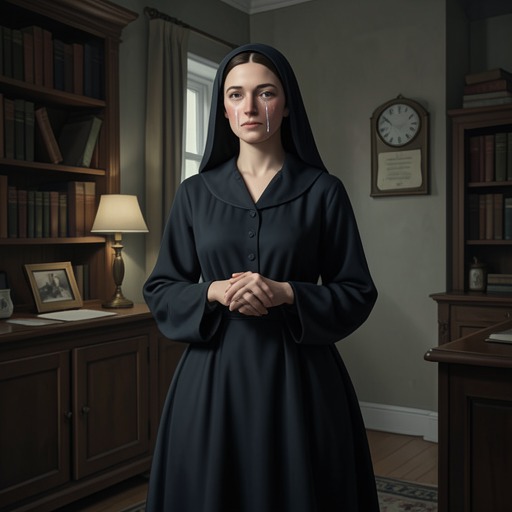
Margaret Kochamma’s bereavement and enduring guilt
The God of Small ThingsMargaret Kochamma’s bereavement and enduring guilt are bound to the journey she chose for Sophie Mol and to the child’s death by drowning. She never forgives herself for bringing her daughter to Ayemenem and leaving her there over the weekend while she and Chacko went to Cochin to confirm their return tickets. The loss strikes twice: Sophie’s death revives Margaret’s grief for Joe, her second husband, and leaves her with a memory she carries for the rest of her life. Her shock, broken recollections, and later apology show how mourning becomes both an intimate wound and a force that reaches into the lives of the other children.
The journey and the decision that remained
Despite everything that had happened between her and Chacko, Margaret would rather spend Christmas with him than with anyone else. She persuades herself that a trip to India would be good for Sophie Mol. Although she expects friends and colleagues at school to find it odd that she is returning to her first husband so soon after her second husband’s death, she breaks her term deposit and buys two airline tickets for the route from London through Bombay to Cochin. The practical decision carries a hope of healing: she has come to Ayemenem to mend a wounded world. After Sophie’s death, that hope is reversed into a lifelong accusation against herself.
The immediate circumstance that gives her guilt its sharpest edge is not simply that she brought Sophie to India. Margaret blames herself for leaving the child in Ayemenem while she and Chacko travelled to Cochin to confirm their return tickets. The absence lasts over the weekend; when the adults return, Sophie is dead. The narrative makes the remembered decision and its consequence inseparable: what had been a short trip to arrange travel becomes, in retrospect, the moment Margaret cannot stop revisiting.
The body and the recognition of death
Margaret’s memory holds Sophie not as an abstract loss but as a body laid out on the chaise longue in the drawing room of Ayemenem House. Even from a distance, the child’s posture makes clear that she is dead, not ill or asleep. The description fixes death in the angle of her limbs and in the stillness that seems to possess authority of its own. Green weed and river grime are woven into Sophie’s red-brown hair; fish have nibbled at her sunken eyelids, and her mauve corduroy pinafore still bears its cheerful word, Holiday! Her skin is wrinkled from remaining in the water too long. The bright promise of a holiday and the physical evidence of drowning coexist in a single remembered image.
The discovery follows a morning of uncertainty at Ayemenem House. Sophie Mol and the twins have not appeared for their morning glass of milk. Because heavy rain fell the previous day and much of the night, Mammachi and Baby Kochamma worry that the river may be dangerous, and Baby Kochamma sends Kochu Maria to search. She returns without the children. In the confusion following Vellya Paapen’s visit, no one can establish when the children were last seen; they may have been missing all night. At about nine in the morning, the household learns that a white child’s body has been found floating downriver where the Meenachal widens toward the backwaters. By the time Margaret and Chacko return from Cochin, Sophie has been laid on the chaise longue, and the journey’s hopeful purpose has given way to the sight that will haunt Margaret for the rest of her life.
Shock, grief, and fractured memory
When Margaret sees her daughter’s body, shock swells in her and breaks into vomiting, leaving her mute and empty-eyed. The loss is doubled in her experience: with Sophie, Joe dies again. This second bereavement has none of the ordinary tasks that had accompanied the first, such as homework to finish or an egg to eat. Margaret had come to Ayemenem seeking repair, but instead feels that she has lost everything and shattered like glass.
Her recollection of the days that follow is indistinct and discontinuous. Medically administered tranquilizers bring long periods of dim, heavy serenity, interrupted by acute episodes of hysteria. The fragmentary quality of the memory conveys the aftermath without presenting grief as a settled or orderly process. She is only vaguely aware of Chacko beside her, concerned and gentle-voiced, and of his contrasting anger elsewhere in the house. At the funeral in the yellow church she faintly remembers sad singing and a bat that had troubled someone. She also remembers doors being battered down, frightened women’s voices, and bush crickets whose night sounds seemed to amplify the fear and gloom in Ayemenem House. These impressions gather the funeral and the surrounding household crisis into a memory that remains blurred, broken by sharp sounds and moments of panic.
Blame, apology, and what remains unsaid
Although Margaret does not know what the children experienced, she repeatedly seeks Estha out while surfacing from drug-induced sleep and slaps him. Someone has to calm her and lead her away. Her grief is thus directed, for a time, at a child who is himself caught in the events surrounding Sophie’s disappearance and death. The narrative leaves the source of Margaret’s blame uncertain rather than presenting it as knowledge: it raises the possibility of a mother’s instinct, while making clear that she does not know what happened.
Later, Margaret writes to Ammu to apologize. In the letter, she says she cannot imagine what came over her, attributes her conduct to the tranquilizers, admits that she had no right to behave as she did, and says she is ashamed and terribly sorry. But the apology arrives after Estha has been sent away and Ammu has had to leave; Rahel is the only one in Ayemenem who can receive it on Estha’s behalf. The letter acknowledges the harm without undoing the separation that has taken place in the meantime.
There is also a limit to Margaret’s memory and remorse. She never thinks of Velutha and has no memory even of what he looked like. The narrative links this absence to the fact that she never really knew him and never heard what happened to him. Her recollections remain concentrated on Sophie, the return to the house, and the family’s visible grief; the absence of Velutha from her account marks how much of the surrounding tragedy lies beyond what she knows. Margaret’s lasting burden is therefore both intensely personal and partial: she carries Sophie’s death and her own decision as an unhealed wound, while remaining unaware of another death entangled in the same crisis.