Meenachal River
The God of Small ThingsThe Meenachal River is the landscape’s shifting boundary and one of the novel’s central routes of consequence. Near where it broadens toward the backwaters, the discovery of a child’s body turns the family’s fear into a confirmed tragedy; elsewhere, its swollen current is crossed by people whose actions belong to the chain of events that follows. The river is not merely a backdrop: it joins the children’s vulnerability, the family’s crisis, and the enforcement of social order in a single changing landscape.
Setting and Changing Waters
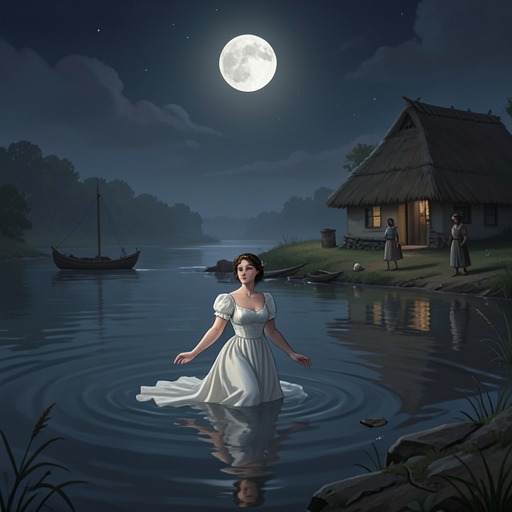
The river changes with the weather and the hour. After heavy rain, it is dangerous enough that the adults worry the children may have gone swimming. At dawn, it remains quick and swollen from the previous night’s rain; later, as it approaches the backwaters, it broadens. These variations give the river a practical force in the plot: its condition shapes what crossings are possible and makes the children’s absence more alarming.
At night, the river rises and moves toward the sea, carrying fragments of the landscape and debris left by the wind. Its movement places Ayemenem in a larger geography of currents and tides, while also making the river a boundary that can be crossed but not controlled. The water’s changing state recurs alongside events that the family cannot reverse.
The Children’s Disappearance and Loss
One morning, the children do not appear for their usual glass of milk. Baby Kochamma and Mammachi first suppose that all three may have gone down to the river for a swim, a possibility made dangerous by the rain of the previous day and night. At about nine, they receive news that a white child’s body has been found floating downstream, where the river widens toward the backwaters. Estha and Rahel are still missing at that point. The river thus marks the transition from uncertainty to the recognition of a loss, while the children’s absence leaves the adults without a complete account of what has happened.
The children later run along the bank calling for the missing girl, but she is gone. The river becomes inseparable from the consequences of the crossing and the family’s bereavement: it carries the child away, while those left on its banks can only call after her. The scene gives the water a double function—as a route through the landscape and as a force that makes a return impossible.
Crossings and the Police
The river is also crossed by individuals whose actions bring the family’s private crisis into contact with public authority. In one night crossing, a young man sits on the highest of thirteen stone steps leading into the water, then enters the river and swims across to the other side. The crossing is accomplished in a few minutes, but its place in the unfolding events gives the river a stark threshold quality: one bank and the other are physically close, while what happens on either side carries different risks.
Afterward, a posse of Touchable Policemen crosses the river and moves through wet undergrowth, with a handcuff in someone’s pocket. The crossing makes the river a passage for organized force as well as individual movement. The police arrive not as neutral observers of the landscape but as agents of a social order whose authority will determine how events are officially treated.
Social Order and Narrative Significance
The river’s role in the story is bound to the caste relations that shape who may cross social boundaries and what follows when those boundaries are challenged. The novel recalls that members of oppressed communities converted to Christianity under British rule in hopes of escaping Untouchability, yet continued to face separation; after Independence, their formal status as Christians also excluded them from benefits reserved for officially recognized castes. This history clarifies the unequal order surrounding the river crossings without reducing the river itself to a simple symbol.
The narrative describes the children as witnesses to a demonstration of human beings’ pursuit of ascendancy, structure, order, and monopoly—a social history presented under the guise of divine purpose. Against that account, the Meenachal River remains materially changeable: swollen by rain, flowing toward the sea, and carrying what enters it. Its crossings connect episodes of loss and state power, while its persistent movement contrasts with the rigid human hierarchies enforced on its banks.