Paradise Pickles & Preserves
The God of Small ThingsParadise Pickles & Preserves is the Ipe family’s pickle and preserves factory, founded by Mammachi and later registered, expanded, and renamed by Chacko. Its trajectory from a profitable small enterprise to a debt-laden business that closes makes it more than a setting: the factory gathers the novel’s conflicts over work, ownership, gender, caste, and political representation into a single place. Its products are made, labeled, and sold there; so are the inequalities that determine whose labor counts, who controls the enterprise, and who can claim to speak for its workers.
Origins, products, and setting
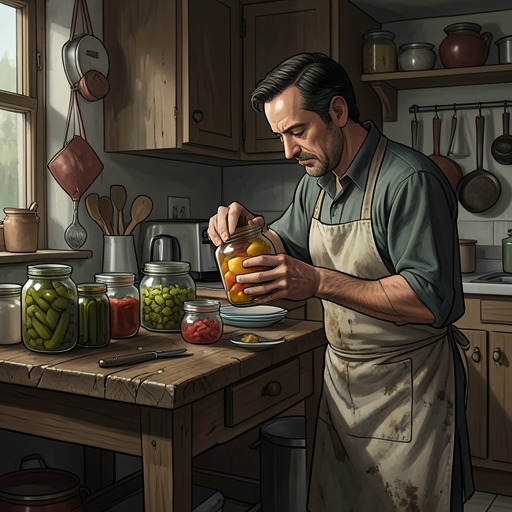
Mammachi began making pickles commercially after Pappachi retired from government service in Delhi and the family moved to Ayemenem. When the Kottayam Bible Society held a fair, it asked her to make banana jam and tender mango pickle. The goods sold quickly, and new orders soon exceeded what she could manage alone. At first the business remained small but profitable, run by Mammachi much like a large kitchen.
The factory produced pickles, squashes, jams, curry powders, and canned pineapples. It also made banana jam even after the Food Products Organization prohibited its sale: the official specifications deemed its consistency neither jam nor jelly, being too thin for one and too thick for the other. The disputed product’s difficult classification echoes, without making the two situations equivalent, the novel’s wider concern with boundaries and the authorities that enforce them.
The business’s name and packaging made it visible beyond its premises. Chacko called it Paradise Pickles & Preserves and commissioned its labels from Comrade K. N. M. Pillai’s press. He first proposed Zeus Pickles & Preserves, but the family rejected the name as too obscure and locally irrelevant; Pillai’s alternative, Parashuram Pickles, was rejected as too locally specific. A later design bore a Kathakali dancer and the slogan “Emperors of the Realm of Taste.” The name, logo, and slogan turned a family enterprise into a public identity, while the factory’s actual fortunes remained precarious.
The building’s later appearance reverses that promise. From the dining-room window, Rahel sees rain falling on the rusted tin roof of what had been her grandmother’s factory. The company’s end is also registered through the cessation of work: pickling, squashing, slicing, boiling, stirring, grating, salting, drying, weighing, and sealing all stop. The factory is reduced to “The earthly remains of Paradise Pickles & Preserves,” a phrase that treats a commercial site as a surviving relic of a lost family world.
Ownership, work, and gender
The factory’s transformation begins when Chacko arrives and registers the business as a partnership. He tells Mammachi that she is the “Sleeping Partner,” invests in can-flinging machines, cauldrons, and cookers, and increases the labor force. Yet expansion does not bring stable prosperity. The financial decline begins almost immediately, buoyed artificially by bank loans Chacko secures against the family’s rice fields around Ayemenem House.
The legal and practical distribution of authority is unequal. Ammu works at the factory as much as Chacko, but he describes it to food inspectors and sanitary engineers as his factory and his products. Legally, Ammu has no claim to the property because she is a daughter. That exclusion sits alongside the family’s conventional view, expressed by Baby Kochamma, that a married daughter has no place in her parents’ home and a divorced daughter no place anywhere. The factory thus reproduces a domestic order in which women’s labor can be essential while ownership and public credit remain with a man.
Chacko’s self-identification as a Marxist does not dismantle hierarchy in the workplace. He summons attractive women employees to his room under the pretext of explaining labor rights and trade-union law, flirts with them, and insists that they address him as Comrade. He also makes them sit with him for tea, to their embarrassment and Mammachi’s dismay. Mammachi knows of his relationships with women workers and eventually ceases to be hurt by them; when Baby Kochamma raises the subject, Mammachi becomes tense and silent.
Mammachi accommodates Chacko’s behavior by arranging a separate entrance to his room at the eastern end of the house, so the women do not have to pass through the rest of the home, and by secretly giving them money. She understands payment as a way of separating sex from love, while the household’s explanation of Chacko’s conduct as “Men’s Needs” leaves his Marxist politics and his feudal entitlement unreconciled. The arrangement protects family respectability and meets the women’s stated material needs, but it does not redistribute power: the factory’s male owner retains control over both employment and access to the domestic space.
Caste, labor politics, and the factory conflict
The factory’s workforce exists within the caste restrictions that shape Ayemenem beyond its walls. As a boy, Velutha had accompanied Vellya Paapen to deliver coconuts at the back entrance of Ayemenem House, because Pappachi would not permit Paravans to enter. Mammachi recalls rules that had required Paravans to avoid public roads and observe other restrictions intended to keep them from contact with caste Hindus and caste Christians. Conversion to Christianity had not erased caste exclusion: converts among Paravans, Pelayas, and Pulayas were given separate churches and clergy, while their formal Christian status later deprived them of benefits reserved for disadvantaged castes.
Mammachi rehires Velutha as the factory carpenter and places him in charge of general maintenance. That employment gives him a defined position in the business, but does not remove the social antagonism surrounding him. Of the factory’s workers, he is the only card-holding member of the Communist Party. Pillai hopes that organizing the workers could strengthen his own political prospects, yet considers Velutha a complication: the other Touchable workers resent him, and Pillai waits for a chance to resolve the problem in his own favor.
Wages sharpen the difference between public principle and daily conditions. Because the business is struggling, the workers receive less than the minimum rates specified by the Trade Union. Chacko himself points out the shortfall and promises revised wages if the factory’s finances improve; he believes the workers trust that he has their interests at heart. The promise does not change the immediate underpayment, and the workers’ dependence on a failing employer makes the promised improvement uncertain.
Pillai’s attention to the factory is also political calculation. He watches its affairs closely because bringing even a small labor union into a hoped-for future constituency could help him on a path to the Legislative Assembly. His interest in organizing workers therefore has both a collective and a personal political dimension. The contradiction is most visible in the dispute that follows: Pillai publicly delivers speeches about the rights of Untouchables during the Communist Party siege, while his dealings with Velutha remain shaped by the political inconvenience of Velutha’s caste position and party membership.
Decline, closure, and narrative significance
A new product briefly gives the factory the appearance of continued initiative. Chacko brings Pillai a crumpled sketch for a label for Synthetic Cooking Vinegar, planned for a spring launch. Pillai understands the design and wins the printing contract, then shifts his political characterization of Chacko from an ally in the ranks of the Overthrowers to someone among those to be overthrown. The business venture and the political maneuver become entangled, but the conflict ends before it can develop into the prolonged struggle Pillai had wanted.
When the factory slumps without resistance, Pillai realizes that the process of political conflict had mattered to him more than victory itself: a continuing struggle might have advanced his ambitions, whereas a quick triumph leaves him no better placed. The closure also reveals the limits of Chacko’s business project. After the loss of Sophie Mol, grief numbs him; he abandons both his dreams of becoming a pickle baron and his People’s War. The factory’s failure is followed by the sale of rice fields, first to meet the bank loans and then to provide food and clothing for the family. A business financed against family land leaves the household with less of that land once the enterprise ends.
The public account of the factory’s conflict differs from the unresolved private one. Newspaper reports describe Sophie Mol’s death, the police “Encounter” with a Paravan accused of kidnapping and murder, and the subsequent Communist Party siege of Paradise Pickles & Preserves. Pillai presents the siege as a protest against management’s alleged role in implicating a Communist Paravan in a false police case. Yet the precise nature of Pillai’s role in the events is never established, and even Chacko does not learn the whole story. By then, his grief has turned his attention away from the political and commercial projects he once pursued.
The building belongs to a broader landscape of altered access and historical loss. The History House can no longer be approached from the river; its hotel guests arrive from Cochin by speedboat, leaving a film of gasoline on the water. In contrast with that new route and commercial use, the factory’s rain-beaten roof and abandoned remains preserve a different kind of history: not a restored attraction, but the residue of labor, debt, family authority, and the political claims made in its name. Long after production has stopped, something remains buried beneath grass and twenty-three years of June rain. The factory’s remembered products and ruined site hold together the book’s central tension between what a family and its public stories try to preserve, and what their arrangements of power ultimately destroy.