The Play
The God of Small ThingsThe Play is a recurring theatrical metaphor through which the novel shows social life being staged and enforced. Family members, children, workers, and officials occupy unequal parts; what may be spoken is carefully limited, while grief, desire, and the forces shaping events remain unsaid. The metaphor begins as a child’s perception of a family welcome and expands into a way of understanding history itself as a performance whose roles are assigned by power.
The family welcome as a staged scene
When Margaret Kochamma and Sophie Mol arrive, Rahel recognizes that she has entered a Play and that her own part is small: she is merely landscape, perhaps a flower or tree, a face among the townspeople. Ammu’s gentle touch on her shoulder tells her to be quiet. The gesture does more than hush a child; it places Rahel within a scene whose rules are already in force and whose central figures are elsewhere.
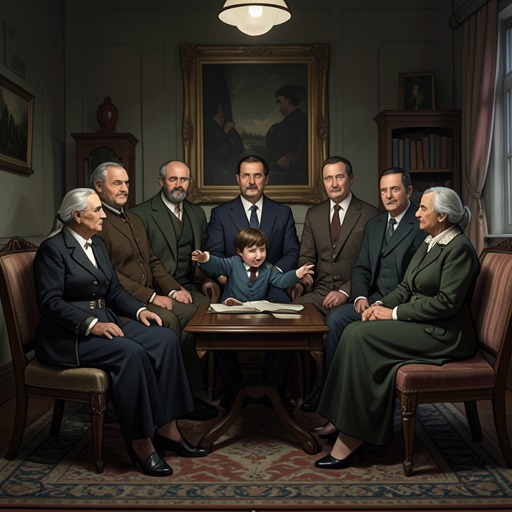
Chacko leads Margaret Kochamma and Sophie Mol triumphantly up the nine red steps, dressed in a suit and tie that make him look like a public man presenting his prizes. The arrival is organized as display: he has brought home a former wife and a child, and the family’s attention gathers around them. The image of Sophie Mol as one of two tennis trophies makes the welcome’s affection inseparable from its performance of status. Around the visitors, the family says what the occasion permits, while larger truths remain submerged.
This division between the spoken and the withheld is stated as a governing rule: only the Small Things are said; the Big Things lurk unsaid inside. The sentence captures both the social decorum of the welcome and the pressure beneath it. The Play is not simply make-believe: it is a structure that determines whose arrival becomes an occasion, whose feelings must be contained, and which subjects cannot safely enter the conversation.
Roles that follow their actors
The theatrical image reappears outside the formal family gathering. When Sophie Mol goes to see what Rahel is doing behind the well, the Play goes with her: it walks when she walks and stops when she stops. The observing smiles follow Sophie, while Kochu Maria moves the cake tray out of the way of her adoring downward gaze. Even in a muddy, unpleasant corner, the scene remains organized around Sophie’s favored place within the family. Rahel, by contrast, is again peripheral, and the difference between the girls is staged through attention and movement rather than explained outright.
Rahel and Velutha can briefly name their exclusion from this arrangement. Rahel tells him they are not there and are not even Playing; Velutha agrees and asks where Estha is. Their exchange makes the metaphor more complicated than a simple distinction between performer and audience. The two are outside the recognized scene, but that does not mean they are free of its power. Their position gives them a view of the roles being enacted, while their exclusion leaves them vulnerable to the social order that assigns those roles.
From social performance to political order
The Play’s implications become darker when the narrative turns to the police account of Velutha. Baby Kochamma tells Inspector Thomas Mathew that a factory worker, a Paravan, tried to force himself on Ammu. She reframes Ammu and Velutha’s relationship as an assault, presenting the charge as a way to contain scandal and defend the family’s reputation. In the telling, she also folds the manner of a man who had humiliated her during the march into her description of Velutha, making her account serve her own fear as well as her claim against him. The accusation becomes more convincing to her as she repeats it.
The official scene has its own roles and cues. The Inspector asks why the matter was not reported earlier; Baby Kochamma lowers her eyes like a chastised child, then invokes Velutha’s supposed insolence, his appearance at the march, and rumors that he was or had been a Naxalite. Her performance of distress and respectability helps turn a distorted family story into a police report. The scene shows that the Play is not confined to domestic manners: it governs who can frame an event, which account gains institutional force, and whose experience is displaced by that account.
Inspector Thomas Mathew, though a Congress man, takes care to consult Comrade K. N. M. Pillai rather than risk a clash with the Marxist government. He summons Pillai to the station and shows him the First Information Report. Pillai acknowledges knowing Velutha but withholds that Velutha belonged to the Communist Party and had come to him the previous night; he also does not challenge the false allegation. The two men do not trust one another, yet they understand how to work the system. Their brief exchange is described as the coordination of mechanics servicing different parts of the same machine. The stage has changed from family home to police station, but the unequal distribution of authority remains.
The children trapped in a role
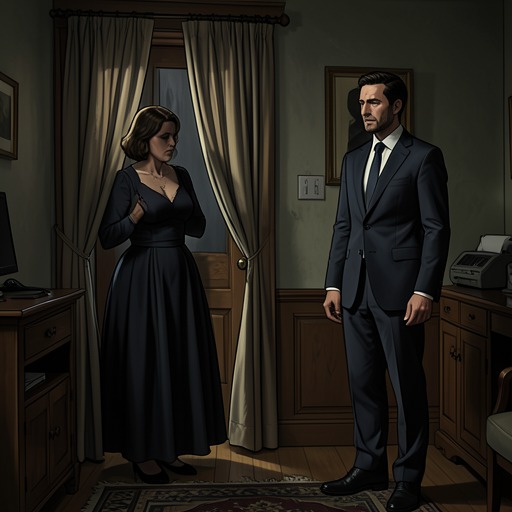
The theatrical metaphor reaches its most intimate form in the image of Rahel outside Estha’s room. Estha sits on his neat bed, looking through the barred window into the darkness; Rahel, outside, looks in at the light. They are described as actors trapped in an obscure play without a hint of plot or narrative, stumbling through parts and nursing someone else’s sorrow, grieving someone else’s grief. The staging gives their separation a concrete shape: each is visible to the reader, but neither can cross the distance between them in that moment.
The passage considers, without presenting it as something they actually receive, how a counselor might tell them they were children, not sinners, and had no control over what happened. Such words might have allowed them to occupy the role of victims, feel anger, seek redress, and perhaps exorcize the memories that haunt them. Instead, they cannot make that crossing. Their inability to adopt the socially legible part of the wronged victim leaves them caught in a play whose sorrow belongs to events they did not control but whose consequences they continue to carry.
History staged as power
The novel finally enlarges the metaphor beyond private memory. What Estha and Rahel witness, though they do not understand it at the time, is called a clinical demonstration of humanity’s pursuit of ascendancy: structure, order, and complete monopoly. History appears as a performance masquerading as God’s Purpose before an under-age audience. The language of theatre exposes the event as made and enacted rather than accidental or inevitable: the era is imprinting itself on those who live through it.
The Play therefore links a child’s small part in a family welcome to the larger roles imposed by caste, political authority, and history. Its stages change—from the nine red steps to the well, the police station, and the scene the twins later remember—but the central imbalance persists. Some people control the story and its official version; others are made into scenery, accused figures, or child witnesses, left with grief they cannot readily name. The metaphor’s force lies in showing that a role can be both a performance and a constraint: recognizing the stage does not by itself give the actors power to leave it.