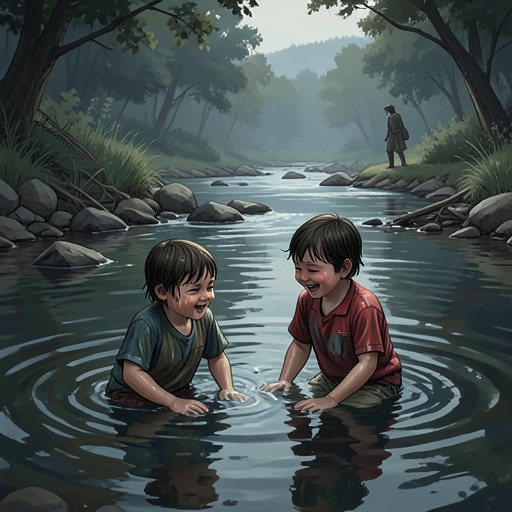
The twins find and prepare to repair the old boat
The God of Small ThingsThe twins find and prepare to repair the old boat, a discovery that converts a moss-hidden remnant into the means for a dangerous crossing. Estha is waiting beneath the mangosteen tree when Rahel finds him; the boat has lain so long beneath moss and ferns that it seems almost rooted in the earth. They carry it to the river, begin imagining its repair, and seek help from Kuttappen and Velutha. What begins as play becomes preparation: the little vallom will eventually carry them toward the History House, where the children’s secret world meets the adult catastrophe unfolding around them.
Discovery Beneath the Mangosteen Tree
Estha waits under the mangosteen tree Reverend E. John Ipe had brought home from Mandalay. The story delays naming what he is sitting on, first presenting it as something gray and grizzled, buried under moss, lichen, and ferns. Rahel joins him, and the twins clear away the growth and stones until the concealed object is revealed: a tiny wooden vallom, the boat Estha has been sitting on and Rahel has found. It is so old that it has nearly taken root.
The discovery is staged as a small act of recovery. The boat is not simply lying ready for use: the earth has claimed it, and the children must uncover it by touch and effort. That gradual recognition makes their find feel at once like a game and an encounter with something left behind. Its age and overgrowth contrast with the twins’ quick, eager movement; what has lain nearly absorbed into the ground becomes newly available for their plans.
From Discovery to Preparation
The twins can swim across the Meenachal River, and, under Chacko’s supervision, they have crossed it before, returning with a stone, twig, or leaf as evidence of their feat. But swimming is not the problem this time. They want to take the boat, with their things in it, so they can prepare to be prepared. The History House is invisible from where they stand, hidden beyond the swamp in the darkness of the abandoned rubber estate. Their destination exists first as something they cannot see, even as they begin readying a vessel to reach it.
When they lift the boat and carry it to the water, it looks to them like a grizzled fish surfaced from the deep, in need of sunlight. It needs scraping and cleaning, but seems to require little else. The image keeps the boat between recovery and use: it has emerged from concealment, but the children still have work to do before it can carry them. Their preparations turn the river crossing from an abstract possibility into a concrete undertaking.
Learning How to Mend It
The twins bring the boat to Kuttappen, who is paralyzed, and ask whether a leaking vallom is difficult to mend. When he asks whose boat is leaking, Estha claims it as theirs and offers to show it to him. They hold the grizzled boat over Kuttappen like a roof, and water drips on him as he inspects it. His practical answer gives the children a sequence of tasks: first find the leaks, then plug them. Estha adds sanding and polishing; Rahel adds oars. Their exchange makes the repair feel like a plan the twins can share, each adding a step to the work ahead.
They also try the boat in play. Estha steadies it on the uneven earth floor with blocks of wood found in Velutha’s backyard workstation, while Rahel gets a cooking ladle with a wooden handle and a polished half-coconut shell to serve as an improvised implement. The twins climb into the vallom and row across imagined vast, choppy waters. The makeshift equipment and the scale of their pretend voyage hold the scene between childish invention and the actual river crossing they are preparing to make.
Velutha’s Warning and Promise
The children tell Velutha that the boat sinks and leaks, then ask him to mend it. He does not simply agree: he warns them against playing silly games on the river. They promise to use the boat only when he is with them. Velutha returns to the same practical first step Kuttappen had named—finding the leaks—and the twins eagerly complete the next part of the familiar sequence, saying that the leaks must be plugged.
When Estha asks how long the work will take, Velutha says a day. Estha is delighted; he had expected a month. He jumps on Velutha, wraps his legs around Velutha’s waist, and kisses him. The promise compresses the distance between the children’s hopeful preparations and the boat’s possible use: the repair no longer seems remote. Velutha’s caution remains, but the offer to help gives the twins’ project both a responsible adult’s involvement and a time limit they can anticipate.
The Boat’s Place in the Story
The old vallom is a practical link in the chain of events around the river. The twins’ effort to prepare it makes possible the crossing associated with Ammu’s secret love for the man her children love by day. Its rediscovery therefore carries two kinds of anticipation: for Estha and Rahel, the boat is an exciting object to claim, mend, and row; in the larger story, it is part of the route by which childhood plans move toward the History House and its consequences.
The narrative’s delay in identifying the boat echoes the children’s own task of clearing it from the earth. Before the object can be named, the reader sees the moss and ferns, the searching fingers, and the struggle to find an edge to hold. The revelation transforms a seemingly ordinary concealed object into the center of a shared undertaking. Their repairs, improvised rowing, and promise to Velutha make that undertaking tangible, while the hidden destination and the boat’s role in the later crossing give the scene its shadow of impending loss.