Travancore-Cochin Marxist Labour Union
The God of Small ThingsThe Travancore-Cochin Marxist Labour Union is the labor organization behind the march that passes the Ipe family’s car on a December day. Its demands include a lunch break, higher wages, and an end to addressing Untouchable workers by caste names. The novel connects this public campaign for workers’ rights to the factory’s own labor disputes and to the local political maneuvering that ultimately leaves Velutha without party protection.
The march and its demands
The march is part of a broader political process: comrades in Trivandrum are to present a Charter of People’s Demands to the state’s chief minister. The union’s campaign makes the laborers’ long working day concrete. Paddy workers are required to work eleven and a half hours, from seven in the morning until six-thirty in the evening; the marchers seek a one-hour lunch break.
The demands also address wages. Women workers are paid one rupee and twenty-five paisa a day, and the union seeks to raise that to three rupees. Men’s daily wages, then two rupees and fifty paisa, are to rise to four rupees and fifty paisa. Alongside pay and working hours, the march calls for Untouchable workers to be addressed by their personal names rather than caste labels. Its program therefore contests both economic conditions and the everyday language through which caste hierarchy is enforced.
A coalition under pressure
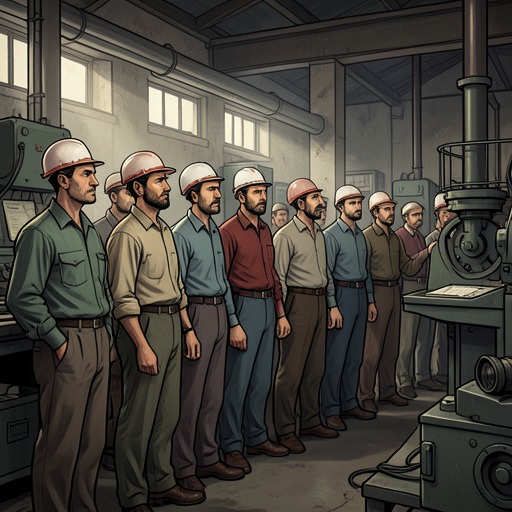
The marchers include party workers, students, and laborers, both Touchables and Untouchables. Their coalition carries what the narration describes as accumulated anger, sharpened by a newer, Naxalite edge. The union’s public demands thus gather different groups around shared labor grievances without erasing the social divisions among them.
The march also unsettles the landed and business elite. Plantation owners and other wealthy men meet at the Sailing Club, where they raise a toast to the idea that a rose would smell as sweet by another name and laugh to conceal their unease. Their reaction sets the union’s demand for workers to be called by their own names against the comfortable wordplay of those who benefit from the existing order.
The factory and local party politics
At Paradise Pickles, Chacko describes himself as a Marxist and uses the language of comradeship with factory women. He invites them to his room under the pretext of discussing labor rights and trade-union law, presses them to call him Comrade, and takes some of them to trade-union classes in Alleppey. Yet the factory’s financial difficulties lead to workers being paid below the minimum rates specified by the Trade Union. Chacko acknowledges the shortfall and promises that wages will be revised if business improves.
Comrade K. N. M. Pillai, meanwhile, urges the workers to demand a yearly bonus, provident fund, and accident insurance in after-hours meetings at his printing press. His speeches join local workplace grievances to broader revolutionary rhetoric, but his position is not independent of private interest: his press earns income from printing the factory’s labels, and he distinguishes the factory owner from the abstract figure of management when it suits him. The union’s political setting is therefore marked by a gap between egalitarian language and the practical relationships through which local influence and income are maintained.
Velutha and the limits of solidarity
Velutha is the only Paradise Pickles worker who holds party membership. That status could make him an ally for Pillai, but Pillai regards it as an awkward complication: the other Touchable workers resent Velutha for older social reasons, and Pillai waits for an opportunity to resolve the problem. The union’s language of workers’ unity thus coexists with caste prejudice among the workforce and with political calculation at its local leadership level.
When Inspector Thomas Mathew summons Pillai to ask whether Velutha has political backing, Pillai says that Velutha has no party protection. He omits both Velutha’s membership and the fact that Velutha had come to him the previous night seeking help. This response removes a possible source of support at a moment of danger. The novel’s larger account of history as an exercise of power places the union’s promised solidarity beside this decisive failure: collective demands are real, but membership and rhetoric do not guarantee protection when local political interests and caste hierarchy converge.