Velutha
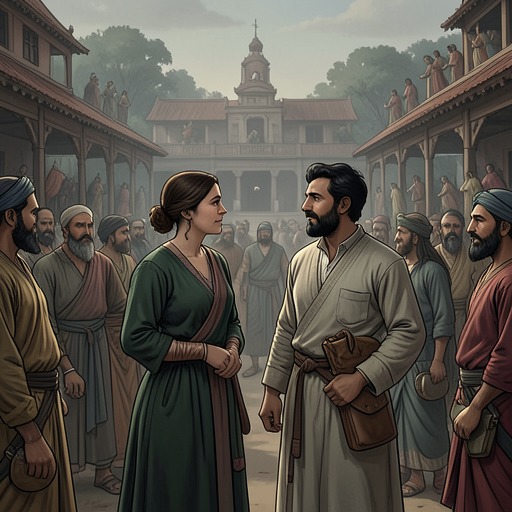
The God of Small ThingsVelutha is a gifted carpenter and a Dalit man whose relationships with Ammu and her children bring the novel’s intimate world into collision with caste hierarchy. He is recognized through the work of his hands and the closeness he shares with the children, yet the same society that benefits from his skill treats his caste as a boundary he must not cross. His fate exposes how family power and official authority turn that boundary into a lethal one.
Identity and Background
Velutha belongs to a community marked by untouchability. His grandfather Kelan was among the Paravans, Pelayas, and Pulayas who converted to Christianity under British rule, hoping to escape caste oppression. The converts were given food and money, but remained segregated: they had separate churches, services, and priests. After independence, their official Christian status also excluded them from government benefits reserved for disadvantaged castes. This history places Velutha within a community caught between formal religious inclusion and enduring social exclusion.
His individual life nevertheless includes education and specialized expertise. At fourteen, he began working with Johann Klein, a German carpenter conducting a workshop in Kottayam. After school, Velutha travelled there by bus and worked until dusk. By sixteen he had completed high school and become an accomplished carpenter, with his own tools and a design sensibility shaped by Klein’s instruction.
Work and Place in the Household
Velutha’s craft leaves a visible mark on the Ipe household. He built Mammachi a Bauhaus-style rosewood dining table and twelve chairs, as well as a Bavarian chaise longue from jackwood. For Baby Kochamma’s annual Nativity plays, he made wire-framed angel wings, cardboard clouds, and a manger. These objects register both his technical range and the family’s reliance on his labor: his work enters their home and ceremonial life even as caste denies him equal membership in it.
The novel repeatedly identifies him through his carpenter’s hands and distinctive presence. A birthmark on his back, shaped like a pointed dry leaf, is called his Lucky Leaf; he says it brings the monsoons on time. The mark becomes a means by which Rahel recognizes him, recalling that she had been carried on his back many times. Later, the image returns as he walks with a coil of insulated wire over one shoulder, his mundu folded above his knees. The recurring leaf links the children’s intimate knowledge of him to the natural and seasonal imagery surrounding the story.
Relationships with Ammu and the Children
Velutha’s bond with the children is affectionate and familiar. He sees them every day and loves them, though he does not initially understand why that love feels different after the family’s encounter with History. In a moment when he is holding Ammu’s daughter, he catches Ammu’s gaze; the narration presents their recognition as a brief suspension of the old social order, not its lasting defeat.
Ammu and Velutha’s relationship violates the caste and gender conventions governing Ayemenem. Baby Kochamma’s view of divorced women sharpens the danger: she believes a married daughter has no place in her parents’ home, a divorced daughter has no place anywhere, and a divorced daughter from an intercommunity love marriage is beyond acceptable description. The contrast is stark. Ammu’s family status makes her vulnerable to expulsion, while Velutha’s caste makes the relationship available to others as a justification for punishment.
Accusation and Political Calculation
After Vellya Paapen reveals the relationship to Mammachi, Mammachi’s anger is redirected against Ammu and Velutha. Her response is framed by caste contempt: she treats her daughter’s relationship with a Paravan as a disgrace and imagines Velutha through demeaning stereotypes. The episode shows private prejudice becoming a family judgment with consequences beyond the household.
Baby Kochamma then brings the matter to the Kottayam police station. She tells Inspector Thomas Mathew that Velutha, a Paravan worker recently dismissed from the factory, had tried to force himself on her niece. The accusation recasts a forbidden relationship as an assault and gives the authorities a story suited to the family’s interests. The inspector questions the family’s conduct toward workers, but his concern is also political: he sends for Comrade K. N. M. Pillai to determine whether Velutha has political support. Although the inspector is a Congress man, he does not want a confrontation with the Marxist government. His precaution makes clear that the response is shaped not only by the allegation but by calculations about local power.
Arrest and Narrative Significance
Velutha returns to the Ayemenem House and faces Mammachi’s outburst with striking restraint. He seems to understand that the old order has been waiting to catch up with him, yet composure does not protect him. The later account places him among the victims of a demonstration of human beings pursuing ascendancy through structure, order, and control. The children witness the violence without yet understanding its political meaning.
The narrative also associates him with details that resist the official reduction of him to a threatening worker: his exquisite carpentry, his daily care for the children, and even his discarded red nail polish, which he had allowed the children to apply. The police laugh at the bright nails, turning a small, playful detail into another occasion for humiliation. In the novel’s moral structure, Velutha’s death is not an isolated tragedy or an accidental storm. It follows from a system in which caste prejudice supplies the accusation, family respectability gives it force, and political calculation helps authority act without regard for his humanity.