old vallom boat
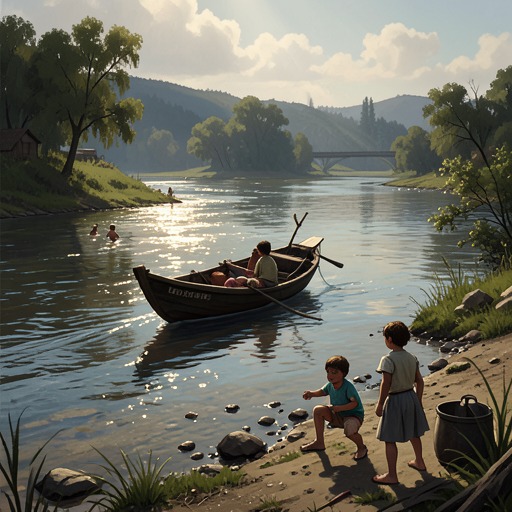
The God of Small ThingsThe old vallom boat is a tiny wooden craft, long neglected and nearly reclaimed by the ground, that Estha and Rahel discover and set about restoring. More than a means of crossing the Meenachal River, it is the physical hinge between the twins’ preparations to reach the History House and Ammu’s secret crossings to meet the man her children love by day. Its age, leaks, and slow return to use give an ordinary object a charged place in the story’s movement toward disaster.
Discovery and Material Condition
The boat emerges after a searching, laborious effort through ferns and stones. The narration first suspends recognition, then names what the children have found: a tiny wooden vallom. It is the boat on which Estha sat and which Rahel found, and its age is made tangible by the suggestion that it has almost taken root. The craft seems less like a ready vehicle than an abandoned part of the landscape, entangled in the long stillness of the place.
That condition matters because the boat has a history of use beyond the children’s immediate plans. Ammu will use it to cross the river at night, to love the man her children love by day. The same vessel therefore belongs to two intersecting journeys: the twins’ secret preparation for the Other Side and their mother’s forbidden passage toward Velutha. The boat’s smallness and decay do not lessen its importance; they make the crossing dependent on something precarious and difficult to revive.
The Twins Prepare a Crossing
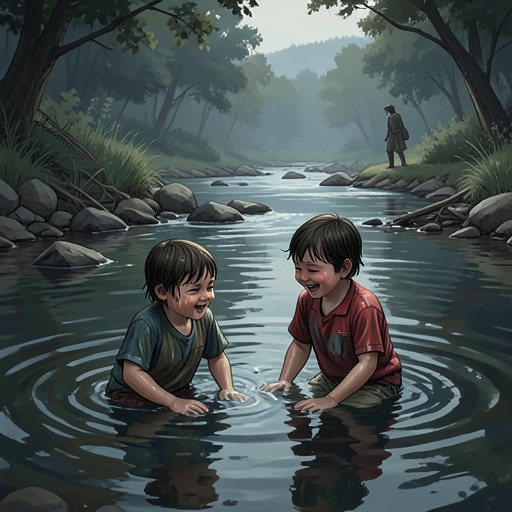
The twins can swim across the river, and under Chacko’s supervision they have crossed before, returning breathless with a stone, twig, or leaf from the Other Side as proof. Swimming itself is not the obstacle. Their undertaking now requires the boat, with its contents, because they want to prepare to be prepared. The difference turns the craft into part of a deliberate expedition rather than a casual means of travel.
From the bank, the History House cannot be seen. It lies beyond the swamp as darkness at the heart of an abandoned rubber estate, with crickets swelling from that obscured direction. Estha and Rahel lift the boat and carry it down to the water. It looks, in the narration’s image, like a grizzled fish newly surfaced from the deep and in need of sunlight. It needs scraping and cleaning, but apparently little else: the children see possibility in a vessel that has spent so long almost merging with its surroundings.
Cleaning and Repair
The twins begin washing the boat in the river without discussing the decision. Cobwebs, mud, moss, and lichen wash away; the work makes its neglected surface visible and turns discovery into preparation. They then flip the cleaned craft upside down and hoist it onto their heads, carrying it together like a dripping shared hat. Estha uproots the red flag as they set off, and the boat becomes part of a small procession moving along a familiar path through undergrowth, past nettles, ditches, anthills, and a deep, water-filled laterite quarry.
The repair remains unfinished. When the twins take the grizzled boat to Kuttappen, the paralyzed man examines it while they hold it above him like a roof, water dripping down onto him. He gives them a sequence of work: first find the leaks, then plug them. Estha adds sanding and polishing; Rahel adds oars. Their exchange makes the boat’s restoration a practical collaboration, with each stage still ahead. The craft has been washed and carried, but it is not yet ready to sail.
Narrative Significance
The boat gathers together age, vulnerability, and intended movement. It has nearly taken root, yet the twins lift it from its resting place and imagine a future crossing; it looks as though it has surfaced from a depth, yet its leaks must still be found and sealed. The narration gives this transformation time, dwelling on the work of uncovering and cleaning rather than treating the vessel as a transparent tool. The children’s care makes its material condition part of the action: the journey depends on a damaged object that must be made usable.
Its significance is also built through dramatic convergence. The twins prepare the old boat for a journey toward the History House, a place they cannot see from the riverbank, while the reader knows that Ammu will use the same craft for nocturnal crossings to Velutha. The boat thus carries the children’s purposeful but incompletely understood preparations alongside the secret adult relationship that gives those crossings their danger. It is at once a found object, a joint project, and a narrow passage through which separate lives move toward the same charged landscape.