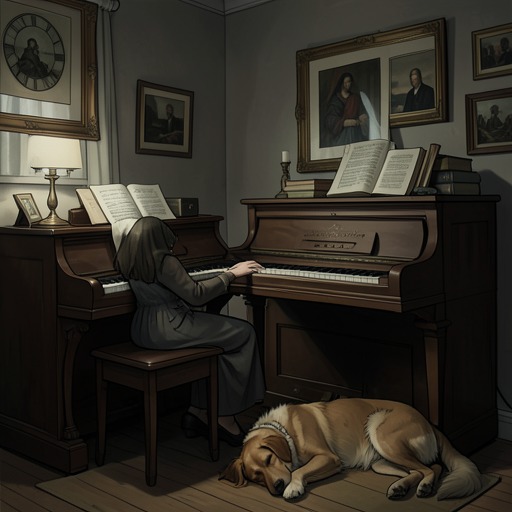
“From Granada to Seville”
The Heart of a Dog“From Granada to Seville” is a fragment of song that recurs at sharply different moments in Heart of a Dog. First heard as a falsetto serenade, it later accompanies the professor’s reflections on his work and his isolation; by its last appearances, the familiar refrain has become an anxious reminder of the consequences of the experiment. The phrase’s changing context gives it a small but persistent role in the book’s pattern of recurrence and contrast.
First Appearance and Musical Character
The refrain first enters as part of a song about Granada, Seville, and “those soft southern nights,” sung in a muzzy falsetto voice. The passage associates it with serenade imagery, while the surrounding scene also includes the professor addressing the dog he has brought in and an exchange with a male visitor. The song is therefore introduced not as a formal performance but as an audible fragment woven into the room’s activity.
A nearby continuation evokes sweet serenades and Spanish blades before the professor turns back to questioning the dog about its behavior. That shift from lyrical song to practical admonishment establishes a contrast that recurs in the phrase’s later use: musical fragments persist alongside the unsettled business of the experiment.
The Refrain Across the Narrative
The phrase returns at moments when music and memory intersect with the professor’s work. During a later exchange, the professor recalls an experience from twenty-five years earlier in Paris, in the Rue de la Paix. The episode does not explain the song’s entire history, but places the professor’s present within a longer personal past, in which remembered experiences and musical references surface together.
Elsewhere, the professor declines an evening’s work, citing both the rabbit’s death and a performance of Aida at the Bolshoi Theatre that he wants to hear. He recalls a duet through its rhythm. This separate musical reference helps establish that music is part of his everyday language and memory; the Granada refrain belongs to a broader pattern of songs interrupting practical conversation, not to an isolated decorative allusion.
Later, while a balalaika plays variations on “The Moon is Shining” in another room, the professor reads a newspaper article that disgusts him. The tune mingles in his thoughts with the article, and he finds himself humming it. Though this is not a return of the Granada refrain, it offers a close parallel: music becomes mentally involuntary amid the pressures of the household, linking sound, thought, and distress.
Loneliness and Disillusionment
The clearest emotional turn comes when the professor thanks his colleague and apologizes for sometimes being testy during operations. He admits that he is lonely, then breaks into the Granada refrain. The song now accompanies an explicit disclosure rather than merely filling the background of a scene. Its recurrence gives the moment a double quality: the melody offers a familiar verbal refuge, while the admission of loneliness makes that refuge feel exposed.
The refrain also returns during the professor’s bitter assessment of the experiment. He fears that its only result will be to leave them all burdened with Sharikov, and contrasts the transformation of a little dog with the repellent human specimen it has produced. In the same passage, he recalls years spent extracting cerebral appendages and asks what that labor was for. The song fragment intrudes upon a stark reckoning with consequences, setting its serenade-like associations against the professor’s disappointment in his own work.
Final Recurrence and Narrative Function
In a later moment, the professor imagines what Sharikov may be doing in the street and again associates the thought with the refrain. The song has moved from an atmospheric fragment to a signal of apprehension: its recurrence marks how the professor’s thoughts about Sharikov have come to occupy the same mental space as the tune.
The phrase’s function depends on repetition with variation. Its words remain recognizable, but the situations around it shift from song and domestic activity to loneliness, regret, and worry. The refrain does not itself explain or resolve the professor’s conflict. Instead, each return makes the contrast more legible between the cultured musical memories he carries and the increasingly troubling consequences he confronts.