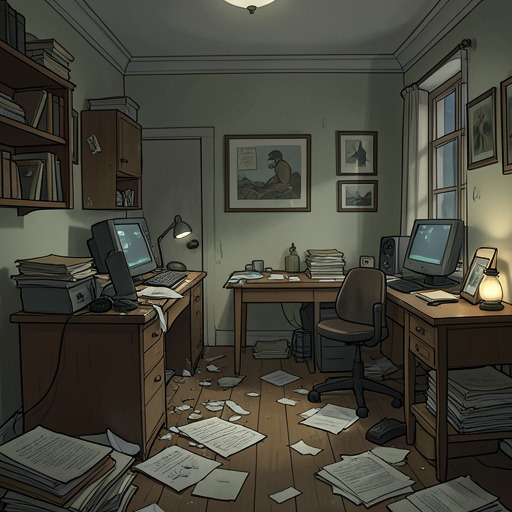
“Ruin starts in people's heads”
The Heart of a Dog“Ruin starts in people's heads” names Professor Preobrazhensky’s insistence that social disorder is produced by human conduct, not by an independent, almost supernatural force. In a heated exchange with Doctor Bormenthal, he turns the word “ruin” against those who invoke it: disorder takes hold when people neglect the work and everyday practices that keep shared life functioning.
The Argument Against an Abstraction
Doctor Bormenthal says that the place is going to ruin. Professor Preobrazhensky rejects the term as a “mirage, a vapour, a fiction,” and mocks the idea that ruin could be imagined as an old woman with a broomstick, breaking windows and putting out lights. His questions force the discussion away from a vague diagnosis and toward observable causes and actions.
Domestic Examples and Practical Responsibility
The professor’s central example is the lavatory. If he were to stop operating every evening and instead start a glee club in his apartment, he says, that would put him on the road to ruin. If he and Zina and Darya Petrovna stopped using the bowl and urinated on the floor, the lavatory would be ruined through their behavior—not by the lavatory itself. The example makes the claim concrete: a shared space deteriorates when the people responsible for it abandon ordinary care.
He extends the same reasoning to the public realm. Those who shout “Stop the ruin!” should, in his view, clear their own heads of “hallucinations” and get on with sweeping the backyards, which he calls their real job. He contrasts cleaning dirt from tram tracks with attempting to settle the fate of Spanish beggars: people cannot effectively undertake both tasks at once, he argues, and he emphasizes the mismatch by describing them as two hundred years behind the rest of Europe and unable even to fasten their own fly-buttons properly.
Rhetoric and Significance
The argument moves from the apartment’s lavatory to the street, connecting private habits with public disorder. Its sharp images and exaggerated contrasts give the professor’s definition force, but also make it polemical: he treats practical maintenance as the remedy and dismisses broader political preoccupations as distraction. The expression therefore condenses his view of ruin into a causal claim—neglected responsibility produces disorder—and makes the state of shared spaces a measure of the choices people make.