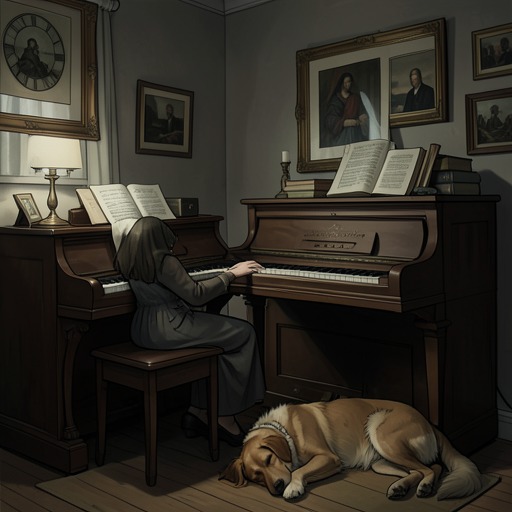
“To the banks of the sacred Nile”
The Heart of a Dog“To the banks of the sacred Nile” is a recurring refrain sung or hummed by Professor Preobrazhensky. Its significance lies in the way it carries the professor’s attachment to opera across sharply different settings: from his plans for an evening at the Bolshoi Theatre to the medical work that occupies his apartment, and from a private exchange with Bormenthal to the novel’s final return to the operating room. The refrain persists while the meaning of the scenes around it changes.
The refrain and the opera
The phrase first appears as part of the professor’s account of his evening. He declines another operation that night, explaining that a rabbit has died and that Aida is being performed at the Bolshoi Theatre. He recalls the duet and sings its rhythm before setting out his principle: there is time for different tasks when one is not always in a hurry. The Bolshoi’s task is to sing, his is to operate; the division of labour, he argues, is how things should be, and how “ruin” might be avoided. The refrain thus belongs initially to an explicit defence of specialized work and of the professor’s right to reserve time for art as well as surgery.
That separation becomes less secure in the evening scene at home. Behind thick blinds, in his study lit only by a green-shaded desk lamp, the professor works over human brains in jars, wearing red rubber gloves and cutting into the grey matter with a small knife. At the same time, he hums the words about the sacred Nile, his attention recalling the gilded auditorium of the Bolshoi. The opera does not interrupt the work; its melody accompanies it. The contrast makes the refrain more than an emblem of cultivated leisure: it persists beside the physical realities of the professor’s scientific practice.
A melody across changing circumstances
The phrase recurs in the professor’s private exchange with Bormenthal, where its familiar musical world stands against a discussion of fatigue, background, and the experiment’s value. Bormenthal urges his mentor to stop working, arguing that he is worn out and unfit to continue. The professor acknowledges the force of the concern, but refuses to abandon the work. Their conversation turns to their fathers’ social positions: Bormenthal’s father was a plain-clothes policeman in Vilno, while the professor’s father was a cathedral dean. The professor links these backgrounds to the Bolshevik perspective on their social origins, and the refrain enters the exchange as he moves between pointed reflection and song.
The melody also accompanies the professor’s reassessment of his experiment. He asks what practical value it has and recalls what Klim Chugunkin was: a man with two convictions, an alcoholic, and a thief who had taken the professor’s beaver hat and twenty roubles. The professor distinguishes the pituitary’s power to determine an individual human image from any power to create a universal human one. What had seemed theoretically interesting has brought him no practical improvement of humankind, the end he had hoped to serve. The refrain’s return within this argument sets the elegance of opera against the compromised results of the experiment, without resolving that tension into a simple verdict.
Repetition and the ending
In the final scene, the professor is again humming the refrain while Bormenthal tidies the shelves in the consulting room. The dog’s point of view frames the moment: it watches the grey-haired professor put his rubber-gloved hands into a jar for a brain, search persistently, slice and examine, and frown as he sings. The phrase returns not as a report of an evening at the theatre but as accompaniment to renewed work. Its recurrence closes a pattern established earlier in the novel, joining the professor’s scientific labor to the opera he loves.
The words remain recognizable while their surroundings alter: first the professor invokes the Bolshoi as a separate sphere of work and pleasure; later the tune sounds amid anatomical investigation, professional doubt, and the intimate conversation with Bormenthal; at the close it accompanies the professor’s continued search. The refrain offers continuity, but not reconciliation. It does not make the experiment successful or erase the damage and uncertainty that surround it. Instead, its repeated return holds together the professor’s artistic sensibility and his persistent identity as a surgeon, leaving the novel’s final image balanced between melody and dissection.