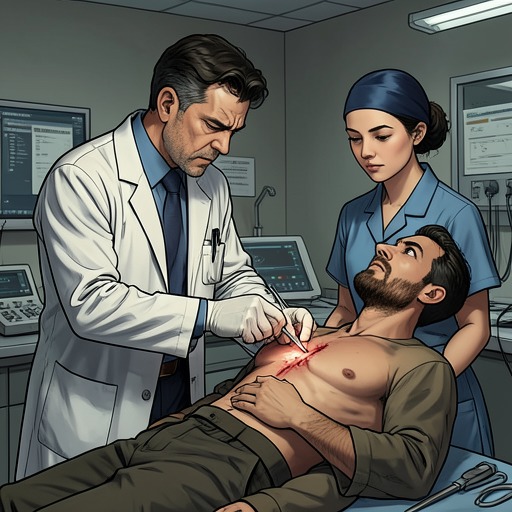
December 23, 1924
The Heart of a DogDecember 23, 1924, marks the operation that begins Sharik’s transformation and gives the novel’s dispute over identity a concrete date. In the case record, a two-year-old mongrel named Sharik becomes the subject of an unprecedented experiment: human testes and a human pituitary gland are implanted, and the resulting organism is later named, registered, and treated as a political actor. The date thus anchors a sequence in which medical intervention creates a new being, while competing acts of naming and paperwork attempt to determine what that being is.
The Operation
At 8:05 p.m. on December 23, Professor Preobrazhensky began what the case notes describe as the first operation of its kind in Europe. The dog’s testes were removed and replaced with human testes from a recently deceased 28-year-old man. The notes specify that the organs had been kept in sterilized physiological fluid, emphasizing the experiment’s clinical and procedural framing. Immediately afterward, the professor performed a trepanning operation, removed Sharik’s pituitary gland, and replaced it with the human donor’s pituitary. The record lists chloroform, camphor, and adrenaline among the substances used. Rather than presenting the transformation first as a philosophical proposition, the novel gives it the form of a dated medical report: a set of interventions performed on an identified animal subject.
From Dog to Named Subject
The case record identifies the experimental subject as a male mongrel about two years old, named Sharik. That name had already been given to him by the professor, who called him Sharik while offering him food. Later, after the transformation, the man who emerged from the experiment chose the name Toligraph Poligraphovich, then insisted that he would use his real surname. These successive names register different claims to identity: the professor’s familiar name for a dog, the new being’s proposed personal name, and the surname he asserts as already his. The surname dispute is handled through official language. Shvonder proposes a certificate identifying the bearer as Poligraph Poligraphovich Sharikov and describing him as born in the flat. The professor objects that Sharikov was not born there. Yet Sharikov’s registration as a City Cleansing Department official makes his name an administrative fact with consequences beyond the household. Naming does not settle the question of his origin; it allows institutions and individuals to advance competing accounts of his belonging.
The Record and Its Consequences
The operation’s medical record gives way to a broader record of uncertainty. In his signed notes, Doctor Bormenthal concludes that the case is finished and that the result is a new organism to be studied as such. The statement marks a limit to the medical account: the operation can be documented, but the being it produces cannot simply be reduced to the original diagnosis or procedure. The transformation also attracts public attention. Rumors spread through the town, onlookers gather in the street, and newspaper reports invent sensational explanations, including a supposed Martian and a child born able to play the violin. These false reports contrast with the precise date and surgical details preserved in the case notes. The experiment is not only a private medical undertaking; its consequences escape the laboratory and become subject to rumor and public interpretation.
Retrospective Reversal
The political authority attached to Sharikov’s identity eventually turns against the people who created and cared for him. In a signed accusation, he charges Professor Preobrazhensky, Doctor Bormenthal, and the two domestic workers with his murder, countersigned by Shvonder and other members of the house committee. When officials later announce the same charge, the professor answers that they must mean the dog he operated on. His response invokes the earlier identity that the transformation had apparently displaced. The novel’s final return to the dog form gives December 23 its retrospective force: the dated operation begins a transformation that does not hold. The sequence from Sharik’s name, through Sharikov’s self-assertion and official registration, to the professor’s insistence that the accused man is his former dog exposes the gap between biological intervention, social recognition, and durable identity. The date records the experiment’s beginning, but not a settled human origin.