Ivan Arnonovich Bormental
The Heart of a DogIvan Arnoldovich Bormenthal is Professor Preobrazhensky’s assistant, the surgeon beside him during the operation on Sharik, and the recorder whose clinical notes frame the dog’s transformation into a human being. His role changes with the experiment: first he helps carry it out and document its results, then he confronts the disorder it produces, and finally he acts to stop Sharikov when the transformed creature threatens the household with a revolver. His medical authority is real but limited; he can observe, record, and intervene, yet the experiment leaves him facing consequences its scientific design did not contain.
Identity and Medical Role
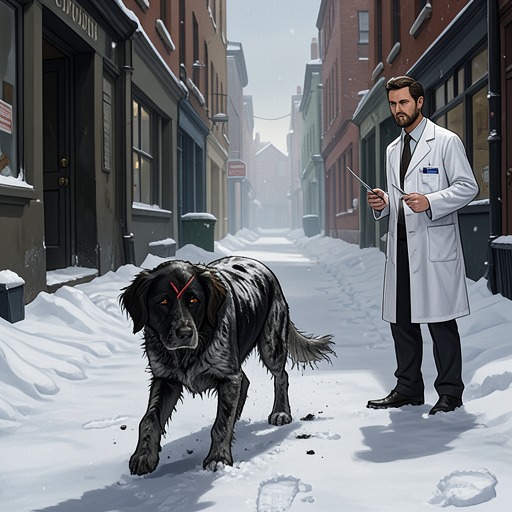
Bormenthal works closely with Professor Preobrazhensky and assists him in the transplantation operation on Sharik. The case notes identify the subject as a male mongrel, approximately two years old, named Sharik, and specify that the procedure is intended to test the combined transplantation of pituitary and testes, including their viability in a host and their possible role in rejuvenation. The notes name Professor Preobrazhensky as operator and Bormenthal as assistant, placing him at the practical center of the work without making him its principal designer.
His conduct during the operation shows a disciplined, responsive assistant. As the professor proceeds, Bormenthal tends the operation and supplies the instruments; the narrative presents their work as coordinated, with the professor directing and Bormenthal responding. The record also conveys the strain of the procedure through Bormenthal’s exertion. This is not a detached observer’s experiment: he participates physically in its execution and remains responsible for watching what follows.
Observation and the Case Record
After the operation, Sharik’s condition becomes critical. The case notes report frequent and severe weakening of his pulse during the night and describe him as apparently near death; Professor Preobrazhensky orders massive doses of camphor. The entry makes the experiment’s uncertainty concrete: before there is any humanized subject to study, the transplanted dog may not survive the procedure.
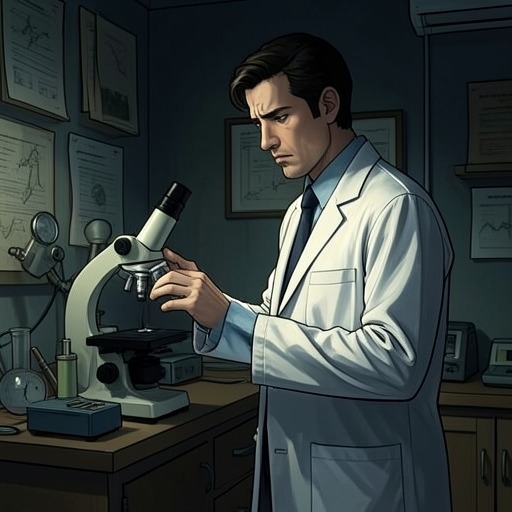
When the professor feels unwell, Bormenthal takes over most of the observations, including pictures and recordings. The experiment meanwhile attracts public attention: rumors spread through the town, crowds gather outside, and newspaper accounts distort what has happened, including a report about a child supposedly born able to play the violin. Bormenthal’s notes register both the clinical work and this widening gap between the household’s evidence and the public stories circulating about it.
The case record ends by declaring that the experiment has produced a new organism that must be studied as such. It lists verbatim speech reports, recordings, and photographs among its appendices and bears Bormenthal’s signature as a medical doctor and assistant to Professor Preobrazhensky. That documentary ending gives his observations a formal authority, but it does not settle what the transformation means or establish that it can be controlled. The notes preserve evidence of change while exposing the limits of the original experimental purpose.
Conflict with Sharikov
As Sharik becomes Poligraph Poligraphovich Sharikov, Bormenthal’s role moves from surgical cooperation to opposition. Sharikov seeks a socially recognized identity, and Shvonder prompts the professor to produce a certificate naming him Poligraph Poligraphovich Sharikov and describing him as born in the apartment. The dispute makes identity a matter of competing claims: the professor regards Sharikov as the result of an operation, while Sharikov and his political ally press for official recognition. Bormenthal is present as the professor’s associate, caught in the household and administrative conflict that follows the transformation.
The hostility eventually becomes an immediate danger. Sharikov’s signed accusation to the authorities describes Bormenthal as secretly living in the apartment without registration and calls him a Menshevik, while also making allegations against Professor Preobrazhensky and the household. The document turns their conflict into an official charge, but it is Sharikov who has supplied the accusations and Shvonder who has countersigned them. Bormenthal is thus endangered not only by Sharikov’s conduct in the apartment but by the political and bureaucratic language used to recast that conduct.
The Revolver and Its Aftermath
The confrontation reaches its decisive point when Sharikov refuses to leave the apartment, claims a right to thirty-seven square feet, and draws a revolver on Bormenthal. Bormenthal’s cigarette falls as the threat becomes immediate. He then restrains Sharikov while Professor Preobrazhensky moves through the room; the narrative shows Bormenthal suffocating him with a small white pad. The episode makes Bormenthal’s intervention the direct response to an armed threat, but it also leaves the household exposed to the consequences of a death that can be described very differently by those outside it.
Afterward, Bormenthal posts a notice beside the doorbell saying that the professor cannot hold consulting hours because of indisposition. The restrained, ordinary wording contrasts with the crisis inside and shows the household trying to control access and public knowledge in its immediate aftermath. Ten days later, an official visitor announces that Professor Preobrazhensky, Bormenthal, Zinaida Bunina, and Darya Ivanova are charged with murdering Poligraph Poligraphovich Sharikov, identified as a sub-department controller of the City of Moscow Cleansing Department. The charge makes Bormenthal’s intervention a matter for official investigation, while the professor answers by claiming not to recognize Sharikov as a person and identifying him instead as the dog he operated on.
Narrative Significance
Bormenthal’s case notes and the later accusation offer sharply different forms of record. His signed report organizes the transformation as a medical case, with observations, recordings, and photographs; Sharikov’s complaint recasts household conflict as political misconduct; the final charge reframes the death as murder. None of these documents is simply a neutral window: each selects facts and assigns responsibility from a particular institutional position.
That documentary structure makes Bormenthal more than a supporting medical figure. He is both a participant in the experiment and a witness who tries to make its progress legible, first through clinical observation and later through action under threat. The experiment’s conclusion—that its product must be studied as a new organism—sits uneasily beside the ending, where the household and authorities dispute whether that product is a human being, a criminal official, or the dog that underwent surgery. Bormenthal’s career within the story follows that unresolved conflict from the operating room to the case record and finally to the scene of accusation.